
High Renaissance
The School of Athens
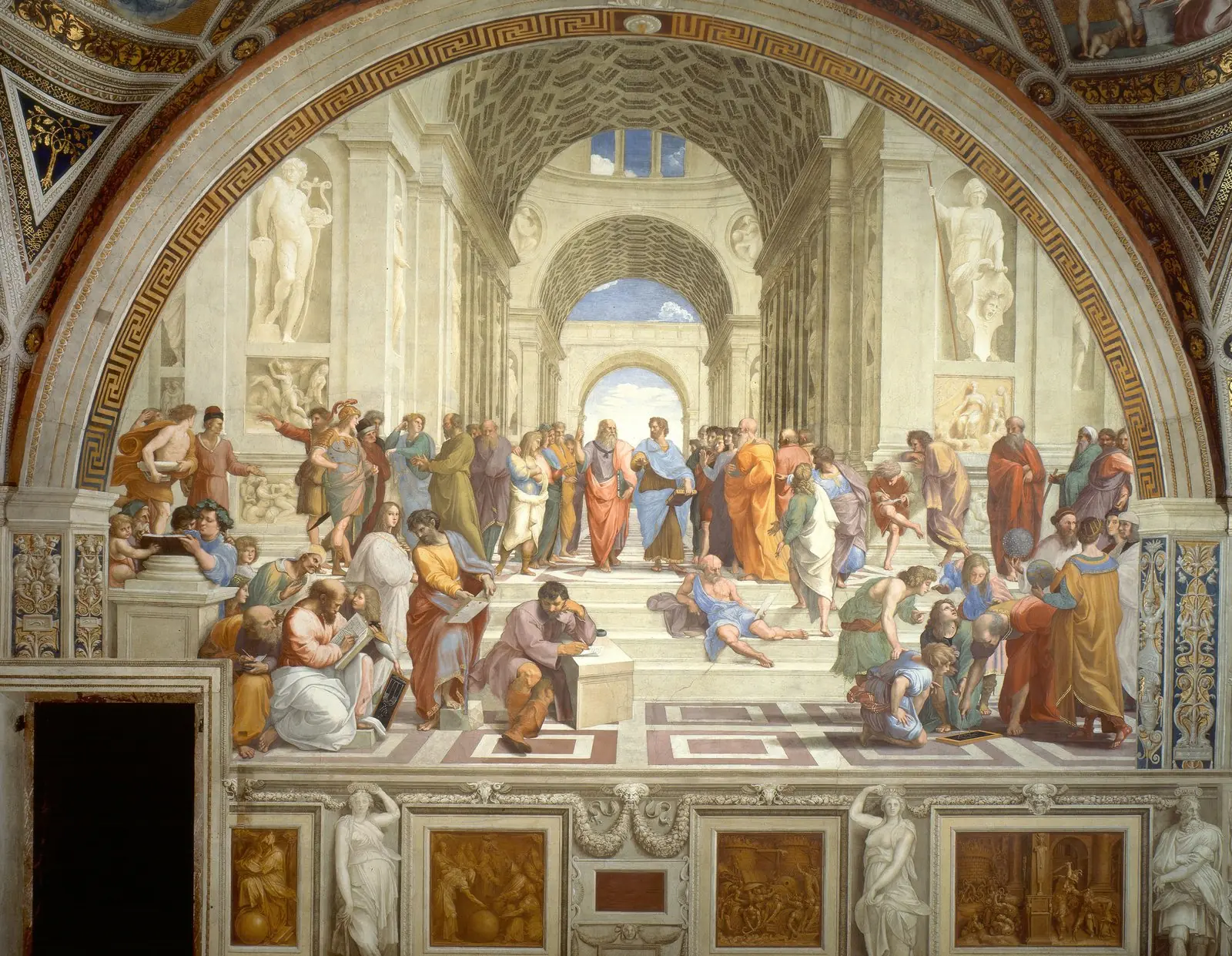
Raphael turns philosophy into a public event. This fresco is not a list of thinkers, it is a staged argument about how knowledge is built. Painted by Raphael around 1509-1511 in the Vatican, The School of Athens belongs to a room where theology, law, poetry, and philosophy were deliberately paired. The image is therefore political as well as intellectual: it asserts that classical learning can serve papal authority and Christian humanism at the same time.
A wall in the Stanza della Segnatura, not an isolated classroom fantasy
The fresco was commissioned for Julius II's library, in a decorative cycle where each wall represented a domain of knowledge. The School of Athens stands for philosophy within that coordinated program. The point was not antiquarian nostalgia. It was to show that Rome could inherit, order, and legitimize the intellectual prestige of Greece.
Once you restore that setting, the work reads differently. You are not looking at random scholars in an imaginary hall. You are looking at a state image of learning, designed to make debate appear orderly, productive, and compatible with institutional power.
How Raphael organizes a crowd without visual noise
Raphael builds the scene on linear perspective that converges behind the central pair. Steps, arches, and pavement lines guide movement toward the vanishing point, while side groups remain legible as separate conversations. This is why the wall feels full but never chaotic.
Color supports structure. Cool and warm clusters separate micro-scenes, then reconnect them through repeated gestures. The composition teaches viewers how to scan: center first, lateral groups second, background architecture last.
Plato and Aristotle as the conceptual hinge
At the center, Plato points upward and Aristotle extends his hand horizontally. Raphael condenses two philosophical orientations into body language: metaphysical ascent versus empirical, civic practice. The fresco does not resolve the dispute. It frames both as necessary to intellectual life.
Their placement at the vanishing point is decisive. Perspective turns conceptual difference into spatial law. This is Raphael's key move: making thought visible through geometry, not through text.
What the side groups add to the argument
Around the center, Raphael distributes methods. Euclid demonstrates with a compass, Pythagoras writes while students observe, Diogenes reclines with deliberate indifference, and a melancholic Heraclitus figure withdraws from collective exchange. These are not decorative extras. They model competing habits of mind: proof, notation, skepticism, solitude.
Identifications remain partly debated, and that ambiguity is productive. Raphael blends portrait likeness, typology, and invention. The fresco functions less as a literal attendance register than as a map of intellectual roles.
Why the fresco still shapes how we picture knowledge
The work has influenced academic painting, civic architecture, and textbook imagery because it makes thinking appear social, visible, and dignified. A quick internal cross-check with The Creation of Adam, The Last Supper, and Mona Lisa shows how different Renaissance artists solved similar intellectual ambitions with radically different visual systems.
Its continued relevance comes from that balance between unity and conflict. The fresco is harmonious, but never bland. If this reading is clearer now, use the art quiz to test whether you can identify Raphael quickly against other Renaissance compositions.
Explore more
Related works
Primary sources
Frequently asked questions
They are Plato and Aristotle. Raphael positions them at the vanishing point so their contrasting gestures become the conceptual core of the fresco.
The gestures summarize different philosophical emphases: Plato toward transcendent forms, Aristotle toward observation and practical ethics. Raphael uses body language as intellectual shorthand.