
Baroque / Musée des Beaux-Arts de Lyon
The Adoration of the Magi
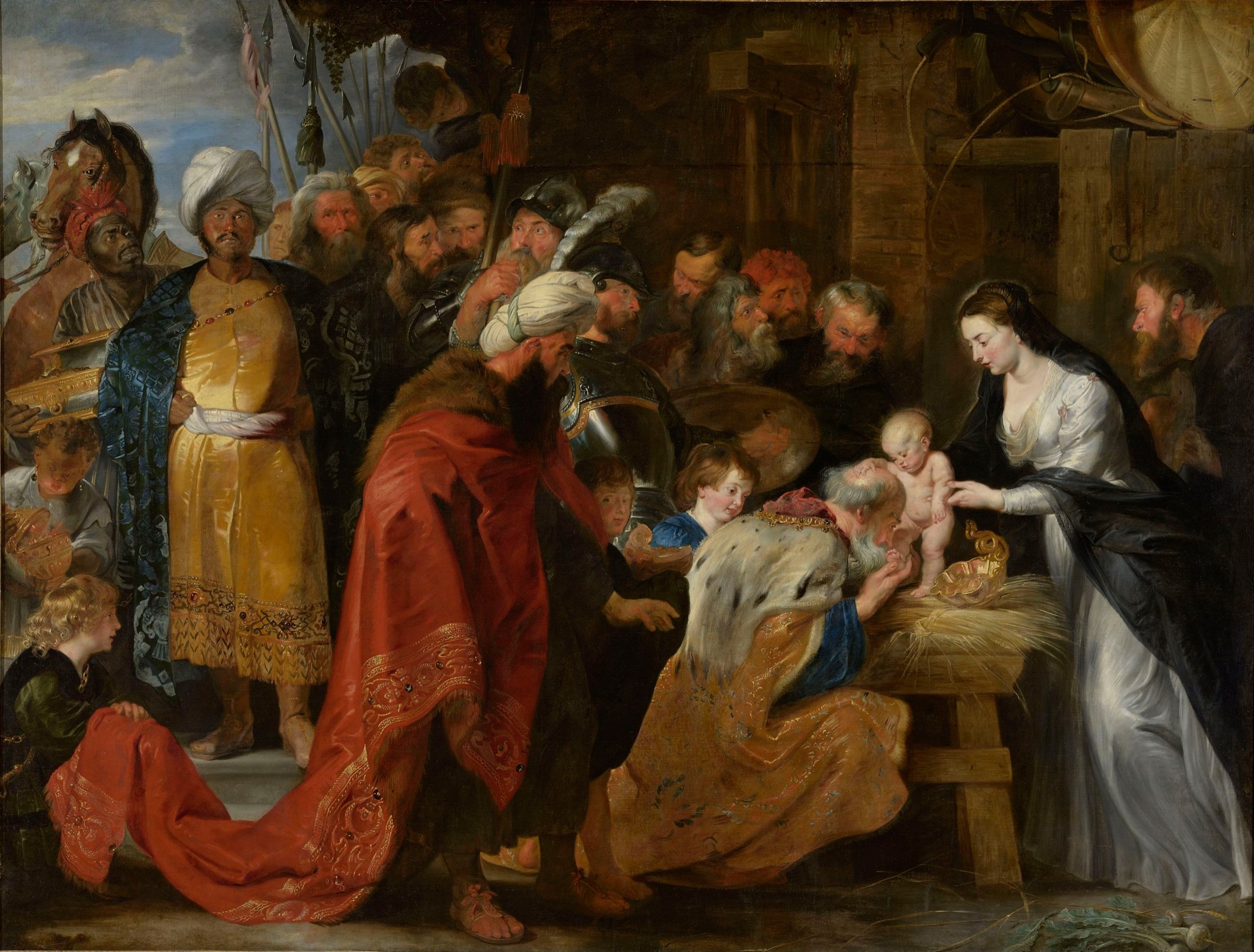
In The Adoration of the Magi, Rubens gathers kings, servants, soldiers, gifts, and heavy fabrics around one simple act: an old king kneels to kiss the Christ Child's foot. Peter Paul Rubens's painting, made around 1617-1618 and held by the Musée des Beaux-Arts de Lyon, stages a lavish arrival inside a poor shelter. The subject comes from the visit of the Magi to the infant Christ, but Rubens does not treat it as a calm devotional tableau. He turns it into a dense Baroque event where luxury, humility, travel, crowding, and touch collide.
The museum's description gives the key physical facts. Mary and Joseph have found shelter in a cave arranged as a stable. The Child is not remote or icon-like; supported by his mother, he leans forward and touches the bald head of the old king, who kneels to kiss his foot. Around that intimate gesture, the composition fills with fur-lined cloaks, brocade, damask, gold coins, servants, soldiers, spectators, and a boy in shadow who carries myrrh and looks out at us.
What the painting shows
The scene is organized around a contrast between poverty and magnificence. The manger is straw and shelter; the gifts are gold, cloth, vessels, and traveled splendor. Rubens makes that contrast visible without turning it into a dry lesson. The eye moves from the infant's body to the king's bowed head, from the gold cup to the heavy textiles, then into the compressed crowd behind them.
The Magi form an oblique line, which the museum reads as an evocation of the three ages of life. Their bodies do not merely stand for a theological idea. They create motion. One kneels, another bends, another stands behind, and servants complete the movement by bringing more gifts into the scene. The painting is wide, but Rubens prevents it from spreading loosely. Every figure pushes the eye back toward the encounter between the Child and the kneeling king.
Rubens's method: abundance made readable
Rubens's intention is not to impress by quantity alone. He wants abundance to become intelligible. The painting is full because the subject is an arrival from afar, a meeting between worlds, and a recognition that must be seen by many kinds of people. Kings, servants, soldiers, onlookers, parents, child, animals, cloth, metal, and straw all occupy the same visual pressure.
The method is Baroque but not chaotic. Rubens uses diagonals and curved links to connect bodies and planes. Color does the rest: warm flesh, white cloth, gold, red, dark armor, brown stable shadow. The surface feels sumptuous, yet the picture remains readable because the movement always returns to the Child. The result is recognizably Rubens: large, generous, crowded, and still controlled.
A Baroque painting without altarpiece format
The Lyon museum notes that the painting was probably intended for a private collection because its horizontal format does not suit an altar. The format changes the problem. Rubens had already mastered public church images such as The Descent from the Cross, where a vertical triptych turns the lowering of Christ into a monumental act of coordinated grief. Here, he works in a broad format, closer to a collector's picture, and uses width to stage a procession of looking, offering, and crowding.
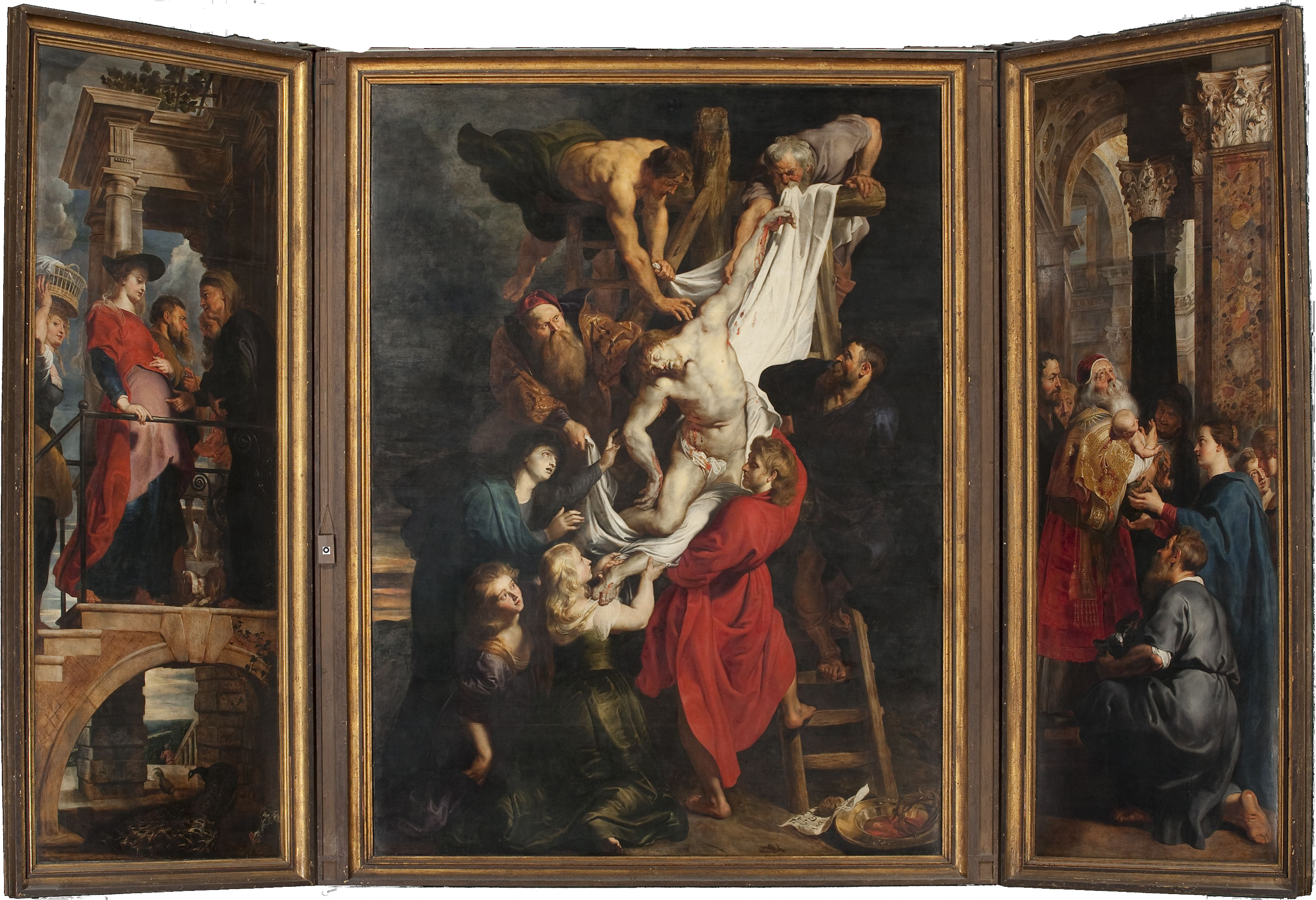
The comparison clarifies Rubens's range. In the Antwerp triptych, white cloth governs the descent of a dead body. In the Lyon painting, gifts and figures gather around a living child. One image is about lowering and receiving; the other is about approaching and recognizing. Both show Rubens's central gift: he can make a crowd feel like a single visual sentence.
The child is small, but the whole painting turns around him
The most direct moment is also the least grandiose. Christ is not enthroned above the crowd. He leans into touch. His hand on the kneeling king's head makes the theological subject human before it becomes ceremonial. The old king's kiss is reverent, but Rubens keeps the scene warm rather than stiff. Sacred recognition happens through bodily contact.
The contact also controls the painting's scale. The canvas is huge, yet the emotional center is tiny: a child's hand, a bowed head, a foot being kissed. Rubens lets the surrounding magnificence expand from that small point. As the crowd grows, the gesture becomes more necessary: it keeps the image anchored.
How to read it in the museum
Start with the child and the kneeling king. Then follow the oblique line of the Magi and the servants who bring gifts. Notice how the scene moves from straw to gold, from humble shelter to courtly fabric, from foreground contact to background crowd. Rubens is not asking you to choose between intimacy and spectacle. He makes each one intensify the other.
Then look for the boy in shadow carrying myrrh and looking outward. He is a small figure, but he pulls the viewer into the crowd. The painting is no longer only something to admire from outside; it becomes an event in which looking itself has a place.
Continue with Peter Paul Rubens, the guide to Baroque, and The Descent from the Cross. Then test your eye with the art quiz.
Explore more
Primary sources
Frequently asked questions
The Adoration of the Magi is a large oil painting by Peter Paul Rubens, dated around 1617-1618 and held by the Musée des Beaux-Arts de Lyon. It shows the Magi presenting gifts to the Christ Child in a crowded Baroque composition.
The painting is in the Musée des Beaux-Arts de Lyon. The museum records it as a French State transfer in 1805.
It shows Rubens's Baroque method outside a vertical altarpiece format: a wide composition full of gifts, servants, soldiers, fabric, diagonal movement, and a strikingly human contact between the infant Christ and the kneeling king.
Start with the Christ Child touching the bald head of the kneeling king. That intimate contact anchors the whole scene before the eye moves through the gold, fabrics, servants, and crowded background.