
Baroque
The Calling of Saint Matthew
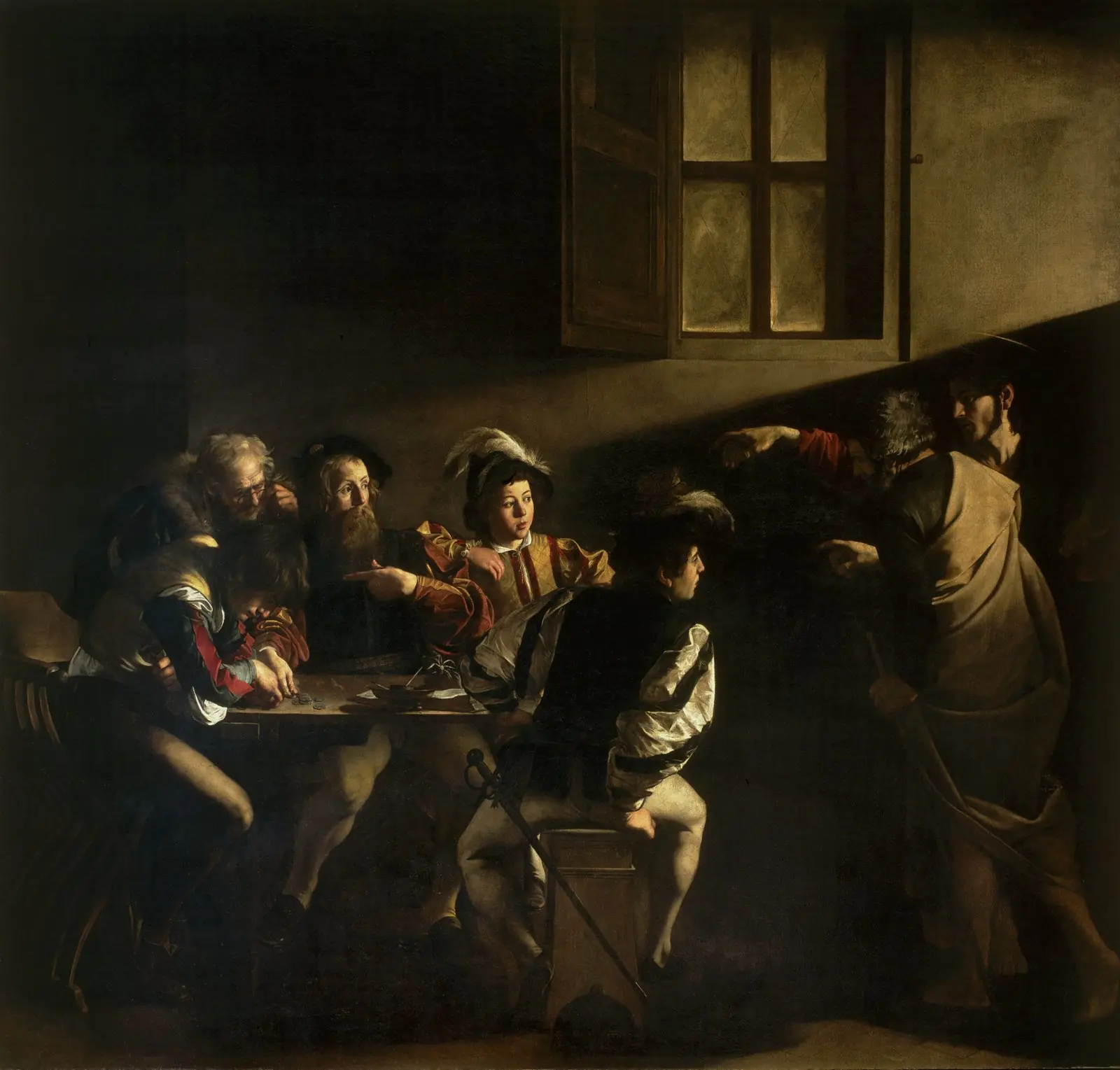
A tax office table becomes a moral crossroads in one beam of light. Caravaggio does not stage conversion as distant theology. He stages it as interruption: money on the table, men absorbed in routine, then a gesture that forces one person to decide who he is.
Rome around 1600: why this commission mattered
The painting was made for the Contarelli Chapel in a Counter-Reformation context where religious images were expected to be clear, emotionally direct, and doctrinally legible. Church patrons wanted sacred history to feel immediate to contemporary viewers, not remote.
Caravaggio responds by placing biblical drama in a room that resembles everyday Roman life. Contemporary dress, rough interiors, and recognizable gestures collapse sacred time into present experience.
What the scene shows in concrete terms
At right, Christ enters with Saint Peter. At left, tax collectors sit around a table counting coins. A diagonal light cuts through darkness and lands on Matthew's group. One man gestures to himself, seemingly asking, "Me?" - the central ambiguity that keeps the moment alive.
Nothing is decorative. Hands, faces, and coins are arranged to make you read a sequence: distraction, intrusion, recognition, hesitation. The painting captures vocation as a process, not a completed event.
For a first reading, follow the path from Christ's hand to the beam of light, then to the pointing finger at the table. That line gives the painting its grammar. It also connects the work to the larger Baroque habit of turning light, gesture, and viewer attention into one directed experience.
Caravaggio's method: light as moral structure
The famous light beam does more than create atmosphere. It allocates responsibility. Whoever is lit becomes answerable. Darkness is not empty background; it is the field from which decision emerges.
This is where Caravaggio differs from many earlier religious compositions. Instead of idealized holiness, he gives psychological timing: Christ's call is decisive, Matthew's response is delayed, and others remain only partially aware.
Gesture as diagnosis
Christ's hand does not force, it indicates. Matthew's uncertain self-pointing answer turns the scene into a diagnostic image of conscience: vocation begins in recognition, not spectacle. The painting remains psychologically persuasive even for viewers without theological background because the hesitation is visible before any doctrine has to be explained.
Caravaggio makes revelation feel like a question that cannot be postponed.
Why this painting stayed historically active
The work became foundational because it joined doctrinal clarity with social realism. It shaped Baroque storytelling and later artists' uses of directional light as ethical argument. For a closer method comparison, read the guide to chiaroscuro and tenebrism: Caravaggio's darkness is not just style, but pressure placed on a decision.
Its chapel setting reinforces that effect. In San Luigi dei Francesi, the painting is not encountered as an isolated image file but as part of a devotional environment where viewers move physically, adjust distance, and read the scene in relation to neighboring canvases. That embodied encounter strengthens Caravaggio's strategy: conversion is presented as something that can happen in ordinary space, to ordinary bodies, in present time.
The art quiz is a good way to test the eye on Caravaggio: look for hard directional light, ordinary bodies, and a scene caught at the instant of decision.
Explore more
Related works
Primary sources
Frequently asked questions
The decisive move is directional light: it cuts across the room and turns an ordinary tavern table into the exact place where vocation becomes visible.
It was made for Counter-Reformation Rome, where religious images were expected to be emotionally direct, doctrinally clear, and immediately readable to broad audiences.
Track the axis joining Christ's hand, the light beam, and Matthew's self-pointing gesture: that line structures the scene's moral timing.