
Baroque
The Descent from the Cross (Antwerp triptych)
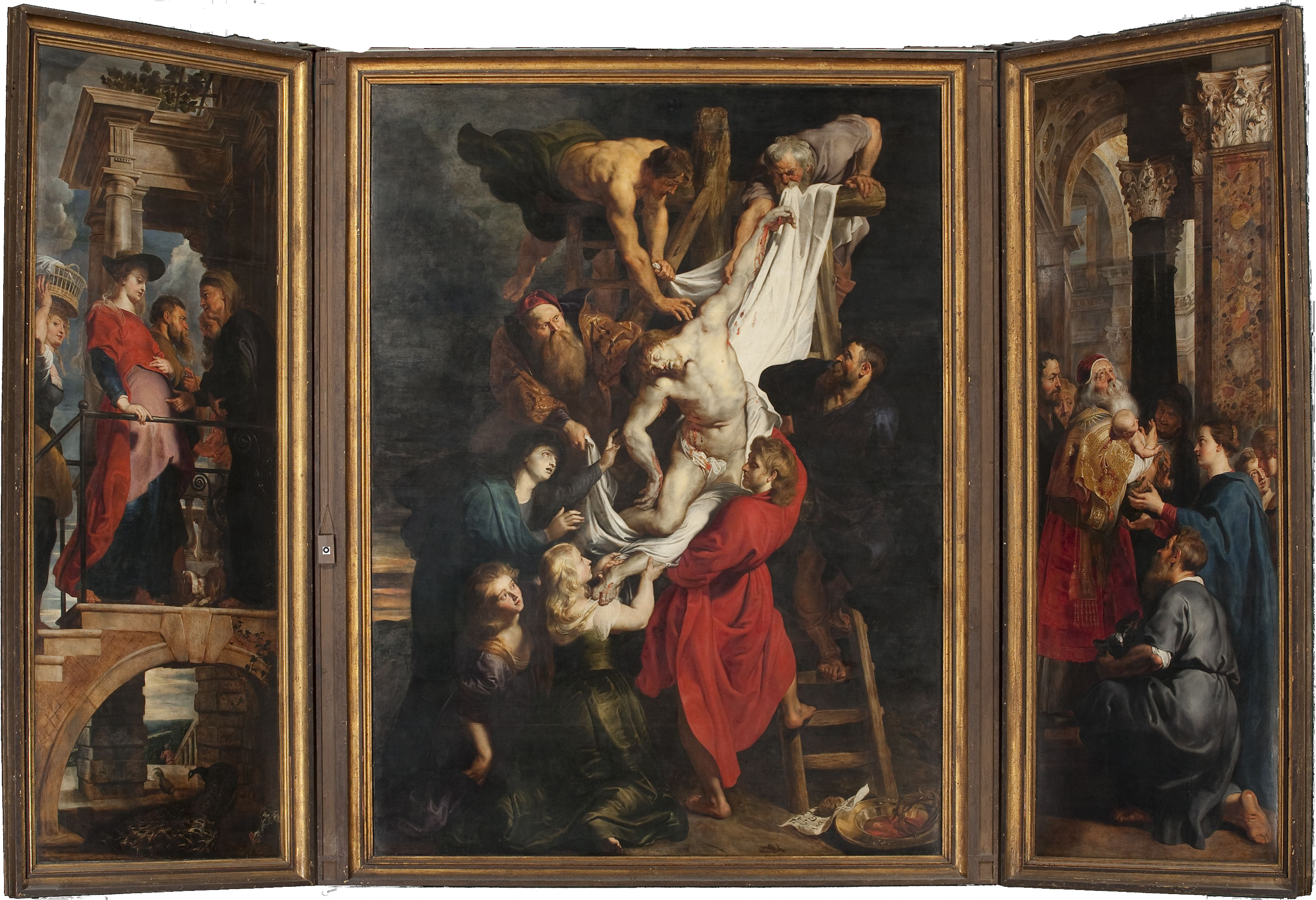
Peter Paul Rubens does not let Christ glide elegantly out of the picture. In the Antwerp triptych, the body has to be lowered, steadied, and received. A white shroud slides down from the crossbeam, men on ladders strain to control the descent, and the mourners below are gathered not around an idea of grief, but around the practical weight of a dead body. Painted for the Cathedral of Our Lady in Antwerp, the work shows how Baroque devotion could become public drama without losing devotional seriousness.
Why this Antwerp triptych matters
Two clarifications matter at once. This is the Antwerp version, not one of Rubens's other descent scenes, and it is a triptych, not a single isolated image. Explainary focuses on this work because it is the large cathedral altarpiece made for the Arquebusiers' Guild, designed to be read in public and at scale. That already changes the tone of the picture. The scene is not private devotion first. It is a public church image built to carry across a nave.
The side panels are part of that logic, not decorative extras. Rubens places the Visitation on one wing and the Presentation in the Temple on the other, so the central descent sits inside a broader sequence of bodies carrying, presenting, and receiving Christ. Once you include those flanking scenes, the middle panel stops looking like a single burst of grief and starts reading as the climax of a larger devotional structure.
The central panel: lowering, receiving, grieving
The main scene is simple to identify and hard to forget. Christ's body is being lowered from the cross by a group of men who work from above and below at the same time. Saint John in red helps receive the falling weight, the Virgin's face registers controlled grief rather than theatrical collapse, Mary Magdalene kneels at Christ's feet, and a brass basin and white cloth at the bottom edge keep the event close to the physical world. Rubens fills the panel with bodies, but he never lets it become confusion. Every figure has a task.
That is why the painting feels slow even though it is full of movement. The subject is not the instant of death, and it is not the triumphant aftermath. It is the dangerous middle moment when a body is still suspended between the wood above and the people below. Rubens chooses the one second in which grief, labor, and ceremony have to happen together.
The white shroud governs the whole image
Look first at the white shroud. It is the real compositional engine of the picture. Rubens uses it as a long diagonal that begins high on the ladder, passes under Christ's torso, and ends near the women below. That one bright band ties the upper and lower halves together, gives the eye a clear route through the scene, and makes the body feel heavy because it looks supported rather than magically suspended.
The shroud also clarifies Rubens's color intelligence. It sits against flesh, armor, black fabric, and deep red cloth, so the whole altarpiece reads through contrast without splitting into separate fragments. The effect is dramatic, but not harsh. Rubens wants the scene to carry across the nave as one large emotional sentence.
From Caravaggio's spotlight to Rubens's public altarpiece
Set this painting beside The Calling of Saint Matthew by Caravaggio and the difference becomes clear. Caravaggio compresses revelation into one room, one beam of light, and one abruptly chosen man. Rubens expands sacred drama across a monumental altarpiece. He keeps the Baroque taste for direction, pressure, and immediacy, but he redistributes it over many figures so the event can read at public scale.
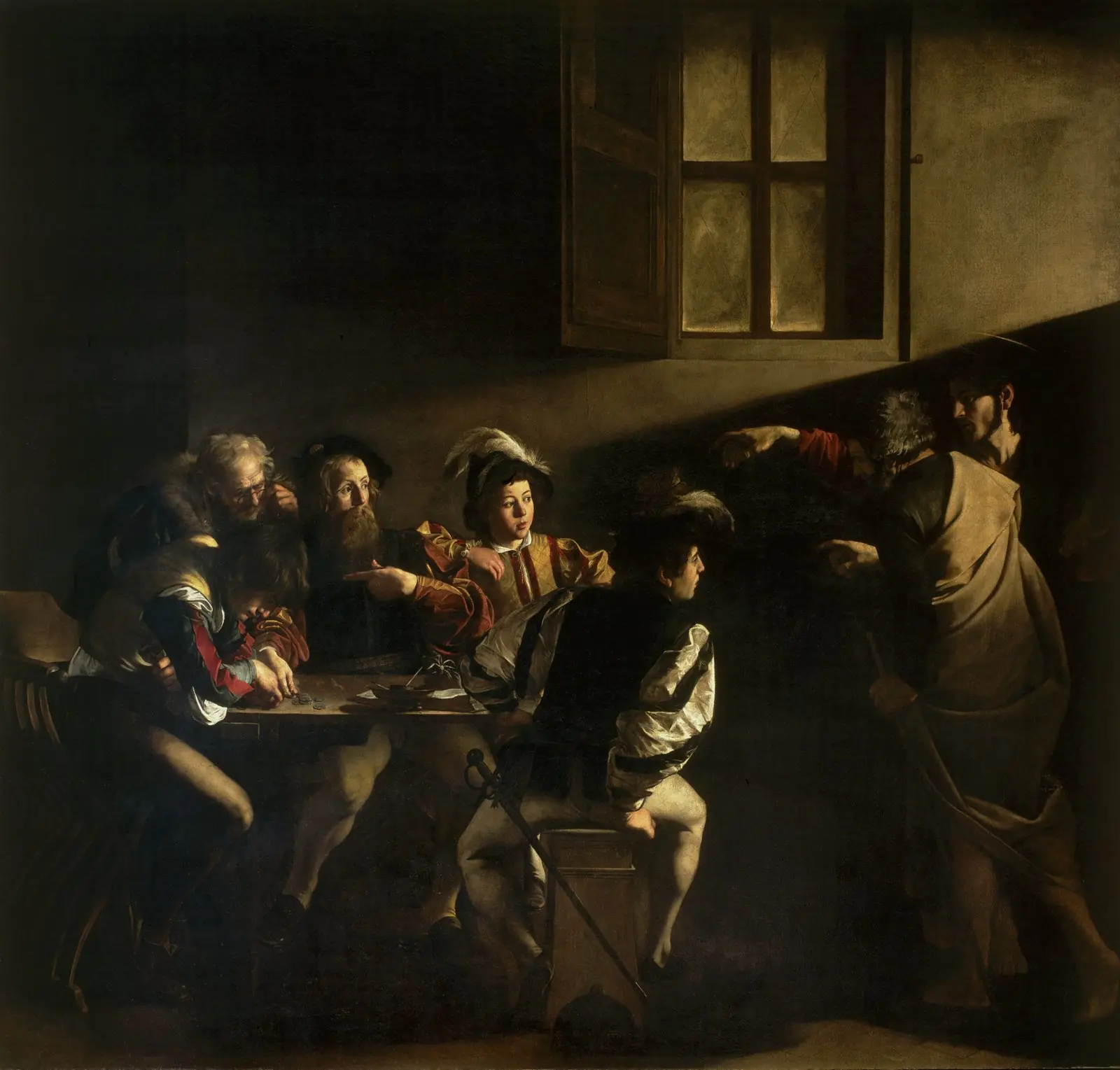
That shift matters because it shows that Baroque art is not only about tenebrist shock. Rubens is luminous, expansive, and orchestrated. The image still grips the viewer immediately, but it does so through collective movement and visible coordination rather than through a single spotlighted rupture.
Rubens's real wager: clarity at public scale
Rubens is not trying to produce shock for its own sake. He wants a large church audience to grasp the event immediately while still feeling its bodily cost. That intention explains the whole method: the descent is readable from a distance, the grief is distributed rather than chaotic, and the white shroud acts at once as support, spotlight, and directional guide. Rubens's great skill is to keep the miracle physical.
A religious painting built for the nave
The Antwerp Descent works best when you remember where it belongs. This is a Counter-Reformation altarpiece made for worshippers who would encounter it in a cathedral, not a museum wall. Its size, clarity, and legible emotion are part of that task. Rubens gives the viewer sorrow, but he also gives structure: a scene organized strongly enough to carry doctrine, liturgy, and memory at once.
That is why the painting remains such a major Rubens work. It proves that grandeur does not have to mean vagueness. Rubens can make a large public image feel readable, bodily convincing, and formally controlled all at once.
Related works
Test yourself with the quiz
Then try the art quiz.
Primary sources
Frequently asked questions
Rubens painted more than one descent scene. This page focuses on the Cathedral of Our Lady triptych in Antwerp because it is the large public altarpiece that best shows how he turned the subject into Baroque church theater.
Look first at the white shroud. It runs diagonally through the panel, connects the men above to the mourners below, and makes Christ's body feel heavy rather than weightless.
It is Baroque because the scene is built as an event for a public viewer: dramatic light, diagonal movement, bodily strain, and emotional proximity all work together to make devotion feel immediate.