
Venetian Renaissance / Musée des Beaux-Arts de Lyon
Bathsheba Bathing
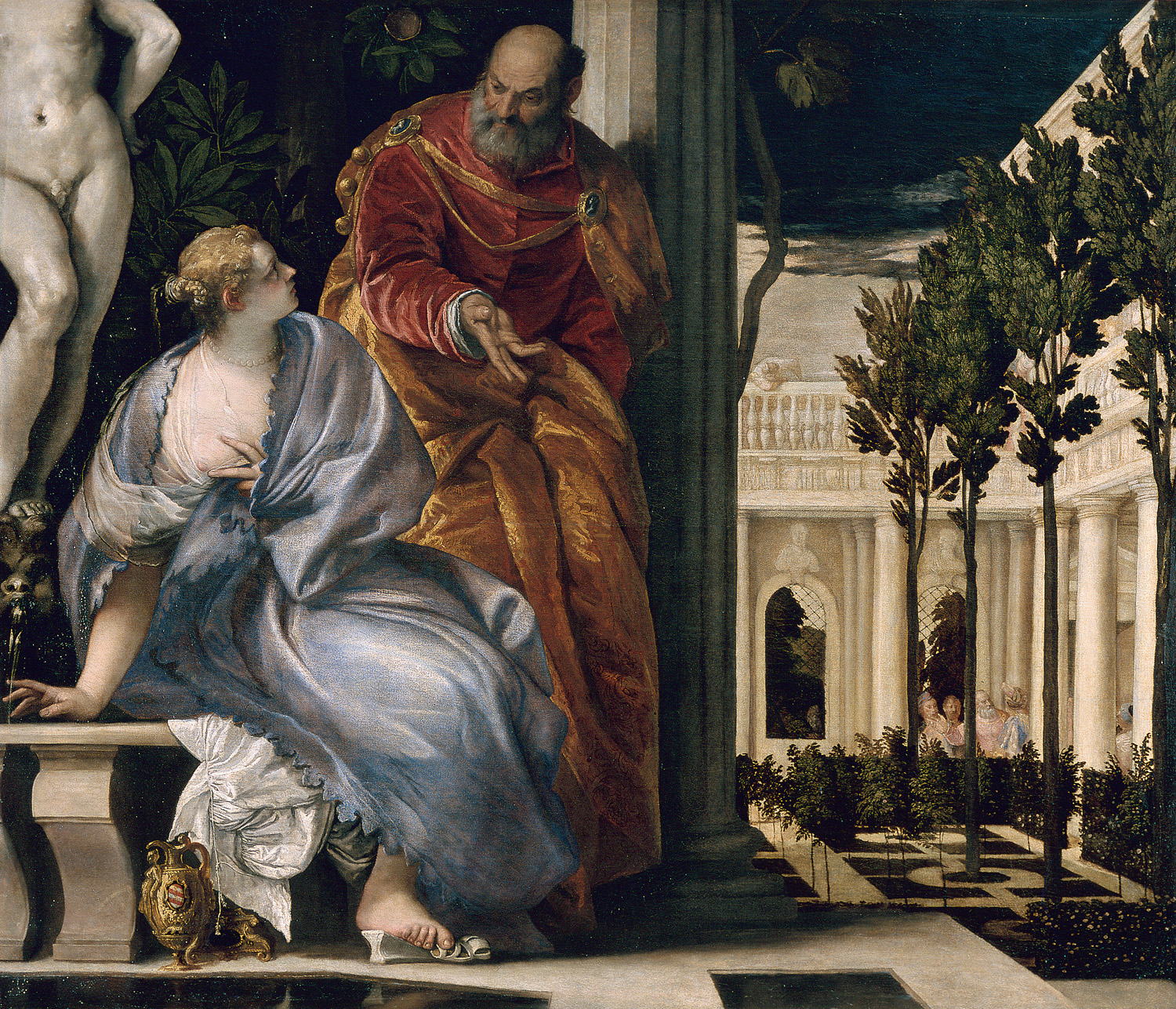
A young woman touches the water, an older man leans toward her, and the painting's beauty already carries a threat. Paolo Veronese's Bathsheba Bathing, painted around 1575 and now in the Musée des Beaux-Arts de Lyon, refers to the Book of Samuel: David sees Bathsheba bathing, desires her, commits adultery with her, and arranges for her husband Uriah to be killed in battle. Veronese does not paint the rooftop gaze or the later violence. He paints the moment of approach, where message, invitation, coercion, and seduction cannot be cleanly separated.
The traditional title therefore identifies the woman as Bathsheba, but the Lyon museum notes that the subject remains debated. The older man may be David's messenger, yet his age and costume also recall other biblical stories, especially Susanna and the Elders. That uncertainty gives the painting its tension: beauty, desire, social rank, and pressure have to be read together.
What the painting shows
The woman sits at the edge of a basin or fountain. One hand presses against her breast; the other reaches toward the water, testing it with a toe or finger. Her clothing has partly fallen away, yet a broad blue-purple mantle covers and frames her body. Opposite her, a richly dressed older man bends forward, speaking with urgency. His velvet clothes, golden cape, cameos, and large buttons give him the weight of status.
The garden is not neutral. Columns, stone steps, water, trees, and distant architecture make the scene feel private and public at once. A small figure sometimes read as David may appear in the background near the colonnade, but Veronese keeps the narrative indirect. The Musée des Beaux-Arts de Lyon also notes that the old man's costume evokes the dress of Venetian doges, and that coats of arms on the ewer and casket may point to a marriage context. Biblical history becomes a Venetian image about alliance, rank, desire, and female exposure.
Veronese's method: color before judgment
Veronese divides the scene into contrasting zones while binding them through color. The pale body, blue mantle, gold cape, red-brown shadows, stone architecture, and green garden do not sit beside one another as separate effects. They circulate. The eye moves before the story settles, which makes the painting elegant and uneasy at once. The surface is sumptuous, but the subject is not innocent: Veronese wraps a power imbalance in a language of splendor.
After Titian, another Venetian way to stage looking
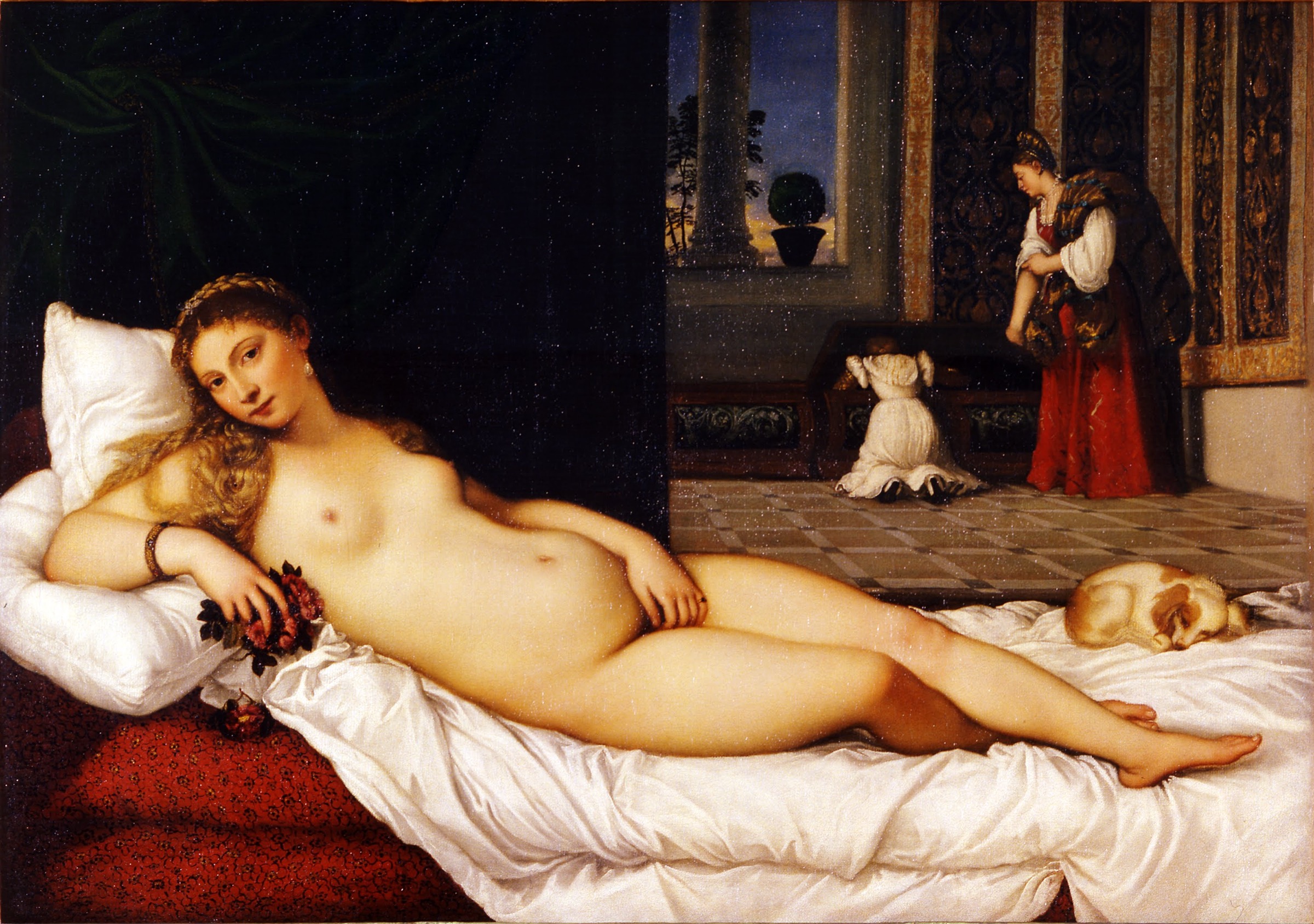
A strong comparison is Venus of Urbino by Titian. Titian's reclining nude faces the viewer inside a bedroom, holding myth, domestic space, and sensual paint together. Veronese keeps the Venetian trust in color and flesh, but he changes the social structure. His woman does not confront us directly; she is approached. The tension is not only between nude and viewer, but between woman, messenger, absent ruler, and social setting.
Why it belongs in a Musée des Beaux-Arts de Lyon shortlist
Bathsheba Bathing has a strong museum history. The Lyon museum says the painting belonged to Louis XIV's collection after the arrest of Nicolas Fouquet in 1661. It was later kept at Versailles, extended at the top and left to fit its setting, and then partially restored to recover its earlier format while retaining the extension behind the current frame.
That history adds weight, but the painting earns attention without it. For a visitor moving through the museum, it is a perfect test of looking slowly: the first impression is splendor; the second is unease.
How to read it in the museum
Start with the line between the two figures. The woman is seated, partly undressed, and close to water; the man stands, clothed, decorated, and speaking. Then follow the color: blue mantle, gold cape, pale skin, stone, trees. Veronese makes these tones pleasurable, but they also guide the eye through a scene of pressure.
Hold the title lightly. Whether the woman is Bathsheba, Susanna, or another biblical figure, the painting stages a meeting between desire and authority. Continue with the profile of Paolo Veronese, the guide to the High Renaissance, and Titian's Venus of Urbino. Then test your eye with the art quiz.
Explore more
Primary sources
Frequently asked questions
Bathsheba Bathing is an oil painting by Paolo Veronese, dated around 1575 and held by the Musée des Beaux-Arts de Lyon. It shows a richly dressed older man approaching a young woman beside water, traditionally identified as Bathsheba.
The painting is at the Musée des Beaux-Arts de Lyon. It was sent by the French State in 1811 and belongs to the museum's highlighted Venetian Renaissance holdings.
No definitive certainty is possible. The Lyon museum notes that the figure may be Bathsheba, Susanna, or another biblical heroine, because the older man's age and Venetian details complicate the usual identification.
It condenses Veronese's Venetian method: sumptuous color, architectural staging, biblical ambiguity, and a scene where beauty and power cannot be separated.