
High Renaissance
Venus of Urbino
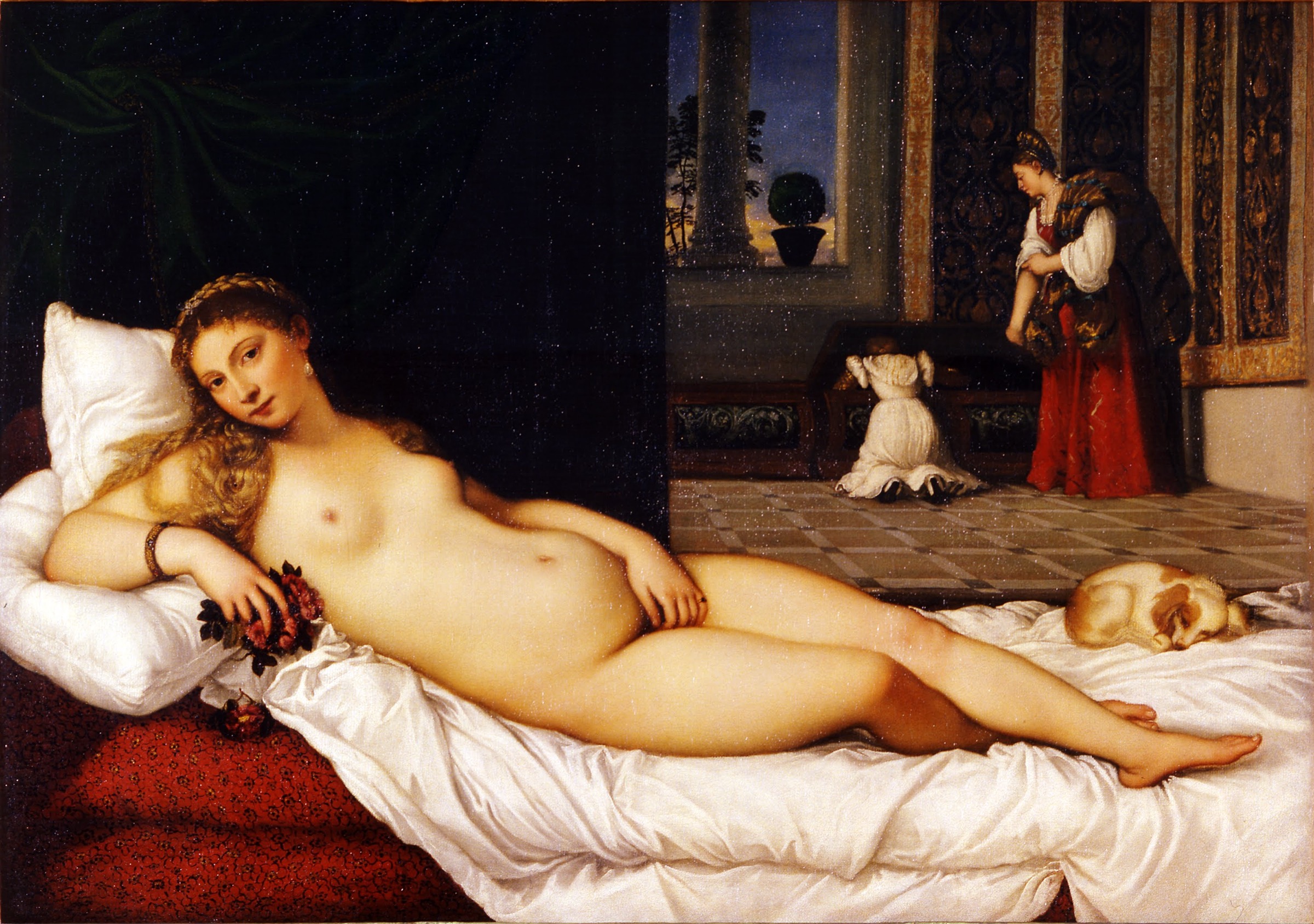
Titian paints Venus as a nude in a furnished bedchamber, which is why the picture never settles into pure myth. Titian gives the image a classical title, but he also gives it sheets, pillows, a sleeping dog, two servants, and a cassone in the back. The result belongs fully to the High Renaissance, while already establishing the structure that Olympia will later push into modern conflict.
A nude in the foreground, a household in the back
The composition is easy to read. Venus occupies the foreground diagonally, her head propped on cushions, one hand holding flowers, the other covering her sex. A small dog sleeps at her feet. Behind her, the room opens toward two women who search in a chest. The scene is therefore split very clearly between an exposed body in front and domestic activity in the rear.
That second zone is what stops the painting from reading as a timeless myth. The dog, the cassone, the servants, and the visible depth of the room tie the nude to a lived interior. The picture stays sensual, but it also becomes domestic, social, and worldly. Titian does not place Venus outside ordinary life. He lets ordinary life remain in the image around her.
Why calling her Venus is only half the story
The title matters because it provides a classical and humanist frame. It raises the nude above simple private display and places her inside a culture that could discuss beauty, love, and poetic idealization through antiquity. But the title does not settle the image. The room keeps pulling it back toward human use, status, and household life.
This is why scholars have long connected the painting with Guidobaldo II della Rovere and with a domestic, possibly marital, context. The dog can suggest fidelity, the cassone points toward elite household furniture, and the servants remind us that the scene belongs to an inhabited interior. Yet the painting does not collapse into a single "marriage picture" reading either. Venus looks out too directly for that. She remains present as a body, not just as a symbol.
Titian's real aim: join ideal beauty to lived space
Titian's intention is not to make the viewer choose between ideal beauty and worldly reality. He wants both to remain active at the same time. The nude is elevated by the name Venus, but the room prevents that elevation from becoming abstract. The interior is believable, but the title prevents the painting from turning into ordinary description. The image works because neither side cancels the other.
Titian does not separate allegory from daily life with hard conceptual borders. He lets them overlap inside one visual field until they feel natural together. What might sound contradictory in words becomes coherent in paint.
Color, not hard contour, holds the picture together
Titian solves the problem as a Venetian painter. Flesh, white linen, the red mattress, the dark green curtain, the black hair, and the warm wall tones are organized as one system of color relations. The body does not stand out because it has been cut from the background by a severe outline. It emerges because surrounding tones keep returning the eye to it.
Set beside Leonardo da Vinci, Raphael, or Michelangelo, Titian broadens what High Renaissance authority can look like. The Roman and Florentine tradition often persuades through design, proportion, and anatomical pressure. Titian proves that oil paint can do the same work through continuity, surface, and color. In Venus of Urbino, color is not embellishment. It is structure.
What Manet keeps and what he removes
Olympia keeps the reclining pose, the frontal address, the hand over the lower body, and the background logic of a servant entering the room. But Manet removes Titian's soft continuity. The sleeping dog becomes a black cat. Warm tonal blending becomes abrupt contrast. Domestic elegance becomes social tension.
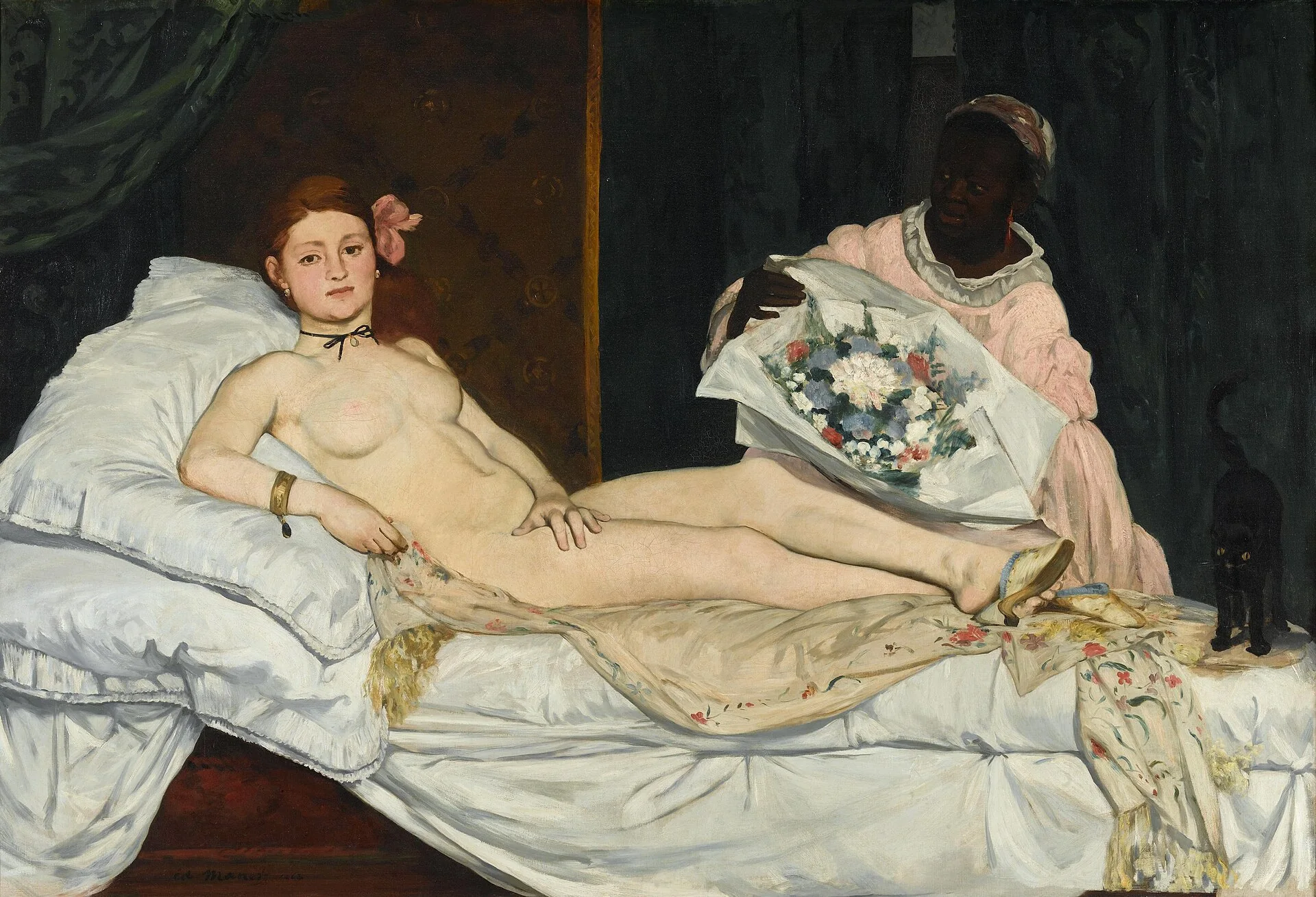
Read beside Olympia, Venus of Urbino stops looking like a beautiful old master nude and starts looking like a compositional model with a long afterlife. Manet makes that structure visible by taking it apart in public. Once you return from Olympia to Titian, the earlier image looks less innocent and far more deliberate in the way it holds myth, domestic space, and direct address together.
The painting matters because it shows how a Renaissance work can be beautiful, erotic, domestic, and intellectually framed at the same time, without reducing itself to one message. It also shows how later painters could inherit those same terms and turn them toward very different social meanings.
Continue from Titian
Comparison path
Then try the art quiz.
Primary sources
Frequently asked questions
No. The title invokes Venus, but the bedchamber, dog, servants, and cassone make the picture feel domestic and worldly as well as mythological.
They anchor the nude inside a household interior. Their presence shifts the painting away from abstract allegory and toward a scene shaped by domestic life, status, and preparation.
Manet borrows Titian's reclining nude, the direct gaze, and even the background servant motif, then strips away the warm Venetian continuity to expose a harsher modern social reality.