
Realism
Olympia
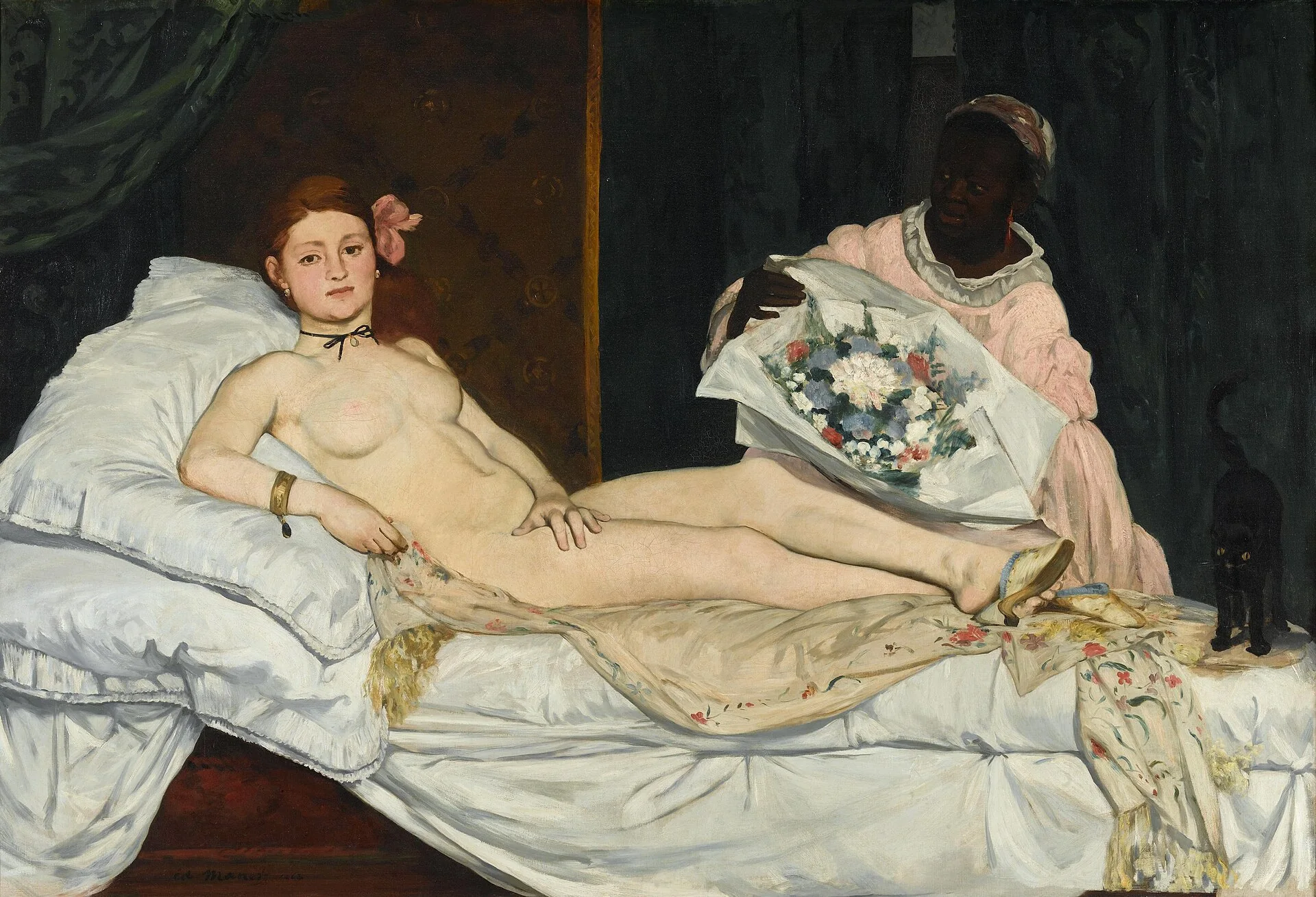
A frontal nude that replaced mythic alibi with modern social reality, and changed the ethics of looking.
A nude that rewires the viewing contract
Manet strips away the soft transitions expected in academic nude painting. The body is bounded by blunt contour, the sheet is flattened into pale blocks, and the black accents (ribbon, hair, cat, servant's dress) snap the whole surface into high contrast. This is not incompetence or haste. It is a calibrated refusal of idealization.
The central decision is the gaze. Olympia does not pretend not to be seen. She sees you back, and that reciprocity changes the contract of the image. The viewer is no longer an invisible connoisseur floating above the scene; the viewer becomes legible inside it.
Salon shock: why 1865 exploded
When shown at the Paris Salon in 1865, Olympia triggered hostility that went beyond polite disagreement. Critics mocked the body, the brushwork, and the "ugliness" of modernity. The scandal is often summarized as moral outrage at nudity, but that is incomplete. French audiences accepted nude bodies under mythological cover. What they found intolerable here was a modern woman without allegorical mask, presented as economically and socially situated.
Manet's title intensifies this. "Olympia" was a contemporary coded name associated with courtesan culture, not classical distance. The painting therefore names the social system it depicts: class, money, service, display, transaction.
Read beside Le Déjeuner sur l'herbe, painted two years earlier, the logic becomes even clearer. Manet first tests how a modern picnic can destabilize Salon decorum; in Olympia, he removes almost every narrative cushion and leaves viewers with direct exchange, direct gaze, and direct social implication.
A strategic dialogue with tradition
Manet is not rejecting art history; he is rewriting it in public. The pose cites Titian's Venus of Urbino, and the format invites comparison with canonical reclining nudes. But where Titian gives warm atmospheric continuity, Manet gives abrupt tonal breaks. Where older models stage ideal availability, Manet stages guarded presence.
That tension between citation and disruption is central to modern painting. Olympia argues that tradition can be used critically: you borrow the structure to expose what that structure had normalized.
The maid, the bouquet, and social hierarchy
The servant with flowers is not an accessory detail. She introduces a second social axis: labor and racialized visibility. In many nineteenth-century readings, attention collapses back onto Olympia alone, but the composition makes that collapse visible as a problem. Manet stages unequal visibility inside one frame: who is centered, who is instrumentalized, who receives narrative depth, and who is denied it.
For current readers, this is one reason the painting remains analytically productive. It does not resolve these tensions; it makes them explicit.
Legacy and contemporary relevance
Olympia became a hinge for modern art because it fused form and social critique. Flatness, edge, and tonal economy are not neutral style choices; they are ways of refusing a comforting fiction. From Degas to Picasso to late twentieth-century feminist rewriting, artists inherit the same lesson: a picture's politics are embedded in how it organizes sight.
The painting still reads sharply because modern image culture runs on asymmetries of gaze, labor, and monetization. Manet's canvas does not predict digital culture, but it gives vocabulary for reading those tensions.
That durability explains why Olympia remains central in teaching collections, where formal analysis and social history must be read together.
Beside Le Déjeuner sur l'herbe, the mechanism becomes sharper: Manet turns borrowed Renaissance structure into modern scandal. By comparison, The Birth of Venus shields erotic display behind myth.
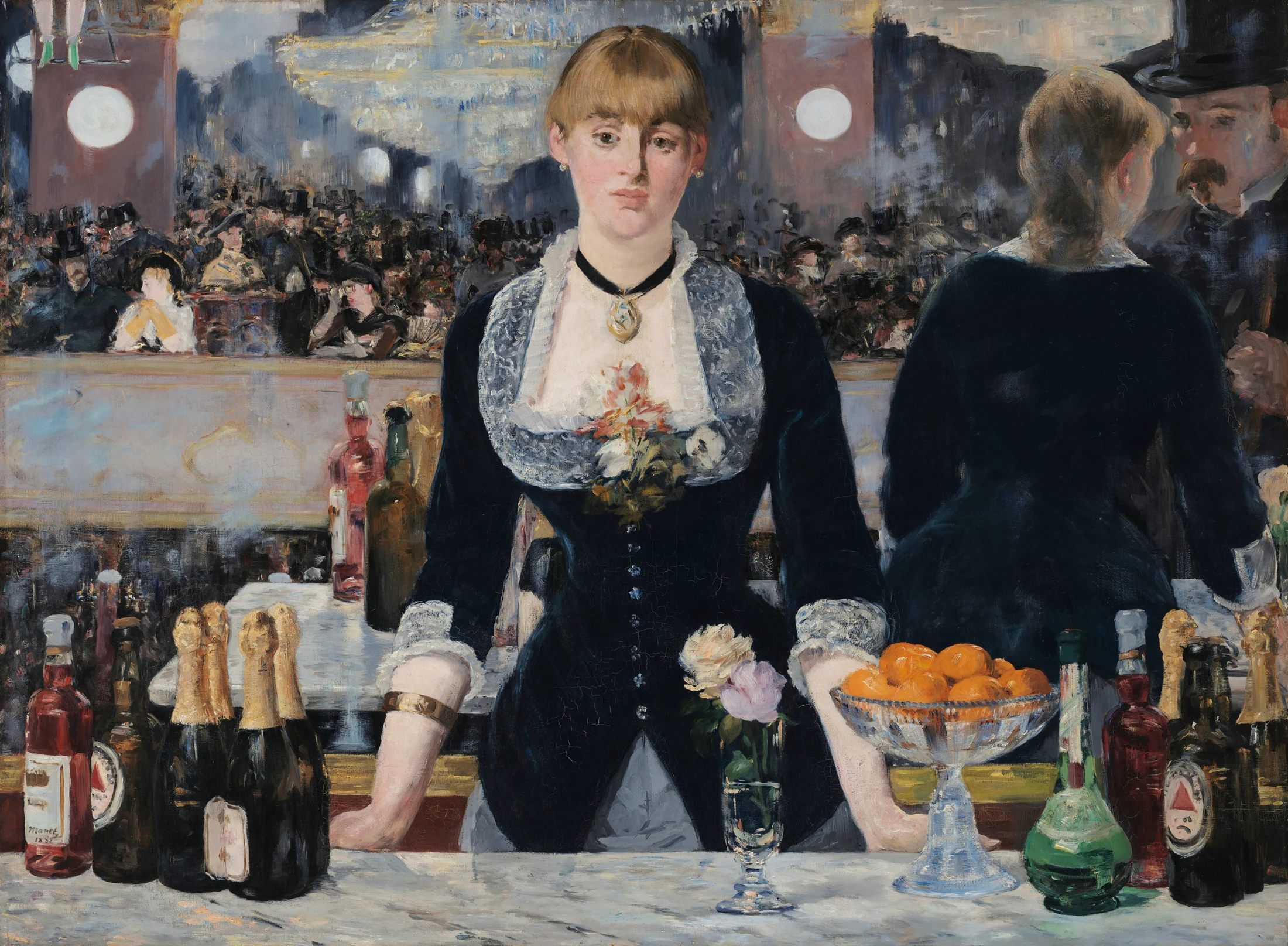
For Manet's late answer to the same problem, continue to A Bar at the Folies-Bergère. There the confrontation is no longer a reclining nude and viewer, but a barmaid, a mirror, and a customer who almost occupies the spectator's place.
Olympia is less a nude than a critique of how nudes are consumed.
Explore more
Related works
If Olympia is clearer now, try the art quiz and see whether you can spot works by Édouard Manet in seconds.