
Realism
Le Déjeuner sur l'herbe
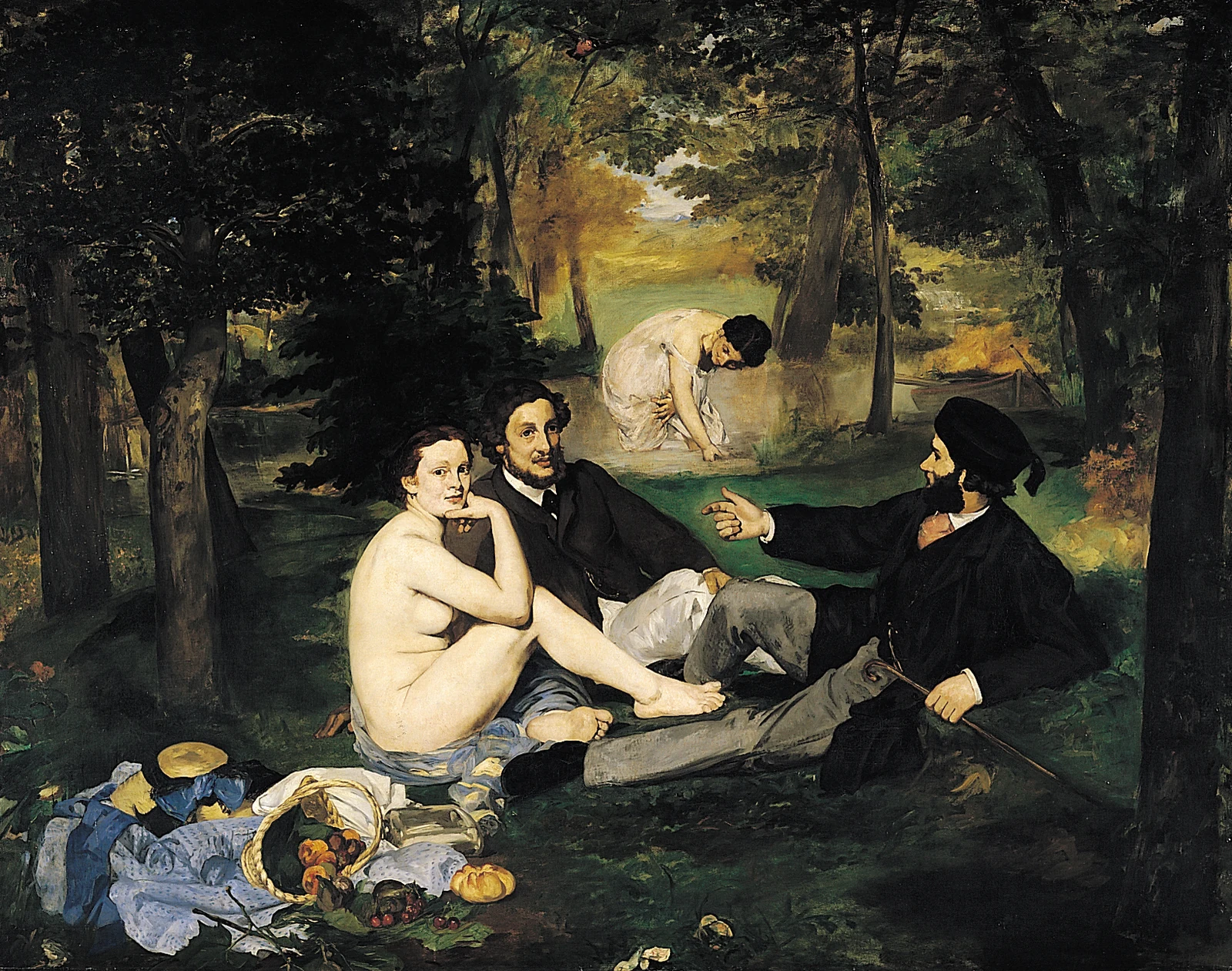
The scandal was not nudity alone. Manet made a nude woman appear in recognizably modern company, without the protective cover of myth. That is why Le Déjeuner sur l'herbe hit Paris so hard in 1863. The picture looks casual at first, almost like a picnic broken by a stare. In fact it is a calculated provocation: old-master echoes, contemporary dress, and a painting style that refuses polite illusion all collide in one field.
Start with what the painting shows
In the foreground sit two fully dressed men and a nude woman who faces the viewer without embarrassment. Behind them, another lightly clad woman bends in the water. A pile of clothes, fruit, and bread lies at the front, but the scene does not behave like a stable narrative. The figures seem close yet strangely disconnected, as if conversation, desire, and social code were all slightly out of joint.
That instability is the key to reading the painting. Manet does not tell you exactly who these people are or why they are together. He gives just enough to make the scene legible, then withholds the reassuring explanation that academic painting usually provided.
- Notice first the nude woman's direct, untroubled gaze.
- Then compare it with the self-absorbed clothed men beside her.
- Look at the still life in the foreground, which anchors the scene in ordinary material life.
- Finally, watch how the bathing figure in back feels too large and too near, making the whole space unstable.
Why it shocked Paris
The painting was rejected by the official Salon jury and shown instead at the Salon des Refusés in 1863. According to the Musée d'Orsay, it became the principal attraction there, drawing laughter and scandal. Viewers were not scandalized simply because there was a nude body. They were scandalized because the nude belonged to the same modern world as the men sitting beside her.
Academic art had long accepted nudity when it arrived under mythological, historical, or allegorical cover. Manet removes that cover. He puts a nude woman in a contemporary setting, gives her no modest narrative excuse, and lets her return the viewer's look. The result feels less like fantasy than like social exposure.
How old art becomes modern scandal
Manet did not invent the composition from nothing. The Orsay record notes that he borrowed his subject from the Concert champêtre, then attributed to Giorgione, and drew on Marcantonio Raimondi's engraving after Raphael's Judgement of Paris for the central grouping. That matters because the painting is not anti-tradition. It is a fight staged inside tradition.
The quickest way to understand the shock is to compare Manet with the pastoral model. In the older Venetian picture, nude and clothed figures share a poetic landscape that keeps everything at a safe remove. In Manet, the same broad arrangement is dragged into modern Parisian visibility. The picnic no longer feels lyrical or timeless. It feels socially exposed.
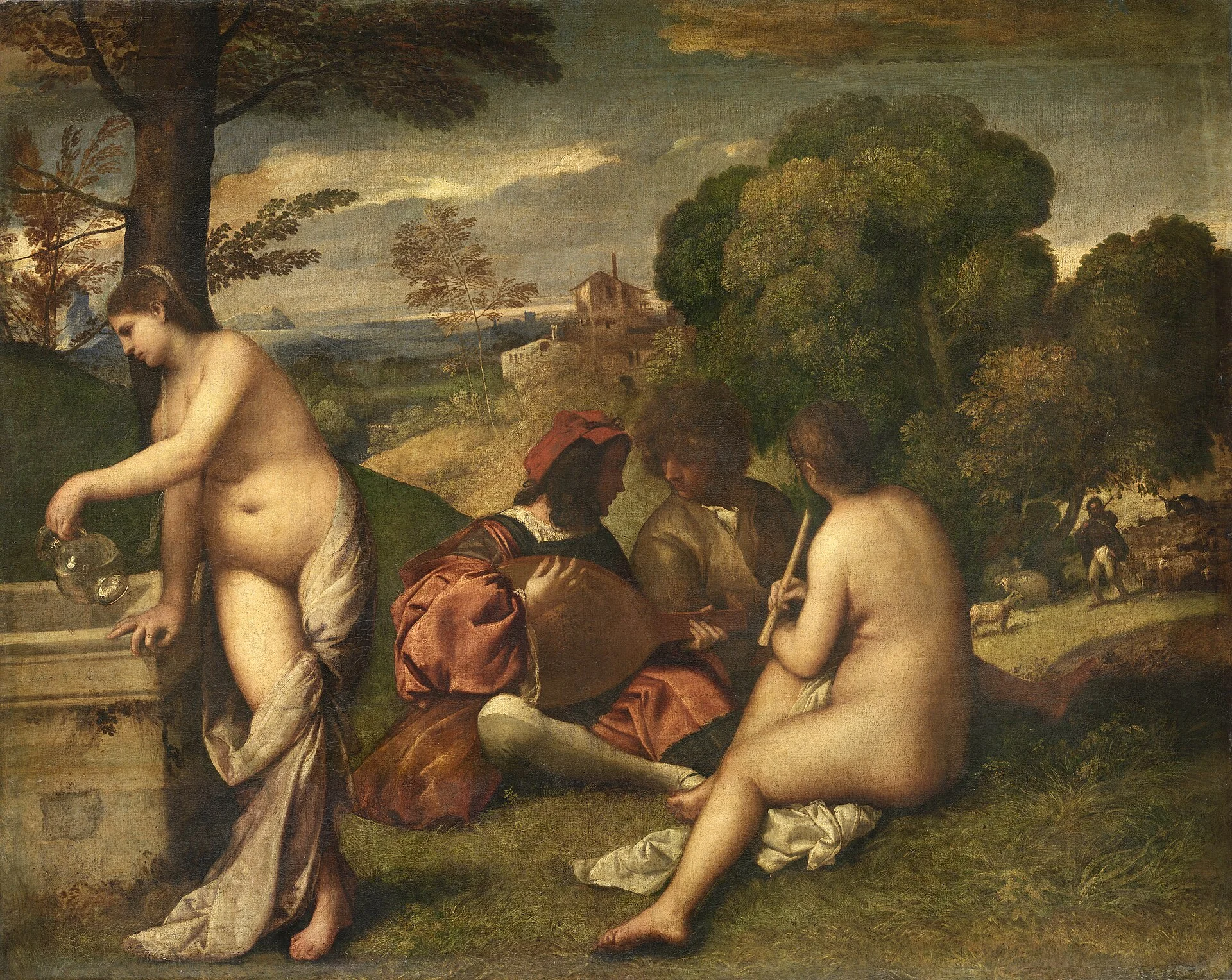
- Old master model: poetic distance, pastoral atmosphere, and acceptable nudity.
- Manet's version: modern dress, direct gaze, awkward silence, and no mythological excuse.
- The result: viewers are forced to confront the present instead of admiring a decorative past.
The break comes in the translation. Old compositional formulas are brought into a recognizably modern register: black jackets, urban bohemian types, abrupt lighting, shallow space, and no attempt to smooth away the shock. Manet therefore makes modernity look like a direct interruption of the museum past.
How the painting is built
Part of the outrage came from technique as much as subject. Manet abandons soft transitions in favor of blunt contrasts. Forms are blocked out rather than softly modeled, and the background does not fully absorb the figures into a convincing deep space. Critics read that as incompetence. It is closer to a deliberate refusal of pictorial comfort.
That refusal is what links the work to Realism while also pushing toward modern painting. Manet is not offering documentary realism. He is making the act of looking socially awkward and visually visible at the same time.
From the picnic to the frontal gaze
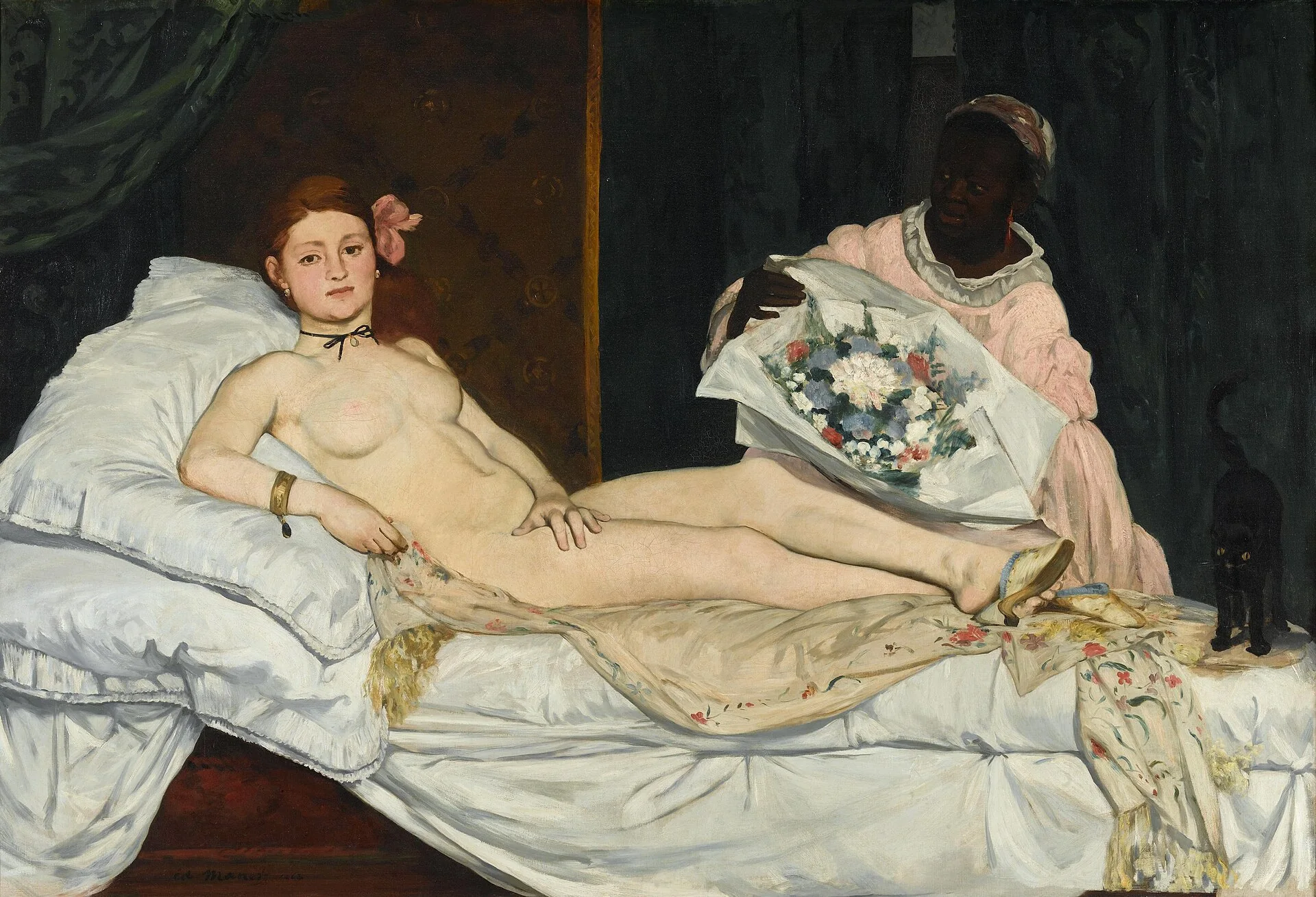
Olympia pushes Manet's project into a more direct register. Le Déjeuner sur l'herbe tests the public by placing a nude inside modern social space. Olympia removes more narrative distraction and makes the confrontation frontal. Read together, the two paintings show how Manet turns scandal into a method.
Then continue to A Bar at the Folies-Bergère, where Manet no longer needs a picnic or a nude to unsettle the viewer. A barmaid, a mirror, and a shifted reflection are enough to make modern social space feel unstable.
What the painting changes
Le Déjeuner sur l'herbe matters because it shows modern art beginning as a problem of spectatorship. The issue is not only what is represented, but how a painting forces viewers to renegotiate their own position in front of it. Manet makes that negotiation public, unstable, and impossible to ignore.
The sequence continues through Olympia, The Railway, and A Bar at the Folies-Bergère, then opens onto Édouard Manet, Realism, and Impressionism. The art quiz can serve as a quick check afterward.
Explore more
Related works
Primary sources
Frequently asked questions
The scandal came less from nudity itself than from the context. Manet placed a nude woman beside modern clothed men and painted the scene without the mythological cover viewers expected.
The foreground shows two dressed men and a nude woman, with a second lightly dressed woman bathing behind them. Manet keeps their exact identities open, which intensifies the scene's unease.
Both paintings test modern spectatorship. Le Déjeuner sur l'herbe introduces the provocation in a picnic setting; Olympia intensifies it by making the nude confrontation even more direct.