
Baroque
Las Meninas
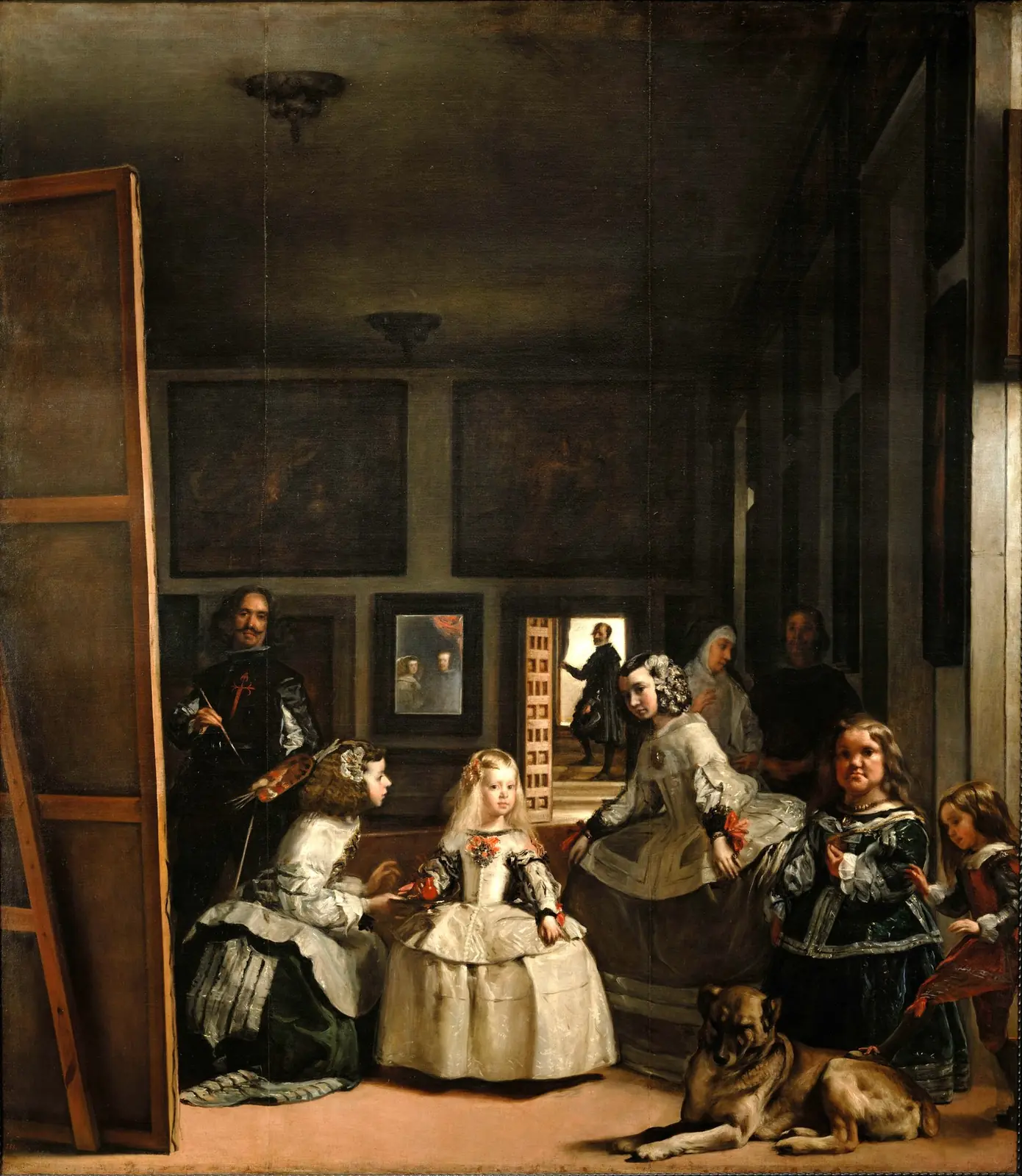
Diego Velázquez paints a royal portrait that behaves like an experiment in power. In Las Meninas, no viewpoint stays stable for long: painter, sitter, monarch, and viewer continuously trade positions. The result is not only a masterpiece of Baroque illusion, but a structural analysis of who controls the image.
Madrid, 1656: court protocol and artistic ambition
The canvas was made for Philip IV's court, in a culture where portraiture usually confirmed hierarchy with maximum clarity. Velázquez keeps the court framework, but complicates its logic from inside. He inserts himself at the easel, not as servant in the margin but as an intellectual operator within the royal environment.
This is the key context: Las Meninas is both a dynastic image and a professional claim. It asks what a court painter can be, not just what a court should look like.
What the painting shows, and what it withholds
At center stands the Infanta Margarita with attendants, dwarfs, and household figures around her. Velázquez appears at left before a large canvas. At the back, a mirror reflects the king and queen. A lit doorway opens deeper space behind the group, while multiple gazes cross and contradict each other.
The scene looks spontaneous, but it is tightly controlled. Light concentrates around key faces and fabrics, then fades into softer passages. You read rank, distance, and attention through luminance before you decode narrative.
The mirror as a device for relocating authority
The mirror is not a decorative trick. It displaces the apparent central subjects outside the painted foreground and forces viewers to ask where they themselves stand. If the monarchs appear only in reflection, the strongest authority sits at the edge of visibility.
That displacement is Velázquez's conceptual move. He turns a portrait into a system of relations: who is looked at, who is looking, and who frames the act of seeing.
Why this differs from other seventeenth-century crowd scenes
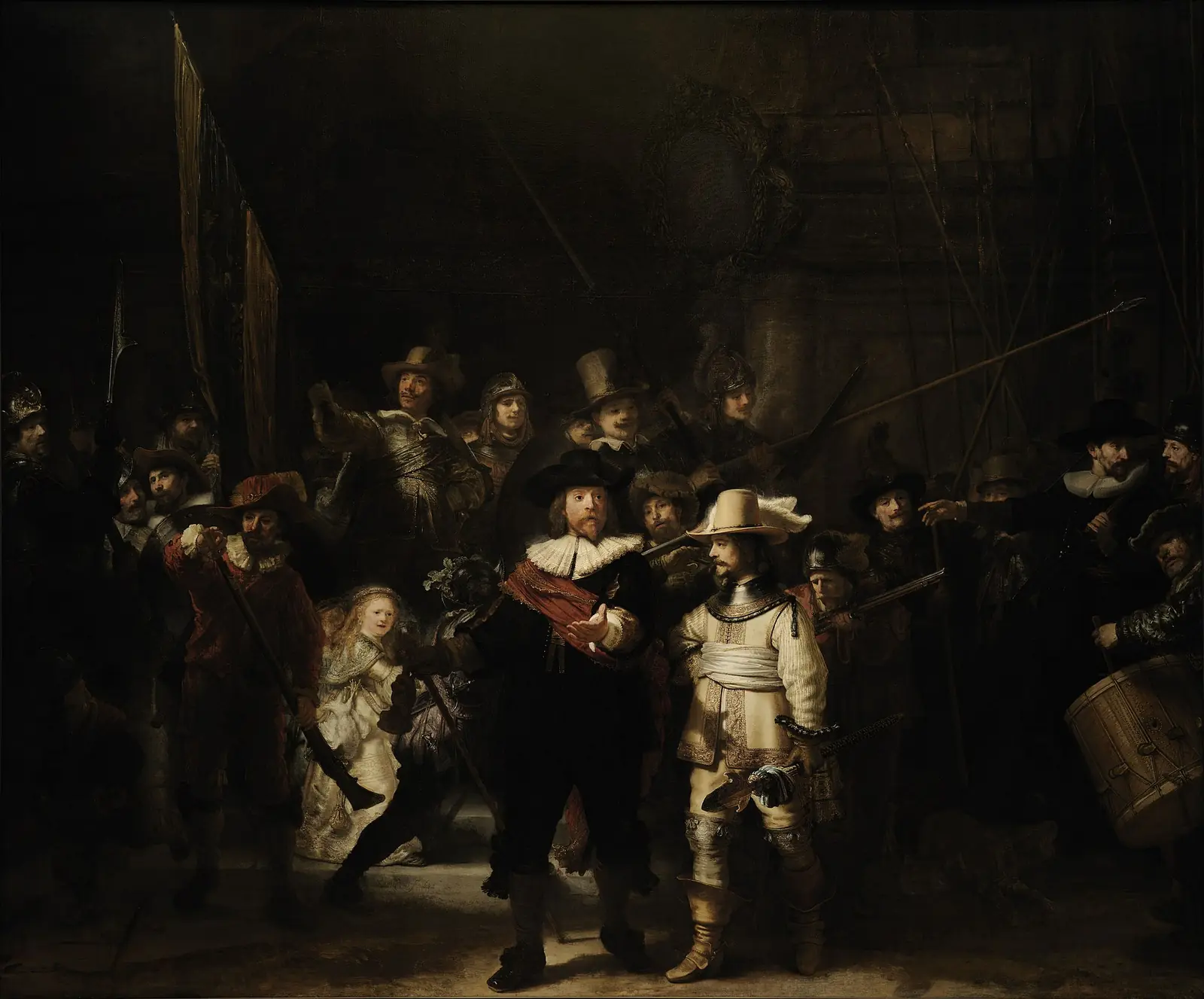
A quick comparison with The Night Watch clarifies the stakes. Rembrandt stages civic energy as collective forward motion; Velázquez stages court power as controlled optical instability. Both are group pictures, but their politics of visibility are opposite.
You can reinforce this reading by contrasting with The Calling of Saint Matthew, where directional light stabilizes a religious narrative more directly than in Velázquez's deliberately ambiguous room.
Why Las Meninas remains central
From Goya to modern studio practice, artists kept returning to this canvas because it combines representation and self-reflection without collapsing into theory alone. It is visually persuasive first, conceptually demanding second.
A final concrete test is to track the path from the Infanta's lit dress to the mirror, then to Velazquez at the easel, and finally to the open door. That sequence demonstrates the painting's core intelligence: rank, labor, and visibility are linked in one controlled circulation of attention.
If this structure is clearer now, use the art quiz to test whether you can identify Velázquez instantly among related Baroque works.
Explore more
Related works
Primary sources
Frequently asked questions
Many readings place the viewer where the king and queen stand, supported by their reflection in the mirror. Velazquez uses this ambiguity to involve the viewer in court ceremony.
The mirror relocates the apparent subject outside the canvas and destabilizes the image hierarchy. It turns a court portrait into a meditation on representation and power.