
Dutch Golden Age
Girl with a Pearl Earring
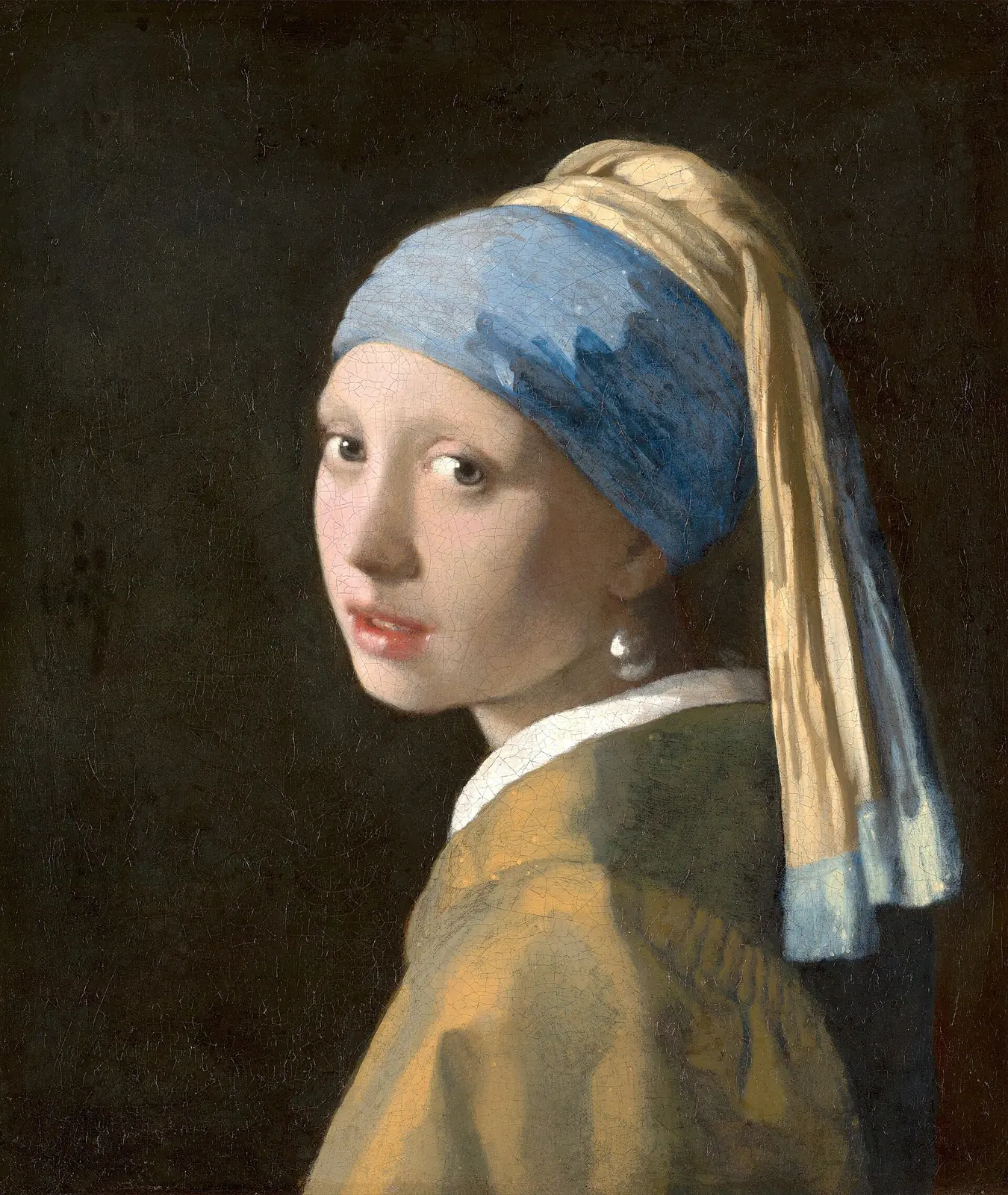
She turns as if you have just called her name, but Vermeer's real subject is not identity. It is attention itself. Johannes Vermeer compresses a whole visual drama into a head turn, a wet highlight on the lip, and one suspended earring. The image belongs to the Dutch Golden Age, yet it feels strikingly modern because it removes almost all narrative props and lets perception do the work.
Delft context: market painting and the rise of the tronie
Around 1665, Dutch cities supported a highly competitive art market where patrons bought works for private homes rather than large church settings. In that environment, artists produced portraits, genre scenes, still lifes, and tronies. A tronie was not a commissioned likeness of a named sitter; it was a study of expression, costume, light, and character type.
That context changes the usual question. Instead of asking "who is she?" the stronger question is "how does this image create presence?" Vermeer answers with extreme economy: limited palette, controlled edge transitions, and a pose that feels caught between speech and silence.
What the painting shows in concrete terms
The figure turns over her shoulder against a dark, nearly empty ground. Her mouth is slightly open, her eyes reflect a small catchlight, and the turban's blue-yellow structure frames the face. The earring hangs low, simplified to a bright highlight and soft reflection. No room, no furniture, no narrative episode distracts from the encounter.
This is why the work feels immediate. Vermeer removes biographical clues, then amplifies micro-signals: skin tone changes at the cheek, moisture at the lower lip, and soft transitions around jaw and neck. The image behaves like a close-up before cinema existed.
Vermeer's intention and method: making light think
Vermeer is not showing virtuosity for its own sake. He is testing how little information is needed for the eye to complete a believable presence. The pearl is the clearest proof: he does not fully describe an object with hard contour and metal hook. He stages reflected light and lets perception finish the form.
The same logic governs the face. Hard edges would freeze the sitter into a static icon. Soft edges keep the head alive, as if the turn is still happening. Vermeer uses painterly restraint to produce temporal tension.
The painting is less a portrait of a person than a portrait of looking.
A useful internal comparison with Vermeer
A quick comparison with The Milkmaid clarifies Vermeer's range. In The Milkmaid, attention is distributed across table, wall, bread, and pouring action. Here, everything collapses into one face and one earring. Same artist, opposite strategy: narrative stillness there, perceptual suspension here.
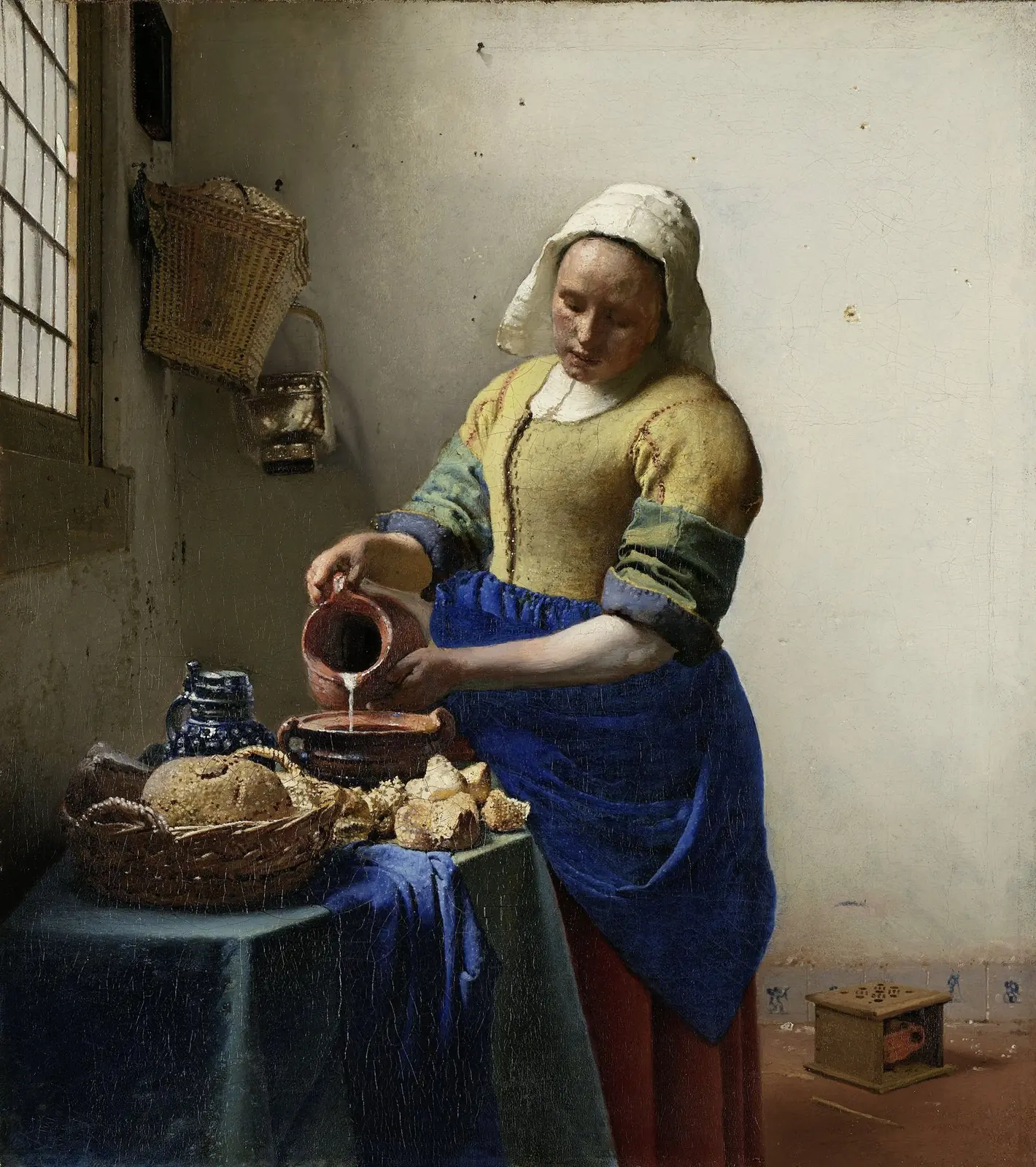
For a broader portrait contrast, connect this page to Mona Lisa vs Girl with a Pearl Earring. Leonardo builds depth through atmospheric landscape and layered psychology; Vermeer builds it through optical minimalism.
Why this small canvas became global
The painting endured because it works at multiple speeds. At first glance, it is immediately legible: a young woman turning toward us. On sustained viewing, it becomes a technical and philosophical exercise in visibility, memory, and desire. That double readability made it ideal for museum culture, publishing, and modern image circulation.
If this structure is clearer now, use the art quiz to test whether you can identify Vermeer quickly among visually related works.
Explore more
Related works
Primary sources
Frequently asked questions
Most scholars classify it as a tronie, a character study rather than a commissioned portrait. The power of the image comes from expression, light, and pose more than from a documented identity.
Vermeer uses a minimal visual formula: a bright highlight, soft mid-tone, and reflected light below. That simplification lets your eye complete the object, which makes the pearl feel more radiant.