
Dutch Golden Age
The Hundred Guilder Print
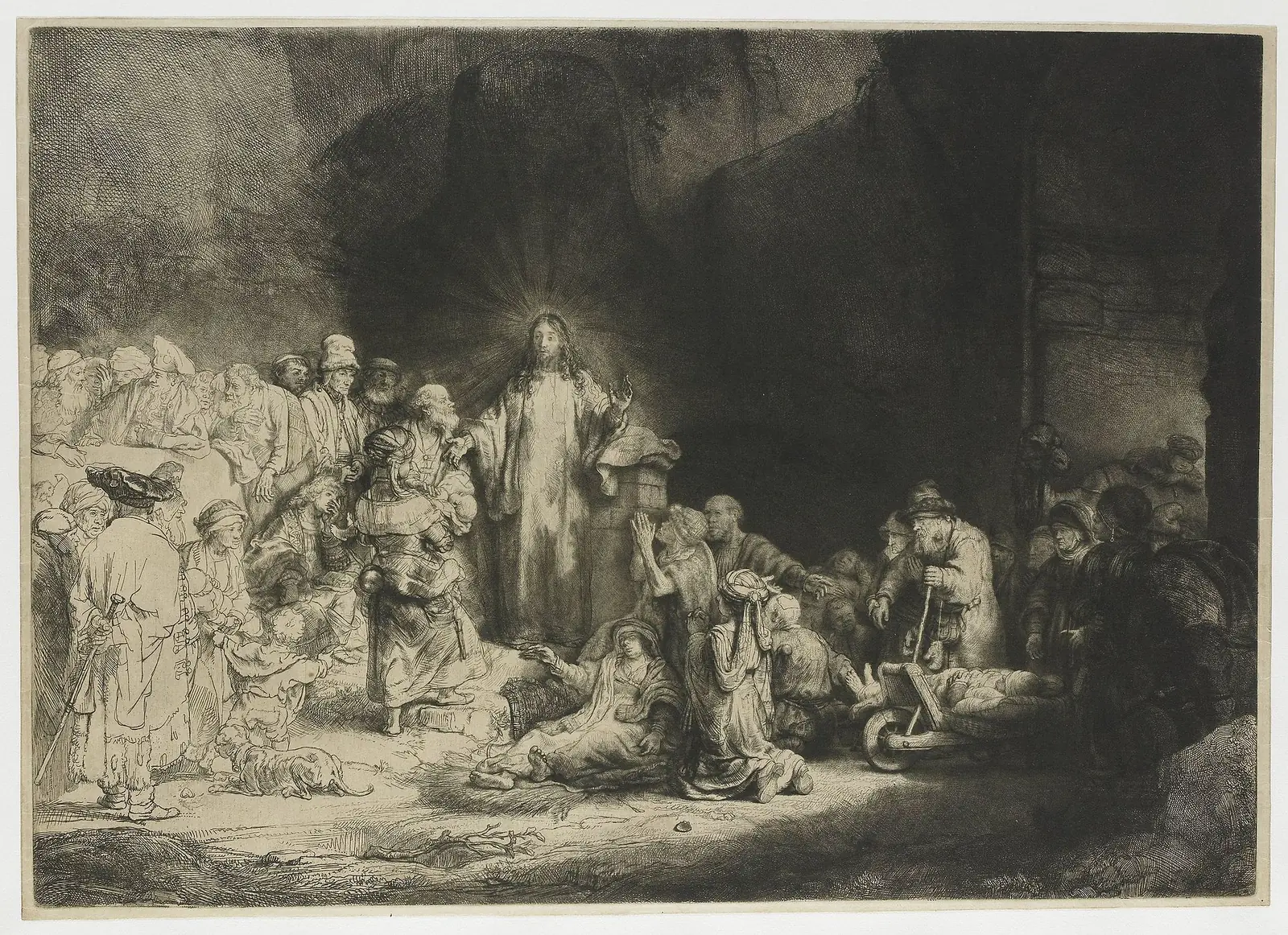
A single sheet that feels like a full public scene. In the late 1640s, Rembrandt van Rijn used etching and drypoint to turn a Gospel passage into a dense social theater of mercy, debate, and hierarchy.
Amsterdam print culture and a risky ambition
The work belongs to a Dutch Republic print market where images circulated across homes, collectors, and dealers. Rembrandt did not treat print as secondary to painting; he treated it as a primary laboratory where theological narrative, technical experiment, and market value could meet.
That context explains the nickname. Calling it the "Hundred Guilder Print" signaled an exceptional price for a print impression, evidence that buyers recognized unusual artistic ambition in the plate.
What the print shows in practice
The scene combines episodes from Matthew 19 around Christ preaching and healing. Children, the ill, the poor, and skeptical listeners occupy distinct zones, each with different emotional temperature. The composition does not isolate one instant; it stages multiple human responses at once.
This is why the sheet reads as lived space rather than illustration. Attention moves through clusters of bodies before returning to Christ as a quiet center of gravity.
How light and line do the interpretive work
Etched lines establish structure, while drypoint burrs deepen velvety shadow. Rembrandt uses tonal hierarchy to guide interpretation: light does not merely describe form, it assigns ethical focus. The most vulnerable figures often receive the clearest legibility.
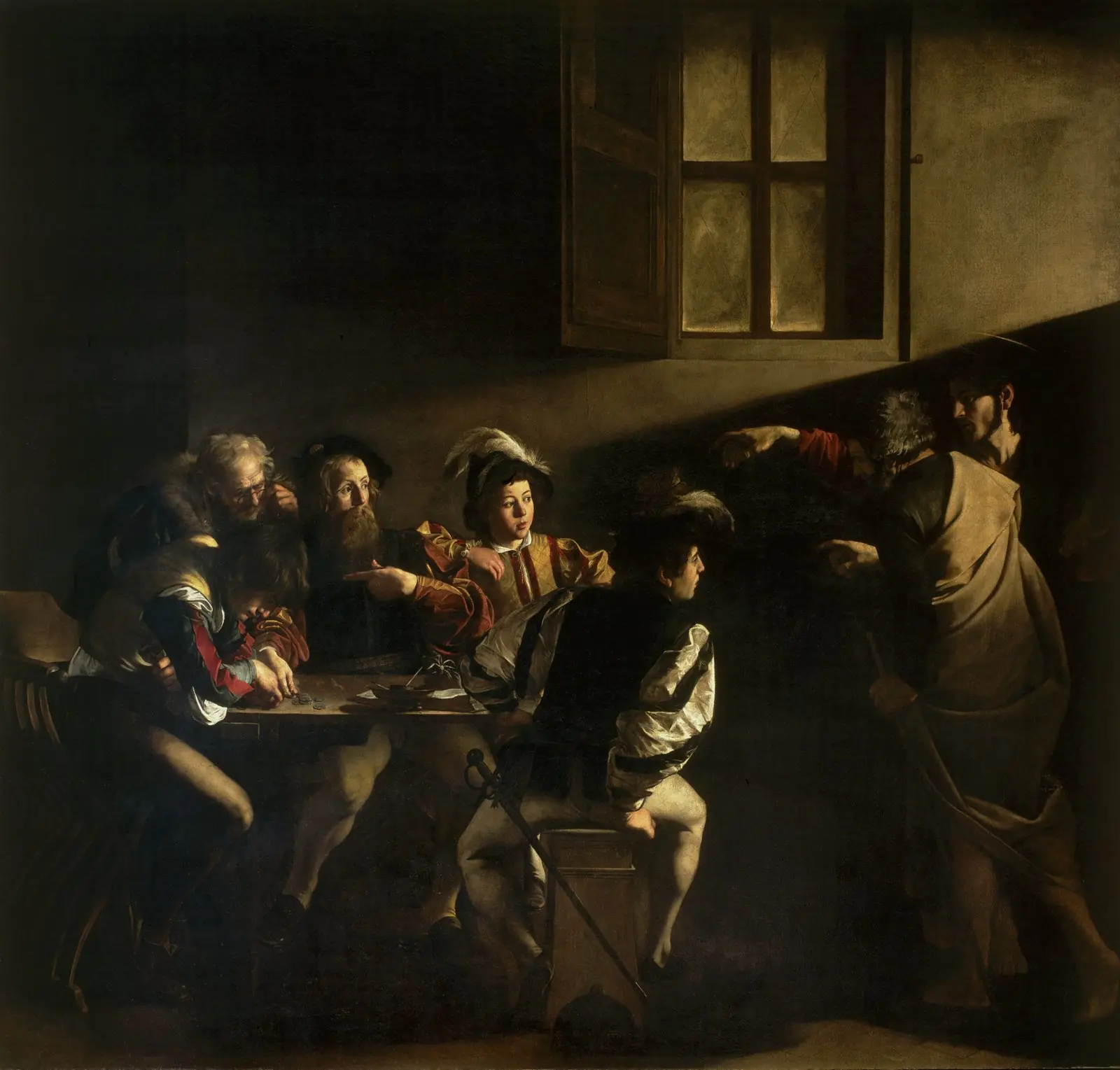
A helpful comparison is The Calling of Saint Matthew. Caravaggio concentrates revelation in one dramatic beam; this print distributes revelation across a crowd.
Why print states and price still matter
The plate survives in different states, meaning Rembrandt reworked lines and shadow over time. Those variations reveal decision-making: where to intensify contrast, where to soften transitions, where to redirect the viewer's path.
Materially, this matters because drypoint burr wears down with repeated printing. Early impressions can appear richer and more velvety in the darkest passages, while later pulls may look cleaner but less atmospheric. Collectors and curators therefore read condition and state together, not as technical trivia but as part of the artwork's meaning and reception history.
Taken together, state changes and high market value show the same point from two sides: this was not routine reproduction. It was a major artistic project in print form.
How to read The Hundred Guilder Print efficiently
Start with tonal masses, not icon labels. Map the brightest zones, then identify how groups are staged around Christ. Only after that should you parse narrative details from Matthew 19. This sequence keeps analysis grounded in what the sheet actually does.
The print's breakthrough is simple: compassion is organized as composition.
Continue with Rembrandt's profile and test your visual recall in the art quiz.
Explore more
Related works
Primary sources
Frequently asked questions
It combines scenes from Matthew 19: Christ preaching, healing, and receiving vulnerable people while skeptical observers remain at the edges.
The nickname reflects a famously high market price for an impression, showing how highly collectors valued Rembrandt's print.
A state is one stage of the metal plate. As Rembrandt revised lines and shadows, later impressions preserved those successive decisions.