
Artist Analysis
Rembrandt van Rijn
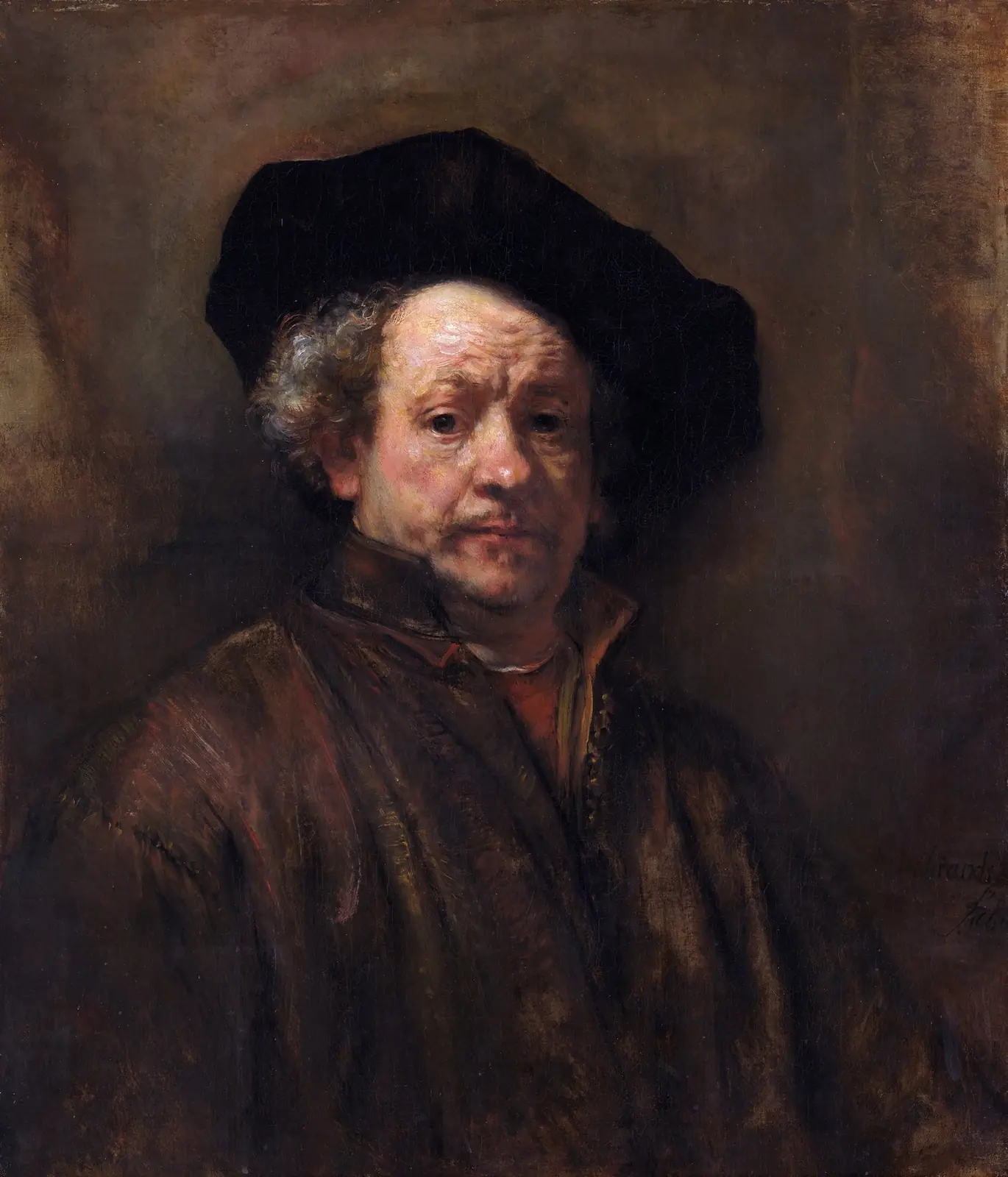
Rembrandt painted faces as if they were weather systems: unstable, layered, and impossible to flatten. He treated light as a moral and emotional instrument. His paintings and prints linger on uncertainty, age, grief, and dignity without reducing people to types.
The Lyon beginning: martyrdom as witness
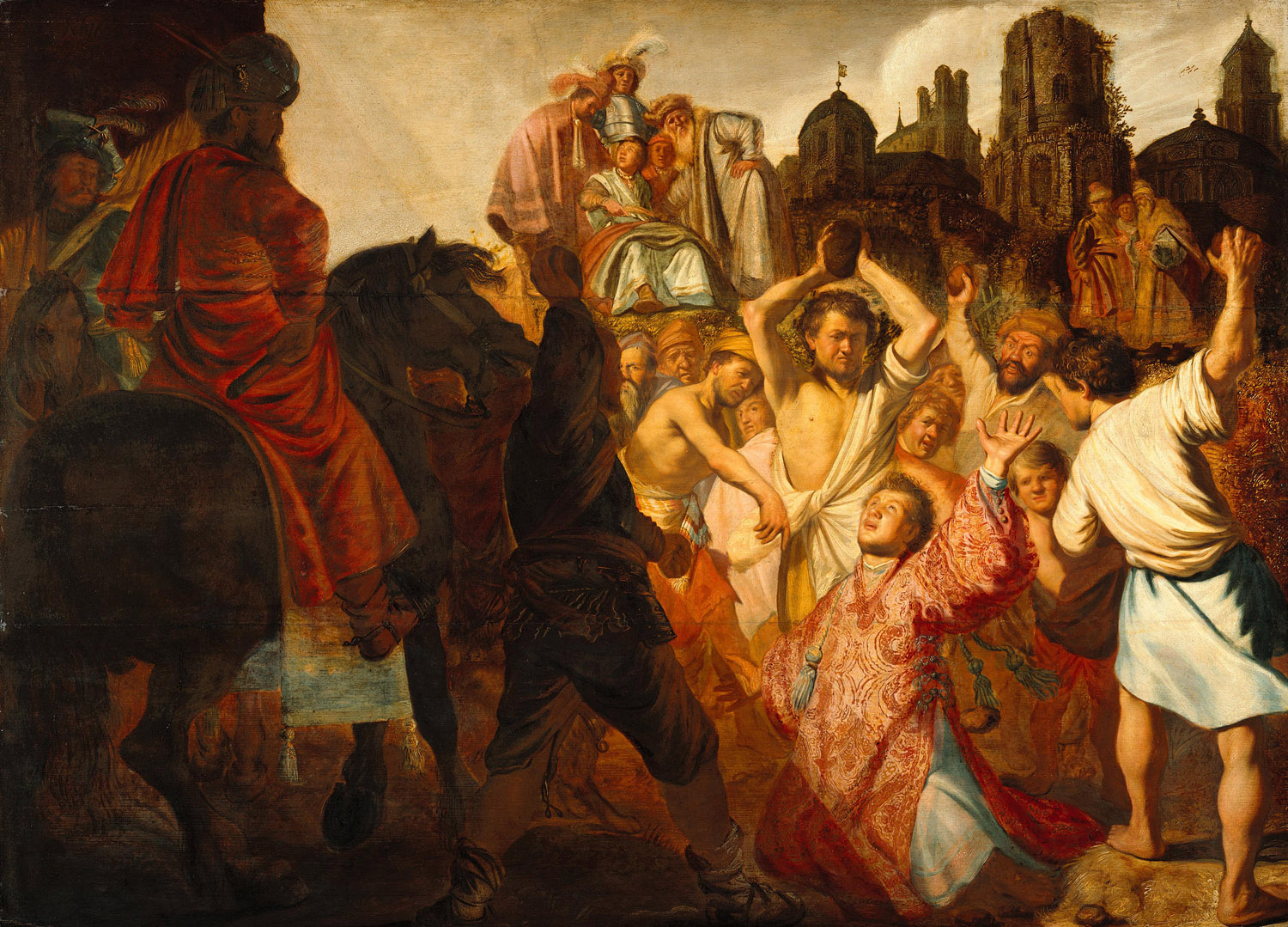
His earliest signed and dated painting, The Stoning of Saint Stephen, already shows the core Rembrandt problem in raw form. Painted in 1625 and now in the Musée des Beaux-Arts de Lyon, it turns a biblical killing into a scene of light, crowd pressure, and conscience. The young painter is still close to Pieter Lastman's history painting, but he is already asking how illumination can separate witness from violence.
A Dutch Republic career built in public
Born in Leiden in 1606, Rembrandt trained first with Jacob van Swanenburgh and later with Pieter Lastman before moving into Amsterdam's high-stakes art market. That trajectory matters: he was formed in a culture where painting, printmaking, religion, and commerce were tightly entangled. His marriage to Saskia van Uylenburgh connected him to collector and dealer networks, while his workshop model tied artistic ambition to daily economic risk inside the wider Dutch Golden Age. A concrete marker is the 1656 bankruptcy inventory, which lists paintings, prints, curiosities, and studio materials; it reads less like a ruin and more like a map of how broadly Rembrandt built his visual world.
His rise in Amsterdam was fast and public. Major commissions such as The Anatomy Lesson of Dr. Nicolaes Tulp positioned him as a painter of civic intelligence, not only of technical skill. At the same time, his house and studio functioned as a teaching and production center, with pupils including Ferdinand Bol and Govert Flinck. This mixed model, where reputation, pedagogy, and market circulation reinforce each other, helps explain both his influence and his exposure to financial shocks when demand changed.
How The Night Watch rewrote civic portraiture
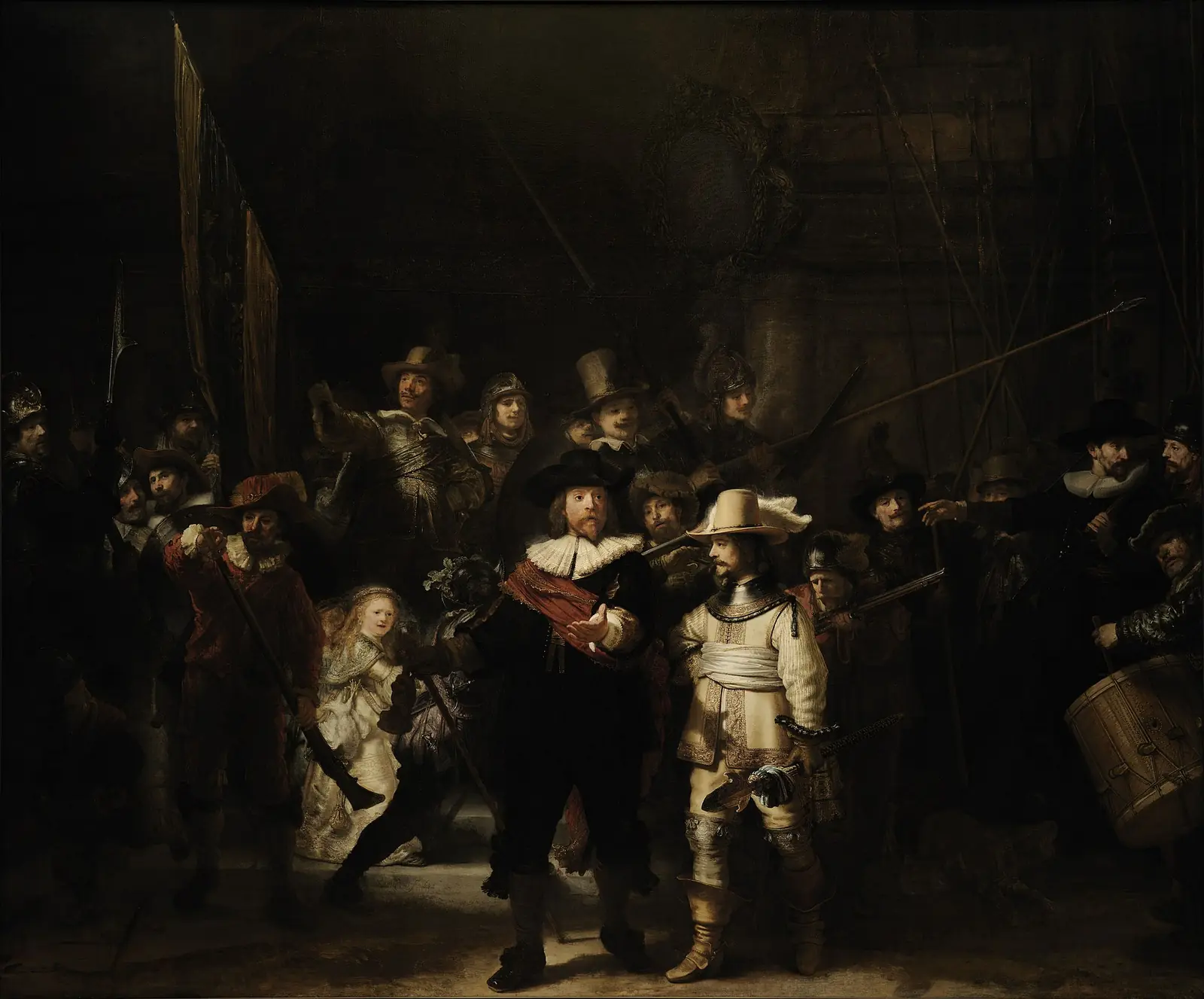
In The Night Watch, Rembrandt turns a militia commission into staged instability. Instead of a stable lineup, he builds diagonal movement, selective lighting, and uneven focus so rank, action, and uncertainty coexist in one frame. This is not decorative drama: it is a political picture about civic identity under pressure, where visibility itself becomes a hierarchy.
Two historical details sharpen that reading. First, the title The Night Watch is secondary: the scene looked nocturnal only after darkened varnish altered the painting's tonal balance. Second, the canvas was cut down in 1715 to fit a new display space. Even in altered form, the work still demonstrates Rembrandt's core move: replacing static corporate identity with choreographed public tension.
Etching as a second studio, not a side practice
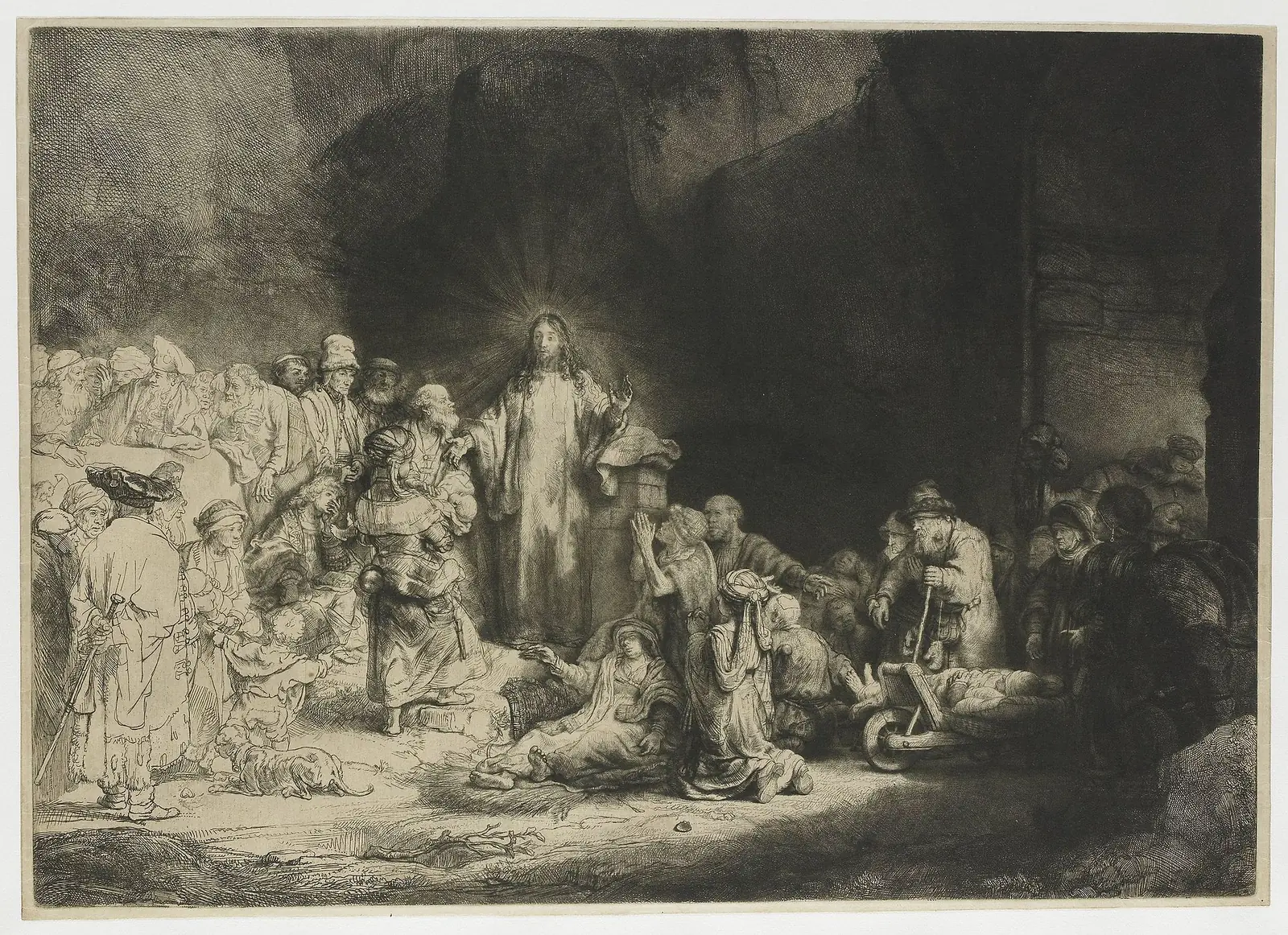
Rembrandt's etchings are central to his method. In The Hundred Guilder Print, he treats the copper plate as a revisable field, producing different states and inking effects that shift narrative emphasis from one impression to another. The print's nickname, tied to an unusually high historical sale price, signals how early collectors recognized its singularity. Read beside Caravaggio and the Baroque, Rembrandt keeps dramatic light but redirects it from theatrical revelation toward ethical hesitation and interior conflict.
This print culture also widened his reach beyond single painting commissions. Because impressions circulated across collections and cities, Rembrandt's experiments in line, burr, and selective wiping became study material for artists who never visited his studio. In practical terms, etching gave him a second timeline of authorship: slower revisions on copper, parallel to faster demands in portrait painting.
Late self-portraits and durable legacy
The late self-portraits complete this biography in paint. After debt crises and family losses, he thickens surface, slows gesture, and lets flesh, shadow, and fatigue remain unresolved. Compared with Vermeer, whose interiors protect equilibrium, Rembrandt keeps conflict visible on the skin of the image. That is the core of his legacy: he proved that technical experiment, market awareness, and psychological depth can coexist without compromise.
His afterlife confirms the point. Nineteenth- and twentieth-century painters repeatedly returned to Rembrandt not to imitate his finish, but to study how matter can carry biography. From realist portraiture to expressionist brushwork, his lesson remained stable: paint should not smooth over contradiction. It should keep complexity legible.
Key works in Explainary
Associated movements
Now test recall with the art quiz: can you recognize Rembrandt van Rijn from visual cues in works like The Night Watch?