Northern Renaissance
Knight, Death and the Devil
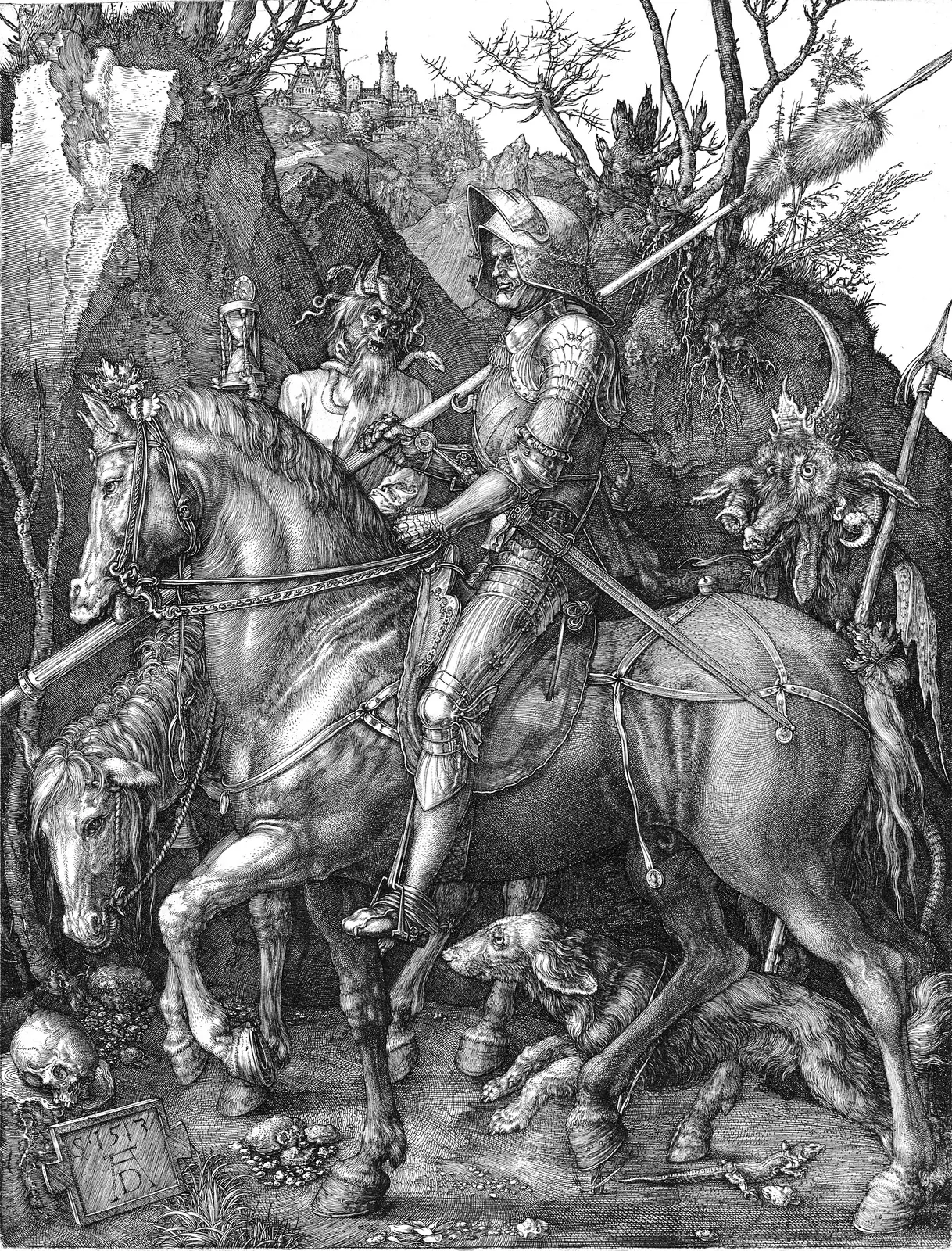
A knight rides forward while Death raises an hourglass and the Devil crowds in behind. The shock of the image is not panic but control. Dürer makes endurance feel visible before the viewer has decoded a single symbol.
What the engraving shows
A heavily armored rider advances through a narrow, rocky passage on a powerful horse. Death appears beside him with an hourglass, the Devil presses in from behind, a dog keeps pace below, and a distant fortress anchors the horizon. The scene is crowded, but it reads quickly: the world around the knight is full of warning, threat, and decay, while the rider does not turn.
That clarity is part of the print's strength. Dürer gives the viewer a simple visual fact - forward movement under pressure - and then surrounds it with enough detail to keep the meaning open. Is this the model Christian knight? A humanist image of disciplined virtue? Or a darker image of perseverance in a world that offers no certainty? The engraving works because it can carry all three possibilities at once.
The context of 1513
Knight, Death and the Devil was engraved in 1513, during the period when Albrecht Dürer was producing the prints now often grouped as his "master engravings." It belongs to the world of the Northern Renaissance, where technical precision, moral seriousness, and intellectual ambition are tightly bound together.
This context matters because the print is not a piece of fantasy for its own sake. It emerges from a culture in which virtue, mortality, religious discipline, and humanist self-fashioning were live concerns. Dürer turns those concerns into a compressed image that feels both symbolic and physically immediate.
Durer's intention
Durer's aim is not to illustrate one tidy moral lesson. He builds an image in which steadfast movement holds its shape while mortality, temptation, and uncertainty gather around it. The engraving is therefore less about defeating evil than about maintaining direction under pressure.
That intention explains why the rider stays so controlled. Durer wants the viewer to feel tested rather than merely entertained. The print asks what inner discipline looks like when the world offers menace, time limits, and no complete guarantee of safety.
How the composition works
The basic structure is simple: the knight moves forward while everything around him suggests interruption. The horse and rider create a stable axis through the plate, and the dense environment closes in around that axis. The engraving therefore does not dramatize courage with theatrical gesture. It dramatizes courage by making steadiness survive contact with disorder.
That is why the knight's armor matters so much. Dürer cuts it with such precision that the figure feels physically resistant, almost engineered to endure. Death's hourglass and the Devil's grotesque body are not just narrative accessories; they are pressures placed against a form that refuses to collapse.
What the symbols do
The hourglass makes time and mortality visible. The Devil embodies threat, temptation, and confusion in a deliberately unstable form. The dog can be read as fidelity or companionship, while the difficult road itself turns the journey into an ordeal. None of these elements needs to be reduced to one fixed code for the print to work. Their force lies in how they surround the knight without altering his direction.
- Follow the rider's line of movement before reading individual symbols.
- Notice how the horse remains controlled even in a crowded, hostile environment.
- Watch how Death and the Devil press in from the margins rather than taking over the center.
- See how the distant architecture stabilizes the image beyond the immediate danger.
Why the engraving medium matters
Dürer's technique is not just a display of skill. Dense hatching builds rock, fur, metal, and darkness into a world of palpable pressure. Because the engraving is small and reproducible, the achievement is even sharper: a portable sheet of paper carries the moral and philosophical weight that monumental painting often seeks on a much larger scale.
This is one reason the image remains so central in art-historical teaching. The print shows how line can become argument. Dürer uses the burin not only to describe surfaces, but to make ethical pressure visible.
How to read it today
The best first question is not "What does every symbol mean?" but "Why does the knight never turn?" Once that forward logic is clear, the rest of the image becomes easier to organize. The engraving is less a sermon with labels than a visual experiment in perseverance.
If you want to continue inside Dürer's world, compare this print with Melencolia I and The Rhinoceros. Together, the three works show how he handles moral resolve, thought, and knowledge through very different visual systems. The art quiz can serve as a quick recognition check afterward.
If Knight, Death and the Devil is clearer now, try the art quiz and see whether you can spot works by Albrecht Dürer in seconds.
Explore more
Related works
Primary sources
Frequently asked questions
Not in any simple historical sense. The rider is usually read as an ideal figure of steadfastness, virtue, or disciplined persistence rather than as a portrait of one named knight.
The hourglass makes mortality visible. It reminds both the rider and the viewer that time is limited, which sharpens the engraving's theme of endurance under pressure.
It combines philosophical ambiguity, intense symbolic pressure, and extraordinary engraving technique. Dürer turns a small, reproducible print into a major statement about courage and mortality.
Compare it with Melencolia I and The Rhinoceros to see how Dürer handles moral pressure, thought, and knowledge under very different visual conditions.