
High Renaissance
The Last Supper
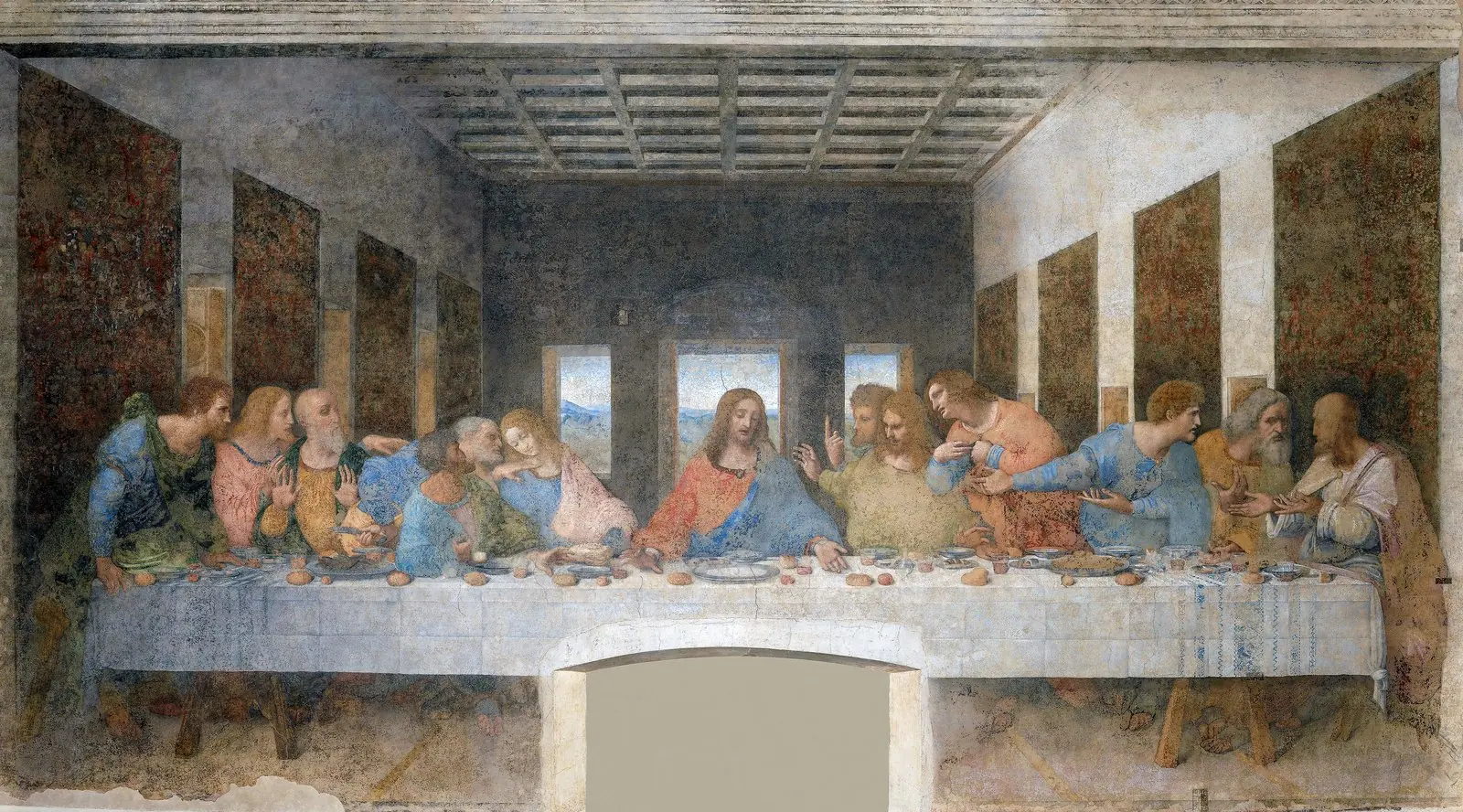
The Last Supper is not really a painting of a meal. It is a painting of a sentence detonating across a room. Leonardo chooses the instant after Christ announces that one of the apostles will betray him. What follows is not chaos, but a perfectly organized shockwave.
That is why the mural remains so powerful even in damaged condition. The painting does not depend only on surface beauty. It depends on timing, grouping, perspective, and the fact that it was made for a real High Renaissance refectory where monks ate every day beneath it.
Not the meal, the announcement
Many images of the Last Supper present a sacred meal in relatively stable terms. Leonardo shifts the emphasis. The decisive event here is speech: Christ has just said that betrayal is already inside the group. Each apostle reacts differently, so the wall becomes a field of interrupted gestures, questions, recoil, and disbelief.
The scene also condenses more than one meaning at once. It still carries Eucharistic force through bread, wine, and Christ's central stillness, but the dominant experience is dramatic and immediate. Instead of showing a timeless ritual from a respectful distance, Leonardo makes the room register the instant when trust breaks.
A refectory is part of the picture
The mural was painted for the refectory of Santa Maria delle Grazie in Milan, not for a chapel or a private studiolo. That setting matters. The subject is a meal, and the viewers were Dominican friars taking real meals in front of it. The wall therefore does not just illustrate scripture. It extends the daily space of eating, silence, and communal life.
Leonardo uses this brilliantly. The table runs almost parallel to the viewer, as if it might continue into the room, yet it also forms a barrier between the apostles and the beholder. The image is close enough to implicate you, but ordered enough to hold you back. That tension is one reason the mural feels so public and so controlled at the same time.
How Leonardo keeps the shock readable
The great achievement of the mural is clarity under pressure. The apostles are arranged in four groups of three, giving the reactions rhythm rather than noise. Christ anchors the center in a triangular stillness, while the lines of the ceiling and side walls converge behind his head.
- Perspective makes Christ the visual and theological center without isolating him theatrically.
- Grouping in threes turns twelve separate reactions into an intelligible sequence.
- Judas remains on the same side of the table as the others, so betrayal feels internal to the group rather than simply labeled from outside.
That last decision matters. In many earlier Last Supper images, Judas is more obviously set apart. Leonardo keeps him within the same human group, which makes the fracture more unsettling. Likewise, the figure at Christ's right, identified in standard art history as John, is calm and yielding rather than spectacularly expressive. The mural distributes intensity carefully; it does not waste it.
A wider High Renaissance comparison
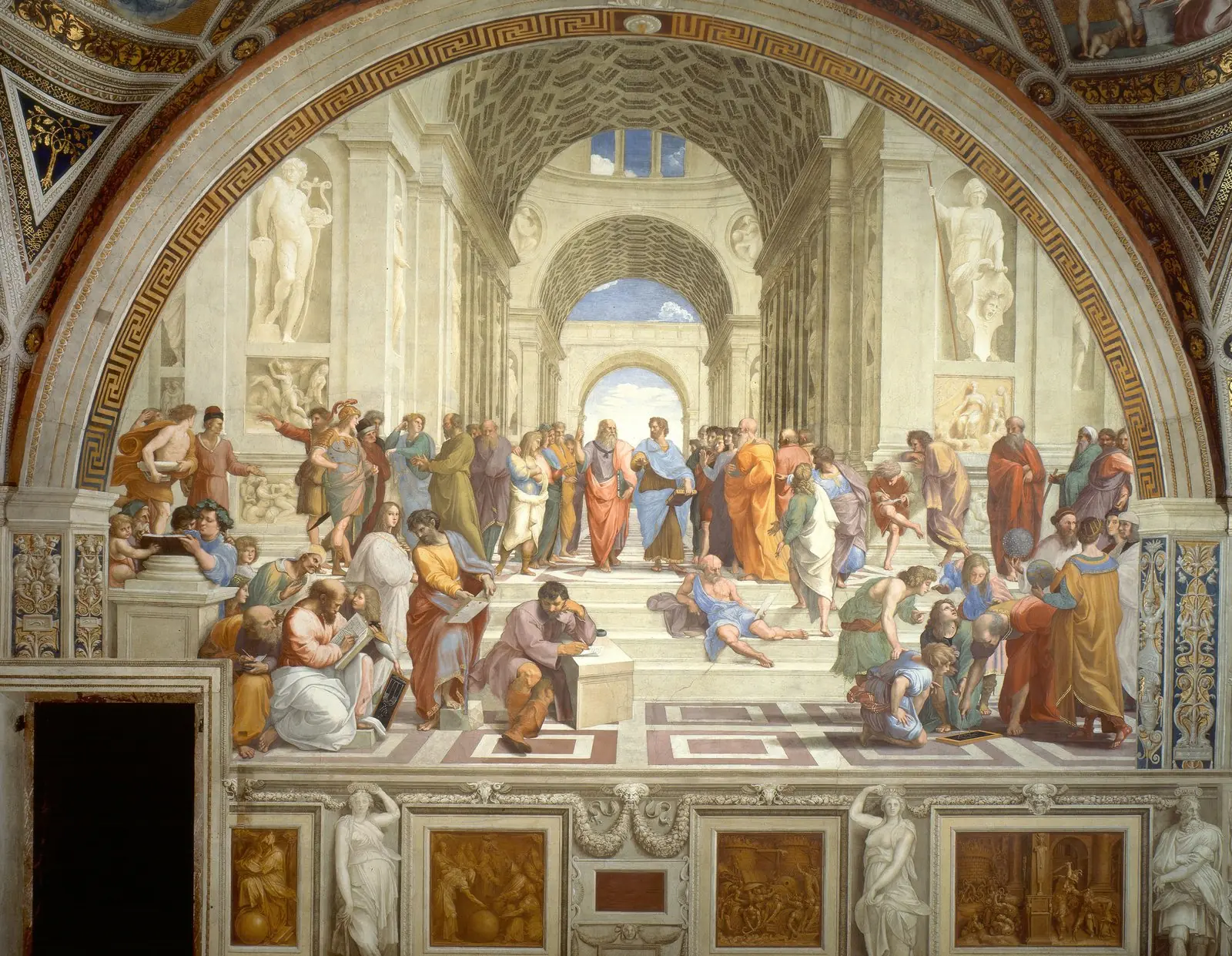
For a broader comparison, place the mural beside Raphael's School of Athens. Raphael organizes philosophical debate in a vast public interior; Leonardo organizes a moment of moral and emotional rupture at a dinner table. Both works belong to the same larger ambition: make complex human relations readable at first glance through geometry and grouping.
This is also where Mona Lisa becomes useful as an internal Leonardo comparison. In the portrait, he organizes delayed psychological response in one face. In The Last Supper, he scales that intelligence up to thirteen figures and an entire room.
Why the wall began failing almost immediately
Leonardo did not use true fresco. He wanted slower, more painterly control than wet plaster allowed, so he worked on dry plaster with a mixed technique closer to panel painting. That decision gave him the ability to revise and modulate, but it also made the mural far more fragile.
The pigments sat on the wall instead of bonding deeply into it. Environmental conditions in the refectory made matters worse, and damage was noticed within decades. This is one of the clearest examples of Leonardo's method in general: extraordinary formal gain achieved through material risk. The same research mentality that made him great also made some of his works vulnerable.
Survival, bombing, and restoration
The history of The Last Supper is not only a history of painting but of rescue. Repainting and restoration attempts accumulated over centuries, often obscuring or distorting what remained of Leonardo's surface. Then, in 1943, Allied bombing devastated much of Santa Maria delle Grazie. The wall bearing the mural survived, though the surrounding refectory was heavily damaged.
The long restoration led by Pinin Brambilla Barcilon from 1977 to 1999 tried, for the first time, to recover Leonardo's surviving paint from under centuries of intervention. Today's visit conditions are part of that same conservation logic: timed entry, filtered air, brief viewing, and limited groups. The work is still visible because the museum treats fragility as a permanent condition, not a temporary problem.
Why this image changed painting
UNESCO is right to treat the mural as more than a masterpiece of one subject. Leonardo changed not only the iconography of the Last Supper, but the larger expectations of narrative painting. He showed that a sacred scene could be monumental, legible, dramatic, and psychologically differentiated without losing formal calm.
Later painters could imitate or resist this model, but they could not ignore it. That is why the mural matters beyond religious art. It demonstrates how painting can organize collective reaction with such precision that a wall becomes a machine for reading human behavior.
Leonardo does not paint thirteen isolated figures; he paints one announcement moving through a group.
Reading paths from The Last Supper
Move next through Leonardo, then outward to the High Renaissance, then across to Mona Lisa and The School of Athens. That route makes the key point clear: portrait, mural, and Vatican fresco all solve different problems, but all demand immediate readability under complex pressure. After that, try the art quiz.
Primary sources
Frequently asked questions
Leonardo shows the moment just after Christ announces that one of the apostles will betray him. The mural also carries Eucharistic meaning, but its dramatic center is the reaction to that sentence.
Leonardo did not use true fresco. He painted on dry plaster to work more slowly and revise more freely, but this left the pigments far more vulnerable than they would have been on wet plaster.
Leonardo keeps Judas within the same side of the table as the other apostles so betrayal feels like an internal break inside the group rather than a simple external label.
Art historically, the figure at Christ's right, visible on the viewer's left, is identified as John the Apostle. Popular speculation persists, but standard scholarship still identifies John.
Yes, but under strict conservation conditions. Access is timed, group size is limited, and the stay in the refectory is brief to protect the fragile wall painting.