
Post-Impressionist Painting
Where Do We Come From? What Are We? Where Are We Going?
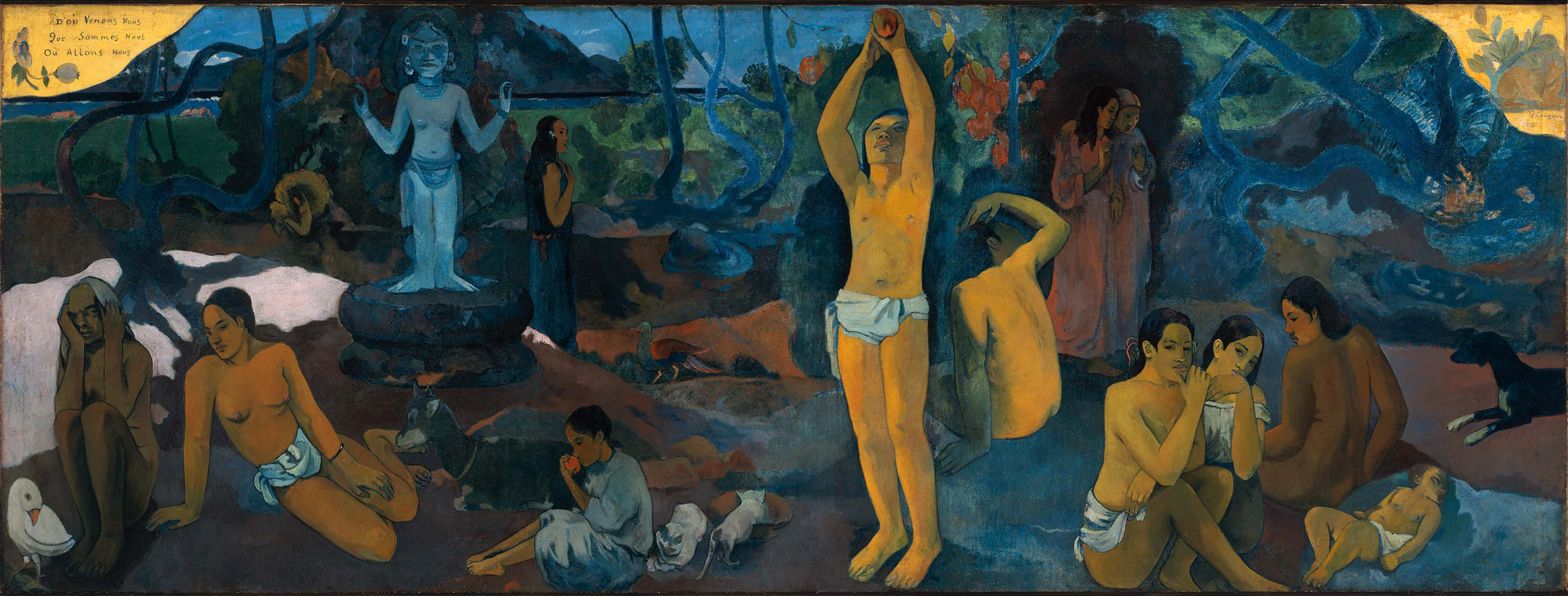
Gauguin stretches a chain of figures across a Tahitian landscape and turns the whole canvas into one painted question about life from infancy to death. Where Do We Come From? What Are We? Where Are We Going? is not a scene you simply look at frontally and finish. Paul Gauguin asks you to read it, almost like a frieze, while never letting the symbols harden into a tidy code. That mixture of structure and uncertainty is exactly why the painting remains so strong.
1897-1898: a monumental painting made under pressure
Gauguin painted the work in Tahiti in 1897-1898, during a period of illness, debt, grief, and sharpened isolation. He conceived it on a canvas measuring 1.39 x 3.75 m, closer to a mural than to an easel picture, and he treated it as a summation rather than as one more episode. The Post-Impressionist ambition is clear here: painting no longer records a passing sensation but builds a total field of thought.
That ambition also explains the surface. Gauguin worked on rough burlap rather than a fine academic canvas, and he left bright yellow corners that make the picture feel declared, almost posted to the wall. The material choice helps the work stand apart from polished Salon finish. It wants scale, bluntness, and finality.
How the image unfolds
The common reading moves from right to left. At the right, an infant lies close to the ground. Around the center, younger and adult figures gather, turn, reach, and think. At the left, an older woman folds in on herself while a white bird nearby remains hard to decode. Gauguin described the sequence himself, so the direction matters. But the picture is not a diagram of life stages in perfect order. The transitions are too strange for that.
Near the center, a blue idol keeps the scene from reading as a simple episode of daily life. It does not supply a single key, but it pushes the painting toward larger questions about the sacred, life, and death. Fruit, gesture, crouching, standing, and looking can then remain together inside the same decorative field.
A philosophical image that refuses neat allegory
The famous title makes the painting sound like a solved program, but Gauguin is more slippery than that. Yes, the work organizes human life from birth toward death. No, it does not reduce each figure to a caption. Some gestures feel ordinary, some ritualized, some deliberately hard to name. The painting holds together because the title gives it pressure, while the forms keep local ambiguity alive.
That is a major difference from older academic allegory. An academic painter might assign each figure a stable symbolic function. Gauguin wants the whole image to feel legible and uncertain at the same time. He gives you a direction of reading, then withholds complete translation.
His method is clear in the way the canvas is built. Gauguin wants the eye to travel across the field rather than settle on one climax, so he flattens the space, simplifies the bodies, and lets color, contour, and sequence carry the thought. The painting is meant to be read as a constructed order, not mistaken for a piece of witnessed reality.
Color as sign, not as daylight
Gauguin's color does not obey natural illumination. Blue, ocher, orange, violet, and green are distributed for force and relation rather than for faithful atmosphere. The figures are simplified by contour, the ground flattens toward a patterned field, and depth never becomes the main issue. This is one of the clearest places to see how Gauguin pushes painting away from observation and toward constructed meaning.
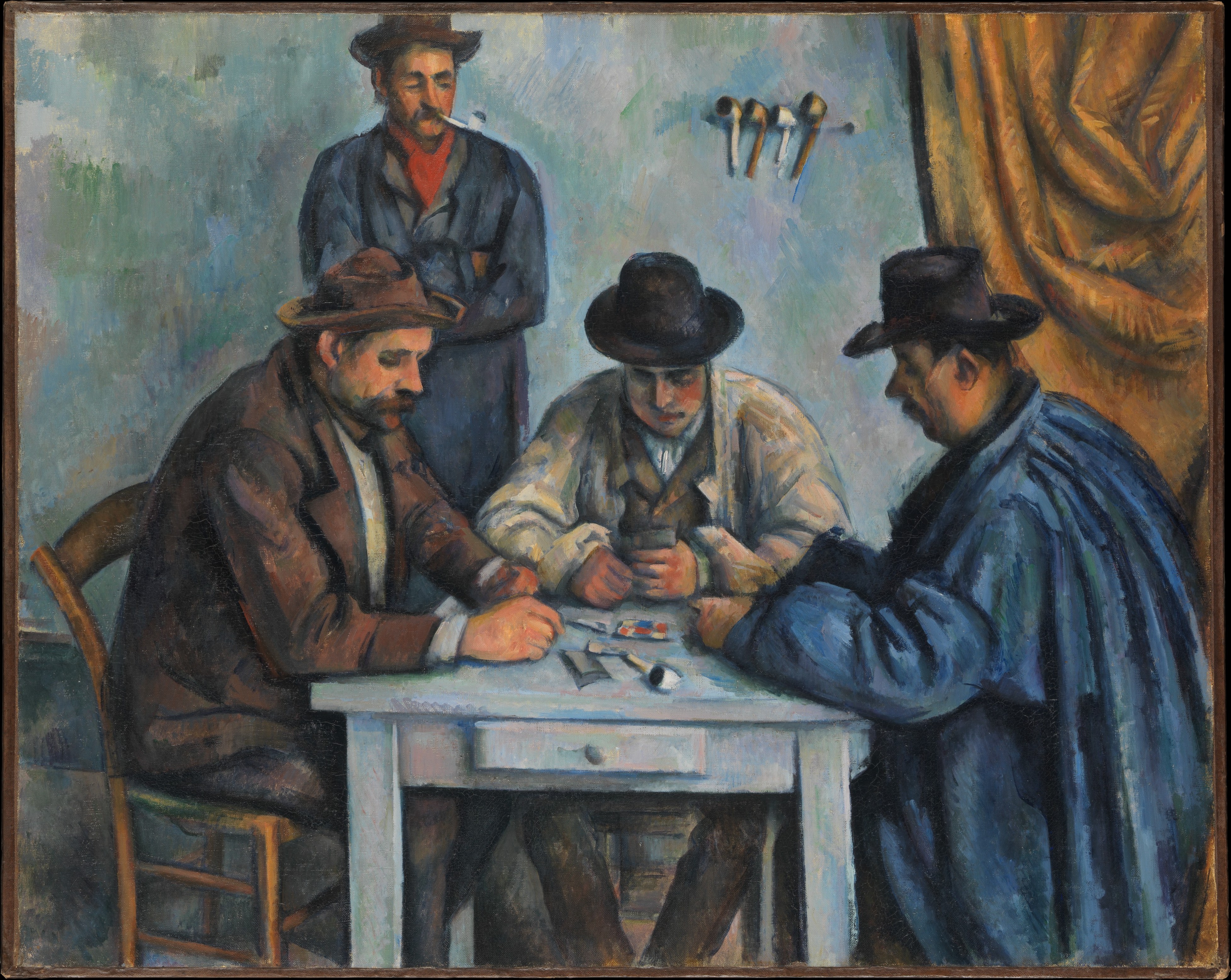
Set the picture beside The Card Players by Paul Cezanne and the distinction inside Post-Impressionism sharpens. Cezanne rebuilds space and weight through patient relation. Gauguin flattens the field, intensifies contour, and lets color carry symbolic charge. Both reject Impressionist immediacy, but they head in different directions.
Tahiti here is painted as an elsewhere
The Tahitian setting is not neutral description. Gauguin paints inside a French colonial world and turns Tahiti into a field of myth, origin, sensuality, and imagined distance. That gives the picture much of its power, but it also makes the work inseparable from colonial fantasy. He is not documenting Tahitian life with ethnographic precision. He is using Tahiti as the place where he thinks he can recompose human beginnings and endings.
The painting's beauty and ambition are real, but so is the constructed idea of paradise behind it. Gauguin wants remoteness, primacy, and timelessness. The canvas tells us as much about his desire to escape European modernity as it does about the place he paints.
A modern monument, not a history painting
This is one of the clearest cases where modern painting becomes monumental without returning to academic history painting. Gauguin makes a picture about the whole arc of human life, yet he does so with flattened space, anti-natural color, decorative rhythm, and unresolved symbolism. That combination feeds directly into later Symbolist, Nabi, and modernist thinking.
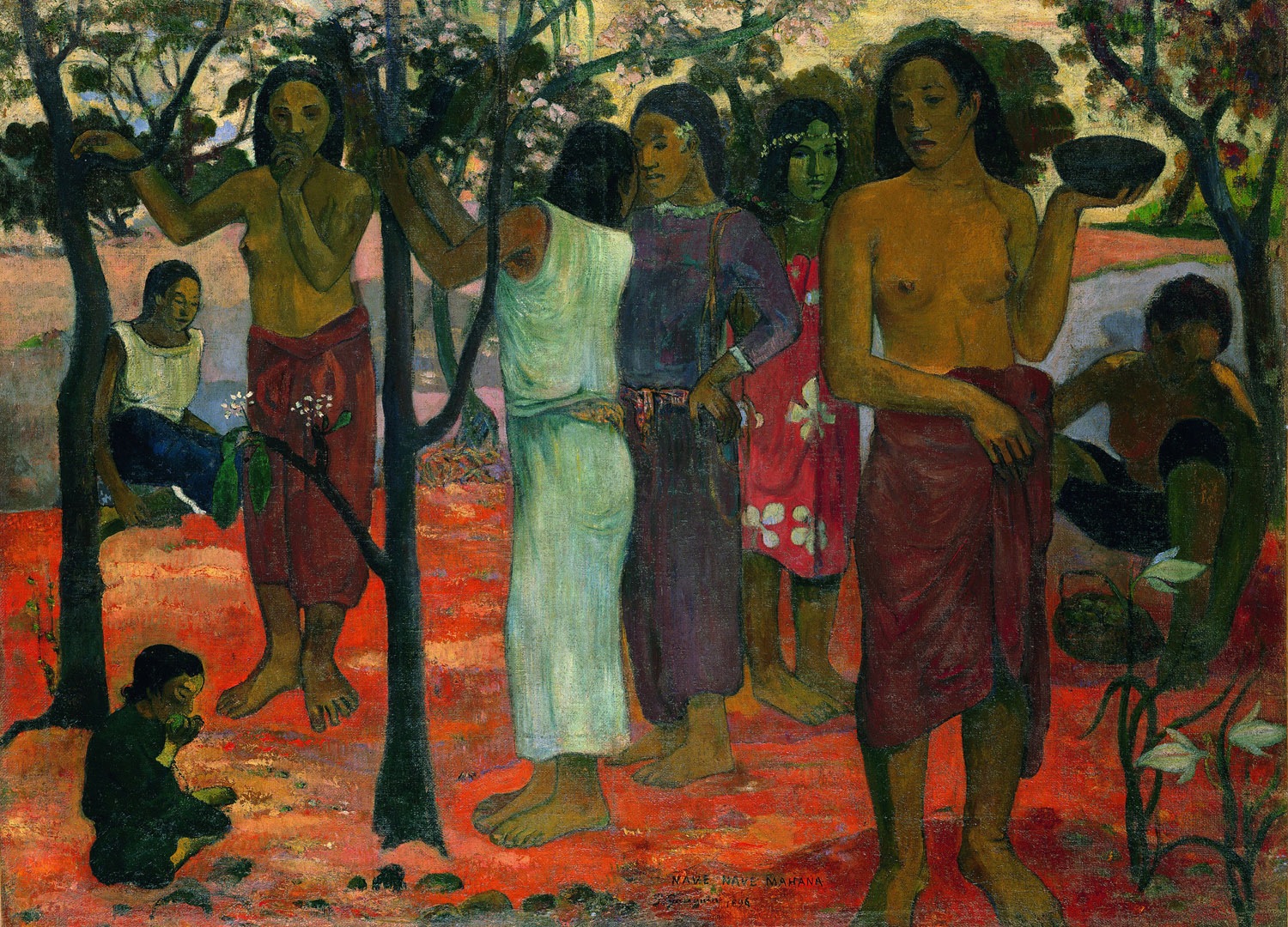
Nave Nave Mahana, now in the Musée des Beaux-Arts de Lyon, shows the same frieze logic at a tighter scale. Red ground, standing figures, and dark tree trunks turn Tahiti into a symbolic construction rather than a continuous landscape.
The painting also clarifies Gauguin's place within Explainary's larger route through modern art. Read it with The Starry Night, The Sleeping Gypsy, and Post-Impressionism and the period stops looking like one style. It becomes a field of incompatible but productive answers to the same question: what can painting do once plain optical description is no longer enough?
Explore more
Then try the art quiz.
Primary sources
- Museum of Fine Arts, Boston: Where Do We Come From? What Are We? Where Are We Going?
- Museum of Fine Arts, Boston: Gauguin and Polynesia
- The Met Heilbrunn Timeline: Post-Impressionism
- The Met: Paul Gauguin (1848-1903)
- Musée des Beaux-Arts de Lyon: Nave Nave Mahana
- MoMA: Paul Gauguin
- Britannica: Paul Gauguin
- Khan Academy: Gauguin, Where Do We Come From? What Are We? Where Are We Going?
- Wikimedia Commons: file metadata
Frequently asked questions
Because Gauguin himself described the image as moving from infancy at the right toward age and death at the left. That sequence gives the painting structure without exhausting its meaning.
The blue idol usually stands for the sacred, the beyond, or the part of human life that thought cannot fully reach. Gauguin places it near the center so the painting can open toward metaphysical space without closing interpretation down.
It shows how far modern painting can move from optical description toward symbolic color, flattened space, and philosophical ambition. Gauguin keeps the picture legible, but he makes meaning depend on structure and sign rather than on naturalistic illusion.