
Early Renaissance
Primavera
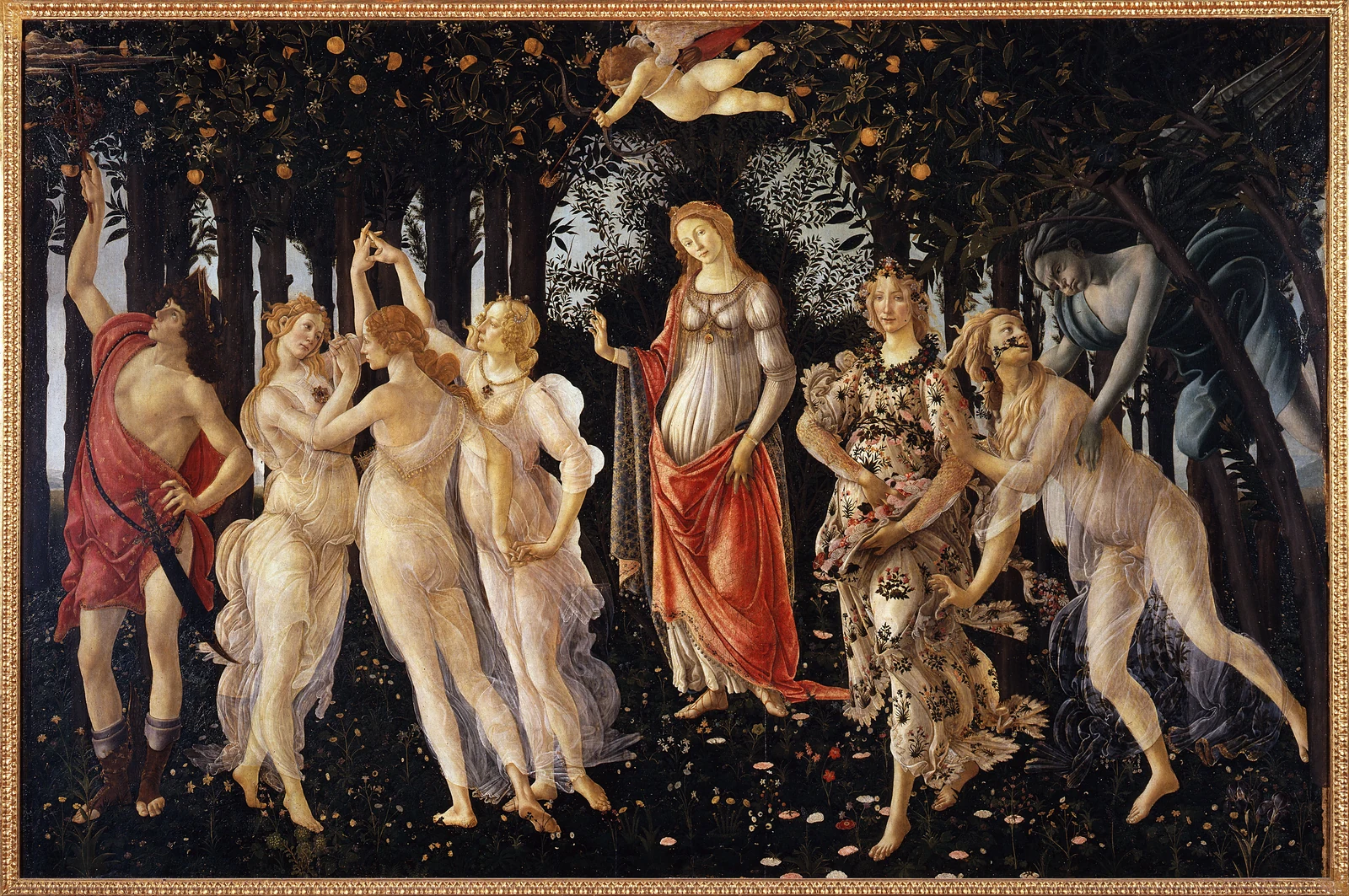
This is not just a painting about spring. Botticelli turns a mythological grove into a controlled procession of desire, fertility, and courtly order. Primavera is one of the most famous and most debated images of the Early Renaissance. A first-time viewer can enjoy it immediately as a beautiful pageant. A slower reader discovers something denser: nine figures, several myths, and a work that seems decorative only because Botticelli makes complexity look effortless.
How to read Primavera without getting lost
The fastest way to read the painting is to divide it into three zones rather than memorizing every name at once. At the right, Zephyrus chases Chloris and her transformation into Flora turns violent desire into flowering abundance. In the center, Venus and Cupid stabilize the whole grove. At the left, the Three Graces and Mercury turn that energy into courtly rhythm, elegance, and restraint.
That reading method matters because Primavera is built laterally, not as deep space. You do not enter the grove as if it were a window onto nature. You move across it figure by figure, almost like reading a visual poem from right to left.
- Right: desire arrives as force, pursuit, and metamorphosis.
- Center: Venus keeps the whole scene from flying apart.
- Left: love becomes measured grace, gesture, and cultivated distance.
- Everywhere: flowers, hair, and drapery keep the surface moving like choreography.
What Botticelli is trying to do
The painting was likely made for a Medici-connected domestic setting, not for a church. The Uffizi notes that it once hung above a lettuccio in the house of Lorenzo di Pierfrancesco de' Medici's heirs, and Giorgio Vasari later described it together with The Birth of Venus at the Villa di Castello. That setting matters because Botticelli is not illustrating myth for antiquarian interest alone. He is building a cultured image for viewers used to poetry, allegory, and courtly conversation.
Art historians still debate the exact program, and that uncertainty is part of the work's fascination. But the basic force is clear. Botticelli turns spring into a visual language for fertility, erotic awakening, civic refinement, and controlled abundance. The painting invites interpretation without collapsing into one fixed message.
Why Venus holds the center
Venus is not the largest figure, but she is the hinge of the whole image. The trees behind her part slightly, creating a halo-like opening that gives her a calm, governing authority. To her right, desire is turbulent and transformative. To her left, it becomes measured grace and courtly poise. She is the point where energy is ordered rather than merely felt.
Cupid above her complicates that calm. His blindfolded arrow points toward the Graces, which means love in this world is never fully rational or controllable. Botticelli therefore balances serenity with risk: the grove looks harmonious, but its harmony depends on forces that remain unstable.
Botticelli's real medium is line
What makes Primavera feel so distinctive is not perspective depth or sculptural weight. It is contour. Hair, drapery, hands, and floral patterns all move in long rhythmic curves. Botticelli wants you to feel the picture as a sequence of elegant transitions rather than as a set of bodies planted in measurable space.
That is why the figures can feel elongated, almost weightless, without losing authority. Their plausibility is not anatomical in the later High Renaissance sense. It is choreographic. Botticelli paints grace as rhythm, and the myth works because that rhythm never breaks.
The comparison that clarifies it fastest
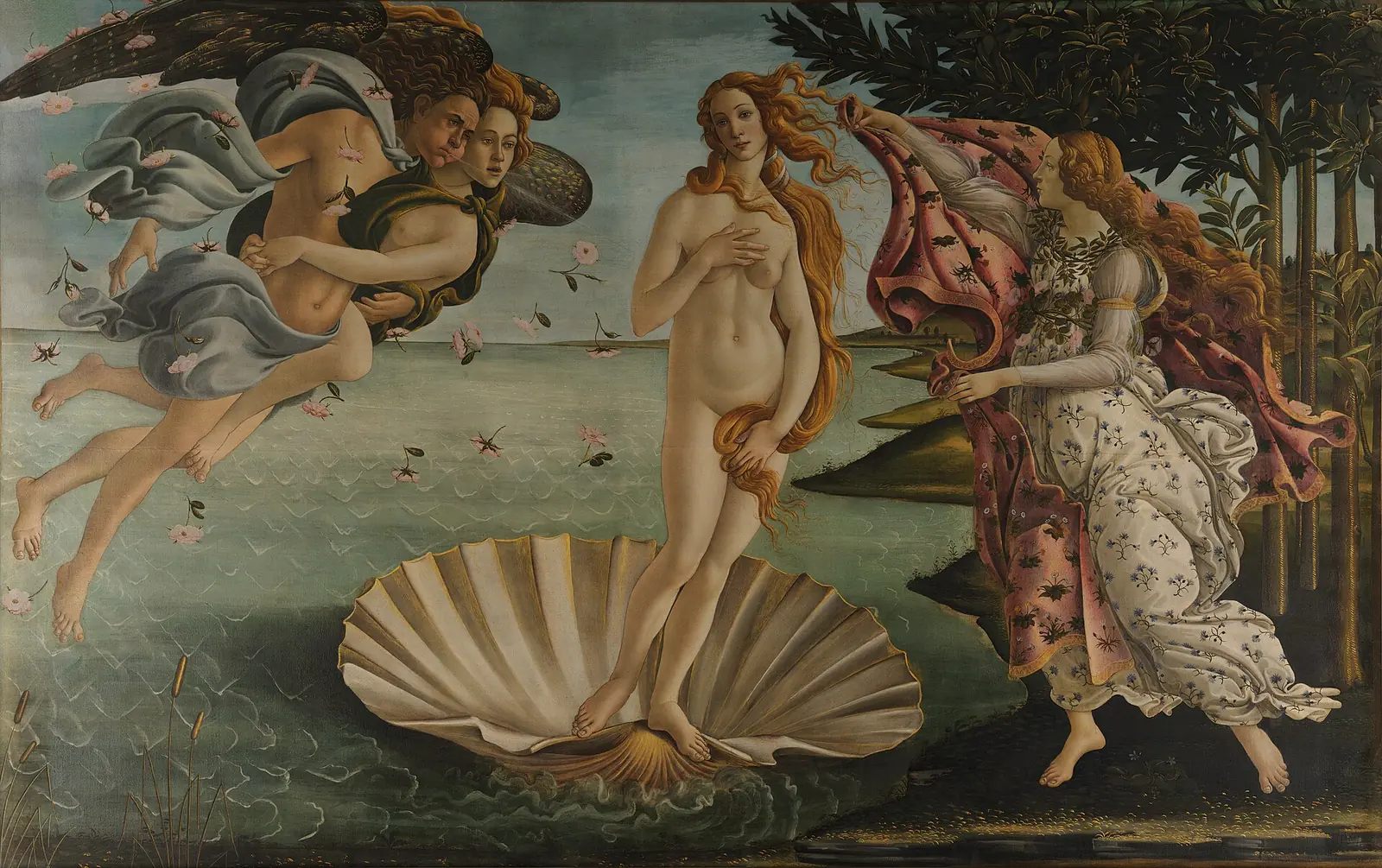
The most useful comparison is The Birth of Venus. Both paintings belong to Botticelli's mythological world and both likely moved in Medici circles. But The Birth of Venus isolates one arrival scene with ceremonial clarity, while Primavera is denser, more crowded, and more enigmatic.
That difference is practical, not just stylistic. In The Birth of Venus, you grasp the whole situation in a few seconds: Venus arrives, attendants receive her, the sea and wind frame the event. In Primavera, Botticelli slows you down. You have to work out a sequence, compare gestures, and understand that the painting is organized less like a single episode than like a chain of linked states.
Why Primavera matters so much
Primavera matters because it shows that Renaissance painting was never just a march toward realism. Botticelli proves that an image can be intellectually ambitious, visually unforgettable, and deliberately resistant to one final explanation. That combination is rare. It is also why the painting rewards both newcomers and very informed viewers.
If you continue from here, stay in the same orbit: move next to The Birth of Venus, then to Sandro Botticelli and the Early Renaissance. The art quiz can then serve as a quick recognition test.
Explore more
Related works
Primary sources
Frequently asked questions
The painting is usually read as a sequence of nine mythological figures: Mercury, the Three Graces, Venus, Cupid, Zephyrus, Chloris, and Flora. Botticelli arranges them across the panel like a living frieze.
Venus stabilizes the image. She stands between the turbulent transformation at right and the measured elegance at left, so the grove feels ordered around her presence.
The Birth of Venus isolates one arrival scene, while Primavera stages several mythological actions at once. It is denser, more symbolic, and harder to reduce to one clean narrative.