
Movement Guide
Early Renaissance
Early Renaissance art begins when painters stop treating the picture as a sacred sign alone and start treating it as a world that bodies can inhabit. Space deepens, figures gain weight, architecture starts to organize belief, and narrative becomes something the viewer can follow through the logic of the image rather than by inherited convention alone.
That is why the Early Renaissance matters so much. It is not a weak prelude to later masterpieces. It is the laboratory in which Renaissance art builds its basic grammar: coherent space, plausible bodies, clearer storytelling, and a new relationship between ancient form, Christian meaning, and civic ambition.
Florence becomes a workshop for new visual rules
The period unfolds inside a specific social world of workshops, patrons, churches, guilds, and urban rivalry. Images are still asked to teach devotion and support public life, but the means begin to change. Painters, sculptors, and architects start testing how geometry, observation, and classical reference can make scenes more convincing without making them less meaningful.
This is what gives the movement its charged instability. Medieval inheritance does not disappear overnight. Gold-ground habits, linear elegance, emblematic clarity, and symbolic hierarchy remain active. What changes is that these older tools are gradually forced to coexist with new demands for depth, bodily presence, and spectator-centered space.
The real breakthrough is not style but intelligible space
People often summarize the Early Renaissance by mentioning perspective, as if one technical discovery solved everything. The deeper shift is broader. Artists are learning how to make the image think spatially. Architecture begins to hold narrative together, bodies occupy ground more credibly, and gestures start to travel across space with more causal force. The picture stops feeling like stacked significance and starts behaving more like an organized environment.
That is why this phase feels exploratory rather than settled. Systems are being built in public. The period is valuable precisely because you can still see the trial process: one image pushes depth further, another clarifies gesture, another tests classical subject matter, another tightens compositional order. The intelligence of the movement lies in accumulation.
Botticelli shows how old grace and new order can coexist
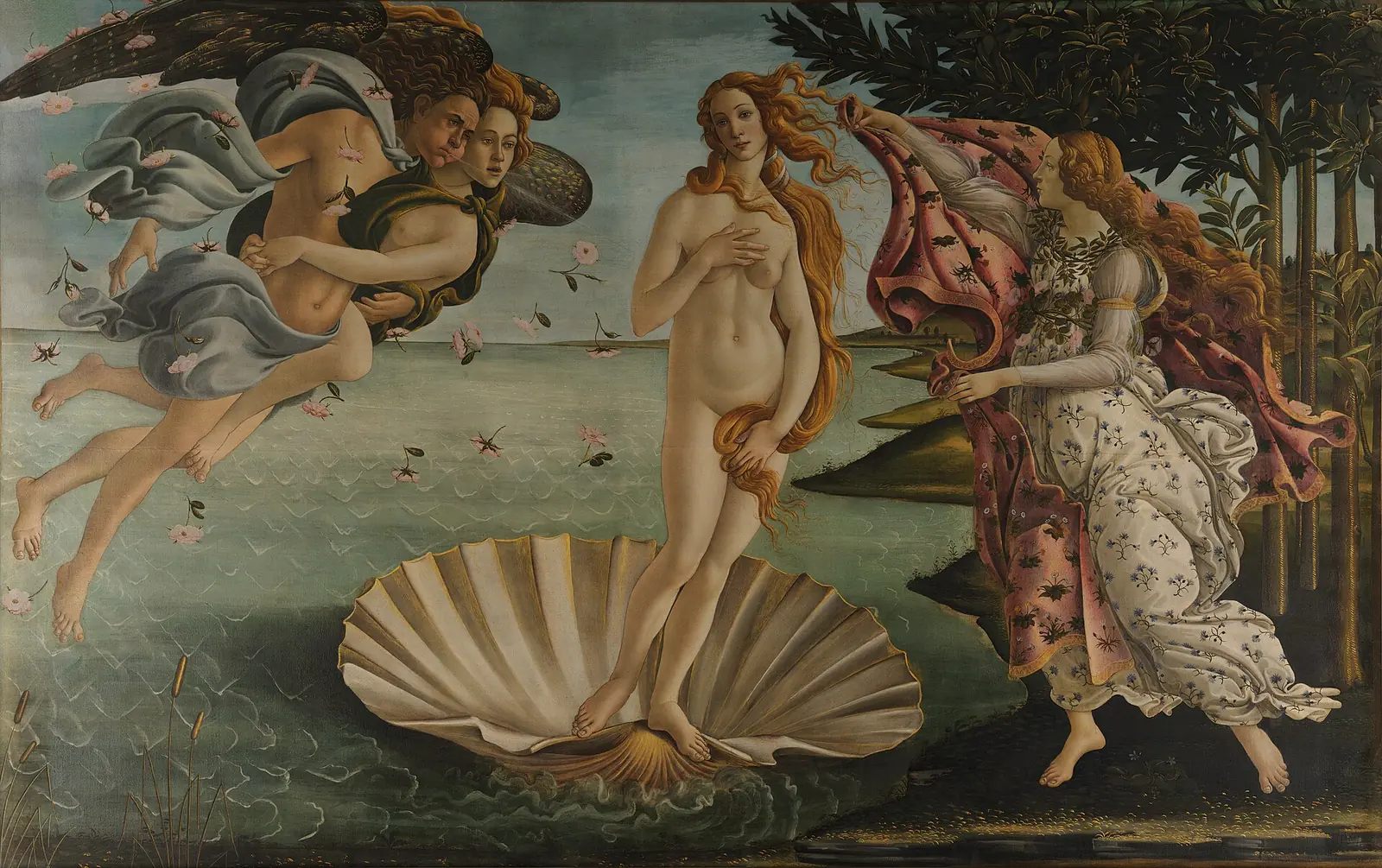
Sandro Botticelli is especially useful here because his paintings make the transition visible without pretending that all problems are solved. In The Birth of Venus, mythological subject matter, elegant contour, and measured spacing create a new kind of image: antique in theme, Christian-era in moral seriousness, and Renaissance in the way the scene is organized for sustained looking.
The painting matters not because it achieves later Renaissance naturalism, but because it proves that myth, bodily idealization, and measured pictorial order can cooperate. The scene is still stylized, yet that stylization is no longer medieval flatness. It is part of a new visual language that wants clarity, rhythm, and legible presence.
Primavera makes the movement look like a thinking system
Primavera pushes the same world into a denser register. Instead of a single, isolated apparition, Botticelli builds a mythological field where sequence, symbolic overlap, and courtly culture all matter at once. The figures read almost like a frieze, yet the painting asks for slow parsing rather than instant decoding.
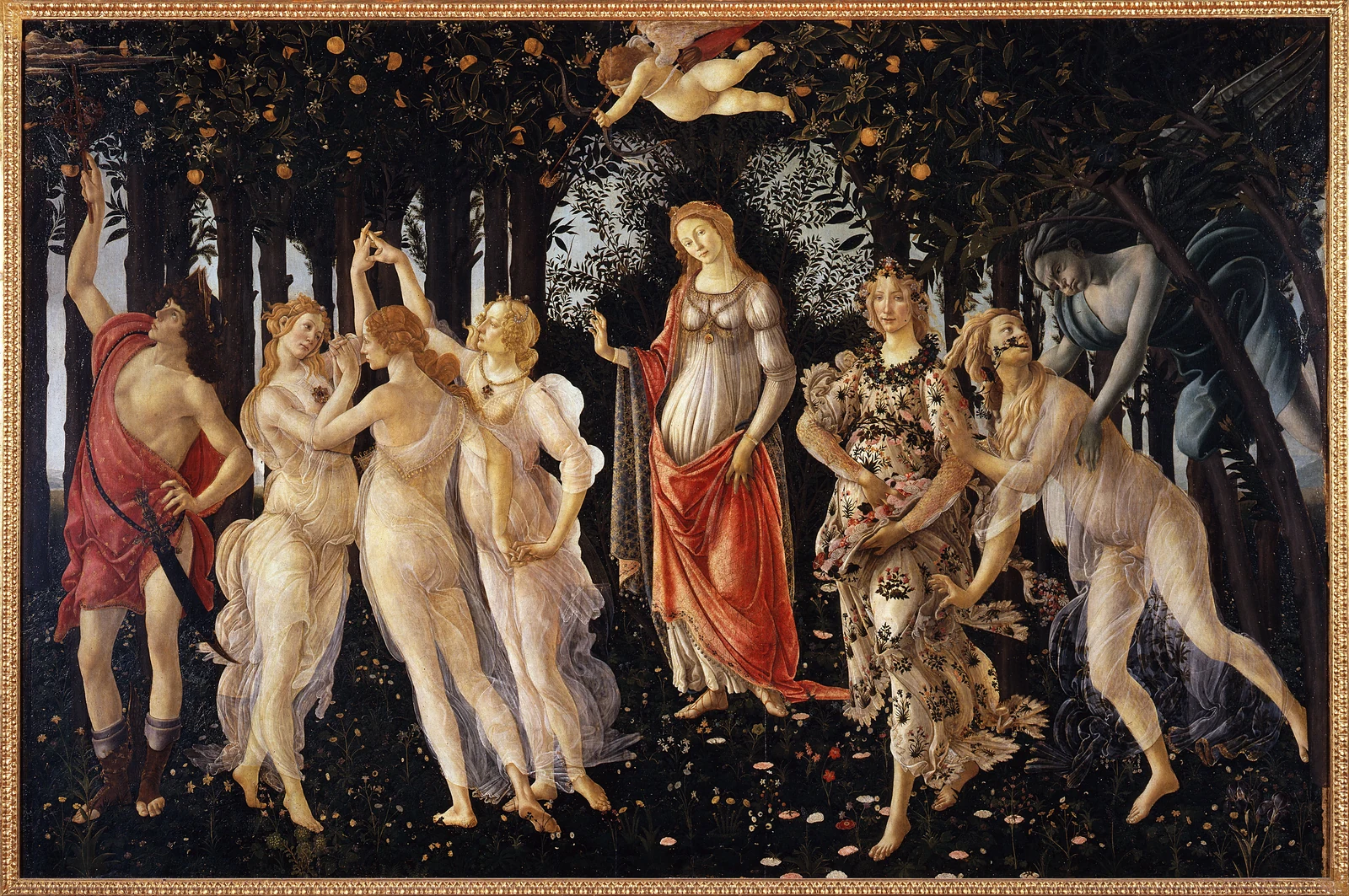
Read beside The Birth of Venus, it becomes easier to see the movement properly. The Early Renaissance is not just about making things look real. It is about making images more structurally readable while expanding what they can hold: myth, philosophy, civic identity, devotional instruction, and court culture in the same visual field.
How to read a transitional image without calling it inconsistent
- Look for the geometric armature first: horizon, architectural frame, or figure arrangement.
- Then ask which older habits remain visible: linear stylization, symbolic emphasis, or devotional hierarchy.
- Track where bodies gain weight, volume, and relation to shared ground.
- Treat any friction between old and new not as failure, but as evidence of invention in progress.
This is the best way to avoid a lazy period story where the Early Renaissance simply waits to become the High Renaissance. What later looks inevitable was built here through repeated trial, workshop transmission, and competitive refinement.
Legacy: the laboratory behind later harmony
Once you read the period this way, the later Renaissance and High Renaissance become easier to judge accurately. Their calm authority is not a spontaneous miracle. It depends on an earlier century of experiments in space, body, gesture, and visual order. Works such as The Last Supper only feel so integrated because this earlier phase had already built the conditions for such integration.
That is the movement's real legacy. The Early Renaissance shows how visual revolutions actually happen: not through one single breakthrough, but through iterative comparison, institutional pressure, and many visible attempts to make images think in new ways.
Key artists in Explainary
Key works in Explainary
A strong route through this movement is to start with The Birth of Venus, then compare it with Primavera, then move forward to High Renaissance. That sequence makes the early phase look less like a preface and more like the place where the visual terms of the Renaissance are actively being built.
Use the art quiz as a quick check: can you recognize the Early Renaissance not by a single style formula, but by its visible negotiation between older devotional habits and new spatial intelligence?
Primary sources
Frequently asked questions
No. The Early Renaissance is not a weak preliminary stage. It is the phase where new systems of space, proportion, and narrative legibility are actively being invented, tested, and argued over.
Because the period is transitional by design. Older devotional conventions, symbolic hierarchies, and linear elegance remain visible while artists build more coherent space, heavier bodies, and more viewer-centered storytelling.