
Romanticism
Wanderer above the Sea of Fog
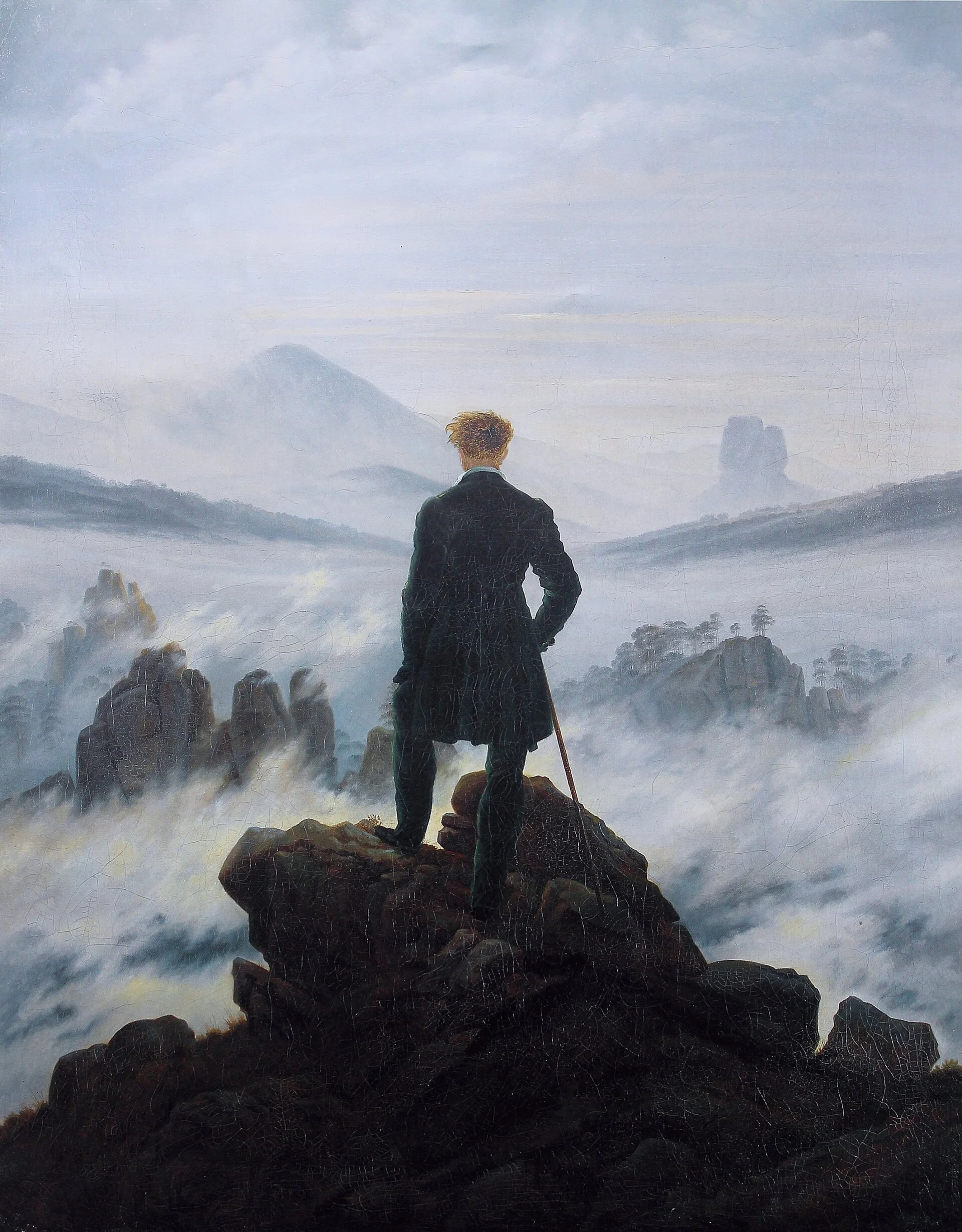
Wanderer above the Sea of Fog looks like a picture of mastery. It is really a picture of incomplete vision. Friedrich places one man on firm rock, cane in hand, but everything beyond him breaks into mist, fragments, and uncertain depth. The painting does not show nature fully possessed. It shows what it feels like to stand before more than you can clearly know.
That is why the image has lasted. It does not simply celebrate landscape or heroic individuality. It makes looking itself the subject, using the back-turned figure, the composed mountain view, and the logic of Romanticism to turn uncertainty into structure.
Not one real panorama, but a composed landscape
The painting feels topographically convincing, yet it is not a direct transcription of one place. Friedrich made drawings in the Elbe Sandstone Mountains, then recombined those motifs in the studio. Art historians can still trace several of the rocky forms, but the final landscape is assembled rather than copied. It is a composite landscape.
That matters because the picture is not trying to document a summit view. Friedrich wants a more exact arrangement than a single real lookout could provide. Foreground rock, drifting mist, and scattered ridges are organized so that certainty keeps breaking and re-forming. The landscape is built to produce a mental experience, not to prove a location.
The force of the back-turned figure
The famous device here is the Rückenfigur, the figure seen from behind. Friedrich uses it with unusual force. Because we cannot read the wanderer's face, we do not receive a fixed emotion. Instead, we share a stance. We are asked to stand where he stands while remaining unsure what exactly he feels.
The composition makes that identification easy. The dark coat cuts sharply against the pale fog, the figure sits near the painting's central axis, and the mountain lines appear to gather around him. He seems commanding at first glance. Yet the missing face and broken horizon prevent the scene from becoming a triumph portrait. The image stays open to pride, awe, hesitation, loneliness, or a mix of all four.
The sublime without total mastery
This is where the painting belongs fully to Romantic art. The landscape is not a neutral backdrop. It is a place where reason reaches a limit. Rock underfoot offers local stability, but the fog refuses total overview. The world opens magnificently and withholds itself at the same time.
That is the painting's version of the sublime. It is not a postcard and not pure terror. It is the experience of feeling mentally enlarged and visually checked in the same instant. In the years after the Napoleonic upheavals, that combination of aspiration and uncertainty had unusual force. Friedrich does not paint explicit politics here, but he does paint a culture trying to orient itself again.
Mountains in the Romantic imagination
The mountain matters here because Romantic culture no longer treated high ground simply as hostile terrain or useful topography. Mountains had become privileged places for testing the self: places of altitude, exposure, isolation, and expanded vision. They offered the promise of elevation, but also the reminder that elevation does not produce total control.
Friedrich uses that new mountain imagination with unusual precision. The summit gives the wanderer a commanding position, yet the sea of fog strips away mastery at the exact moment it seems to be granted. That tension is thoroughly Romantic. The mountain is where the subject rises, but also where the world proves larger than the subject.
A useful comparison: Friedrich and Munch
A productive comparison is The Scream. Edvard Munch also made one of the great modern images of subjectivity, but he does it in the opposite way. Munch pushes anxiety into a face and a cry; Friedrich removes the face and pushes pressure into viewpoint, distance, and weather.
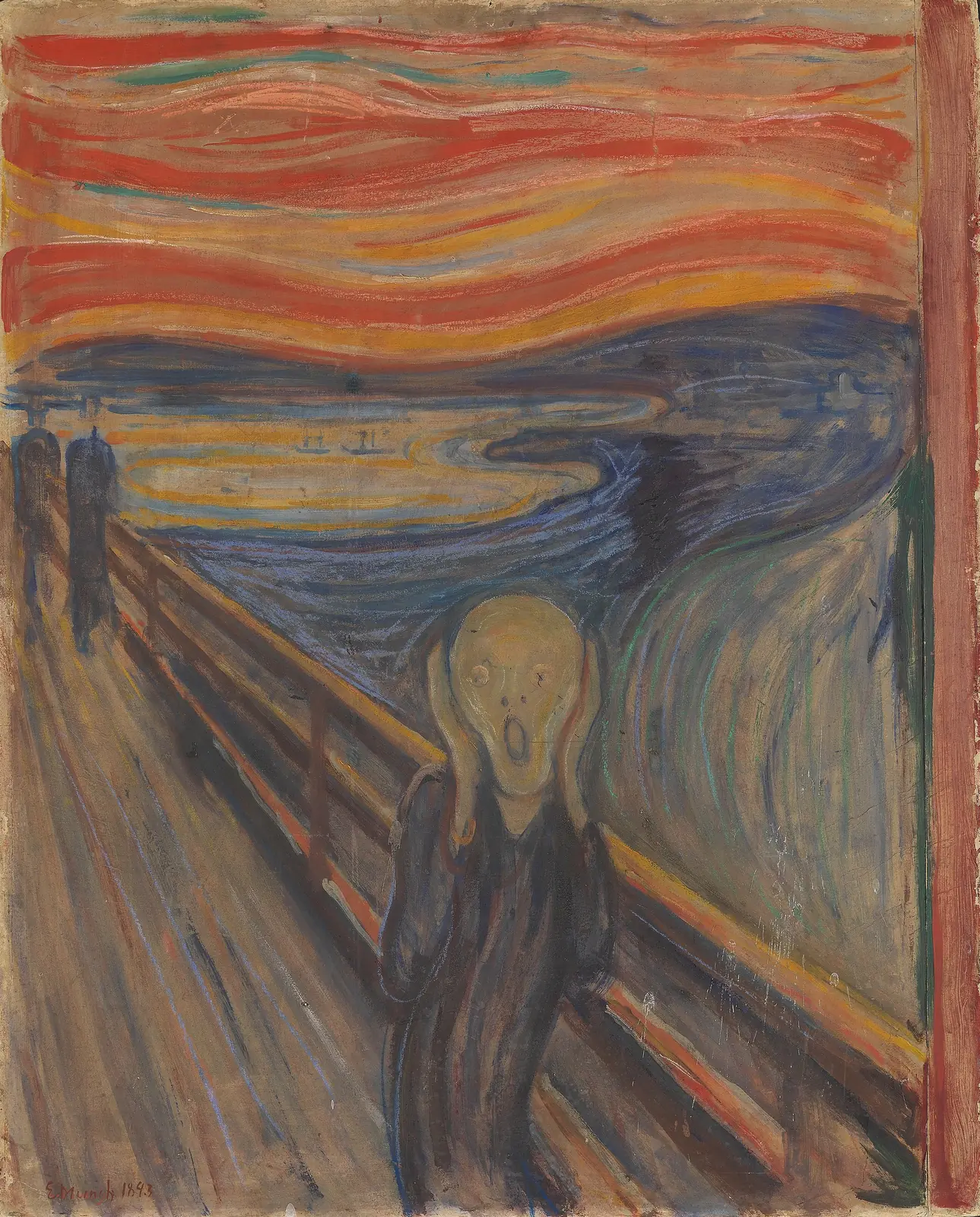
That difference clarifies what is special here. Wanderer above the Sea of Fog is not an emotional outburst disguised as landscape. It is a highly controlled way of turning landscape into inward experience without ever leaving the external world.
An image with unstable scale
The figure first feels large because Friedrich gives him the strongest contrast in the painting: dark coat against white mist, sharp outline against dissolved distance. We lock onto him immediately. But once the eye begins moving across the ridges, the effect changes. The landscape keeps extending, and the wanderer begins to look less like a conqueror than a temporary measure inside something much larger.
That instability is essential. The painting lets the human subject feel central for a moment, then quietly removes that privilege. It is one reason the image remains richer than a simple heroic summit scene. Friedrich makes scale itself think.
A picture with a long afterlife
The painting survives so well because its structure is endlessly reusable. The Hamburger Kunsthalle's Friedrich project is right to call it one of the most referenced works of art ever made and a template for countless travel photographs. One figure from behind, a high viewpoint, unstable weather, and a withheld face: the formula is simple enough to repeat and rich enough to stay suggestive.
Its afterlife is not limited to tourism. Contemporary artists such as Kehinde Wiley and Elina Brotherus have reworked the image openly, because Friedrich's model still fits modern questions about identity and self-projection. The painting offers a way to show a self through a viewpoint rather than through exposed expression. That is one reason it keeps moving so easily between museum culture, popular imagery, and contemporary art.
Friedrich does not give the wanderer a face; he gives him a position in space.
Reading paths from Wanderer above the Sea of Fog
To widen the picture, go next to Friedrich, then to Romanticism, then across to The Scream and The Raft of the Medusa. That sequence makes a useful distinction: inward uncertainty, social disaster, and modern anxiety are related, but they are not staged the same way. After that, try the art quiz.
Primary sources
Frequently asked questions
A Rückenfigur is a figure shown from behind. Friedrich uses it to let viewers share a point of view without locking the meaning to one visible facial expression.
Not as a single view. Friedrich drew motifs in the Elbe Sandstone Mountains, then recomposed them into a composite landscape. The final panorama feels real, but it does not exist as one exact lookout.
The turned back keeps the figure open. Instead of reading one face, viewers project themselves into the stance, which makes the painting less like a portrait and more like an experiment in seeing.
The image combines a memorable silhouette, a striking high viewpoint, broken visibility, and open meaning. That mix made it a central Romantic painting and a lasting template in modern visual culture.
The painting is in the Hamburger Kunsthalle in Hamburg.