
German Expressionist
Ernst Ludwig Kirchner
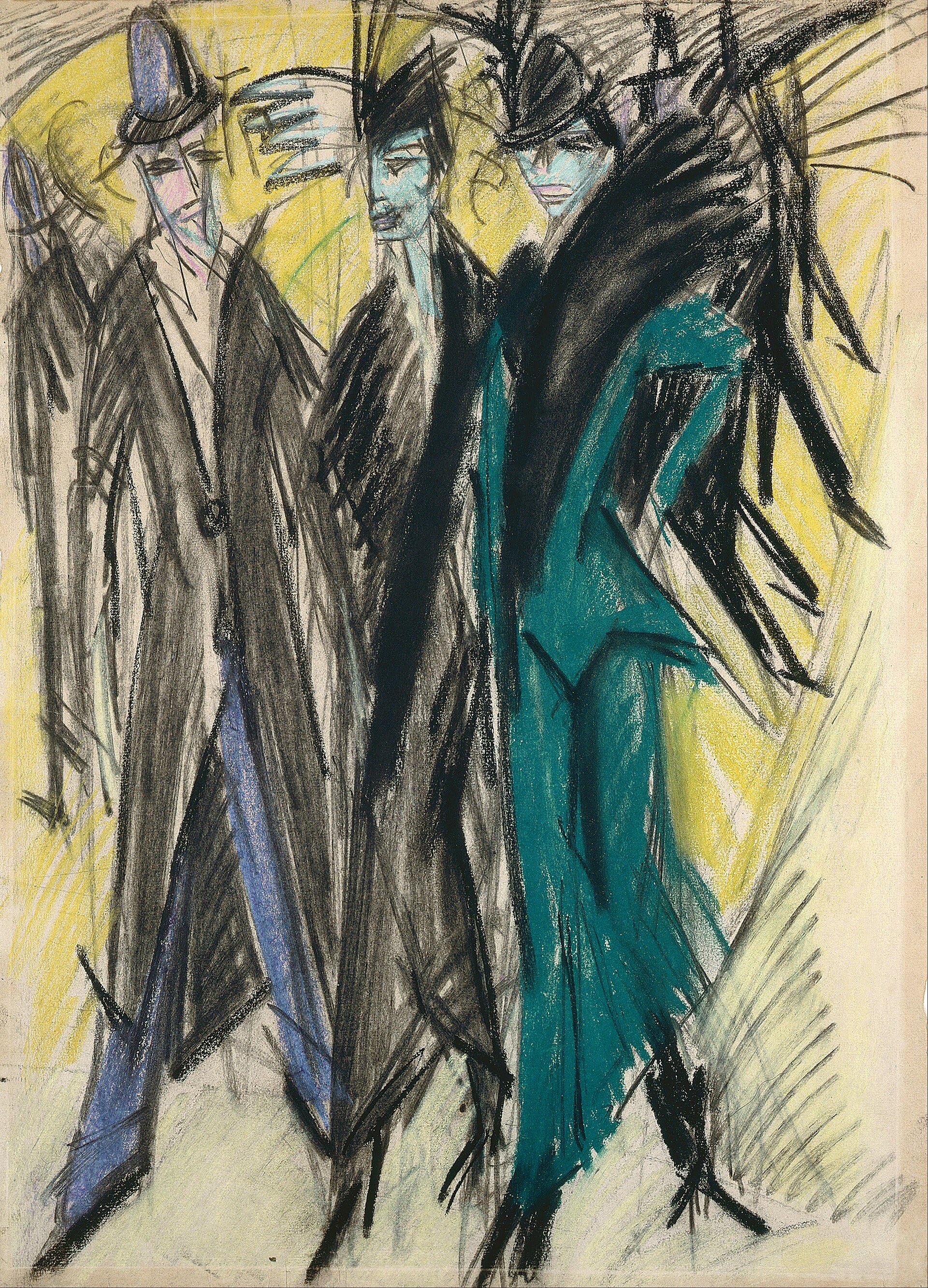
Kirchner did not use distortion as decoration. He used it to make modern life look as strained as it felt. That is why he remains one of the clearest ways into German Expressionism. From Die Brücke to the Berlin street scenes and the late Davos paintings, his line keeps turning bodies, streets, and landscapes into sites of pressure.
This page makes the most sense if you hold three things together. Kirchner is a group artist before he is a solitary genius. He is the painter who gives metropolitan life one of its hardest early twentieth-century forms. And he is also a case study in what war, persecution, and exile do to an artist without reducing the work to biography alone.
Dresden: a movement born in the studio
Kirchner studied architecture in Dresden, where he met Erich Heckel, Karl Schmidt-Rottluff, and Fritz Bleyl. In 1905 the four friends founded Die Brücke. The name was not decorative. They wanted a bridge away from academic finish and toward something more immediate, more collective, and more visibly alive.
That shared beginning matters. Kirchner's art grows out of studio life, communal experiment, and print culture as much as out of private temperament. The group looked closely at medieval German woodcuts and at African and Oceanic objects then circulating through ethnographic museums. The result is a harder language of contour and color: flatter planes, sharper cuts, and a rougher surface that rejects polite finish.
Berlin makes the paintings harder
When Kirchner moved to Berlin in 1911, the work became faster and more abrasive. Berlin offered cabarets, department stores, prostitution, fashion, and the constant pressure of circulation. He did not treat the modern city as a neutral backdrop. He treated it as a machine for exposure: people passing close to one another while remaining socially separate.
This is also the phase in which the group begins to fracture. Kirchner's 1913 Chronicle of Die Brücke overstated his own role and helped push the movement toward breakup. The tension shows in the paintings. Public life no longer looks open or festive. It looks brittle, electric, and faintly predatory.
Why Street, Berlin matters so much
Street, Berlin keeps Kirchner's social and formal intelligence in one frame. The scene is crowded, but not communal. Two fashionable women dominate the foreground, while the men around them repeat like units inside a system of quick glances, money, and movement. The city is busy; the painting is lonely.
The picture matters just as much formally. The tilted ground, sharp contour, and acid color refuse the visual comfort that an older city painting might offer. Compare it with Bal du moulin de la Galette and the shift is obvious. Renoir paints public sociability. Kirchner paints public stress.
War, collapse, then Davos
Kirchner volunteered for military service in 1915, but the experience ended quickly in psychological collapse. Sanatoria, medication, and a long period of instability followed. The war does not explain everything in his art, but it changes the stakes. After 1915, the nervousness in the work is no longer only social. It is personal as well.
From 1917 onward, Switzerland becomes decisive. Davos changes the setting, but it does not erase the pressure. The late Alpine paintings may look calmer at first glance, yet they still rely on hard contour, tilted construction, and strong artificial color. Kirchner does not abandon modern tension in the mountains. He relocates it.
What Kirchner changed in painting
Kirchner matters because he makes style function as explanation. His contour behaves like a cut. His color does not imitate daylight so much as emotional temperature. His space refuses stable rest. All of that means distortion is not a theatrical extra laid on top of the subject. It is the way the subject becomes readable.
That is why he remains so useful beside Edvard Munch, The Scream, or our essay on Impressionism vs. Expressionism. Kirchner shows what happens when modern painting stops asking only how the world looks and starts asking how the world presses on the body looking at it.
Legacy after Kirchner
Kirchner's legacy is double. Inside art history, he keeps Expressionism from shrinking into vague emotional intensity. He shows that jagged line, acid color, and unstable space can analyze crowds, commerce, desire, and social exposure with unusual precision.
His impact also runs forward. Later expressionist and neo-expressionist painters return to him for speed, contour, and the refusal of polite finish, while museum histories of modernism keep returning to the Berlin pictures to explain how the city becomes a psychological subject. Kirchner still matters because he teaches viewers to read pressure as form.
Reading paths from Kirchner
A strong route is simple: begin with Street, Berlin, move out to Expressionism, then compare Kirchner with Munch and The Scream. That path makes it easier to see what is specifically Kirchner's: less solitary despair than Munch, more social pressure embedded in the look of the paint itself.
Primary sources
Seen that way, Kirchner matters less as a tragic biography than as one of the artists who made modern pressure legible.
Frequently asked questions
Kirchner is central because he makes distortion do analytical work. His jagged contour, acid color, and unstable space turn modern life into visible strain rather than decorative style.
Street, Berlin matters because it shows Kirchner at full intensity: the city becomes a system of glances, money, speed, and isolation. It is one of the clearest paintings of metropolitan pressure before World War I.
Only on the surface. The late Alpine pictures are quieter in subject matter, but they still rely on hard contour, tilted space, and strong artificial color. Davos changes the setting more than the underlying tension.
The Nazi regime treated Kirchner's art as "degenerate" because Expressionism clashed with its official ideals of order, naturalism, and ideological control. Hundreds of his works were removed from German museums in 1937.