
Expressionism
The Scream
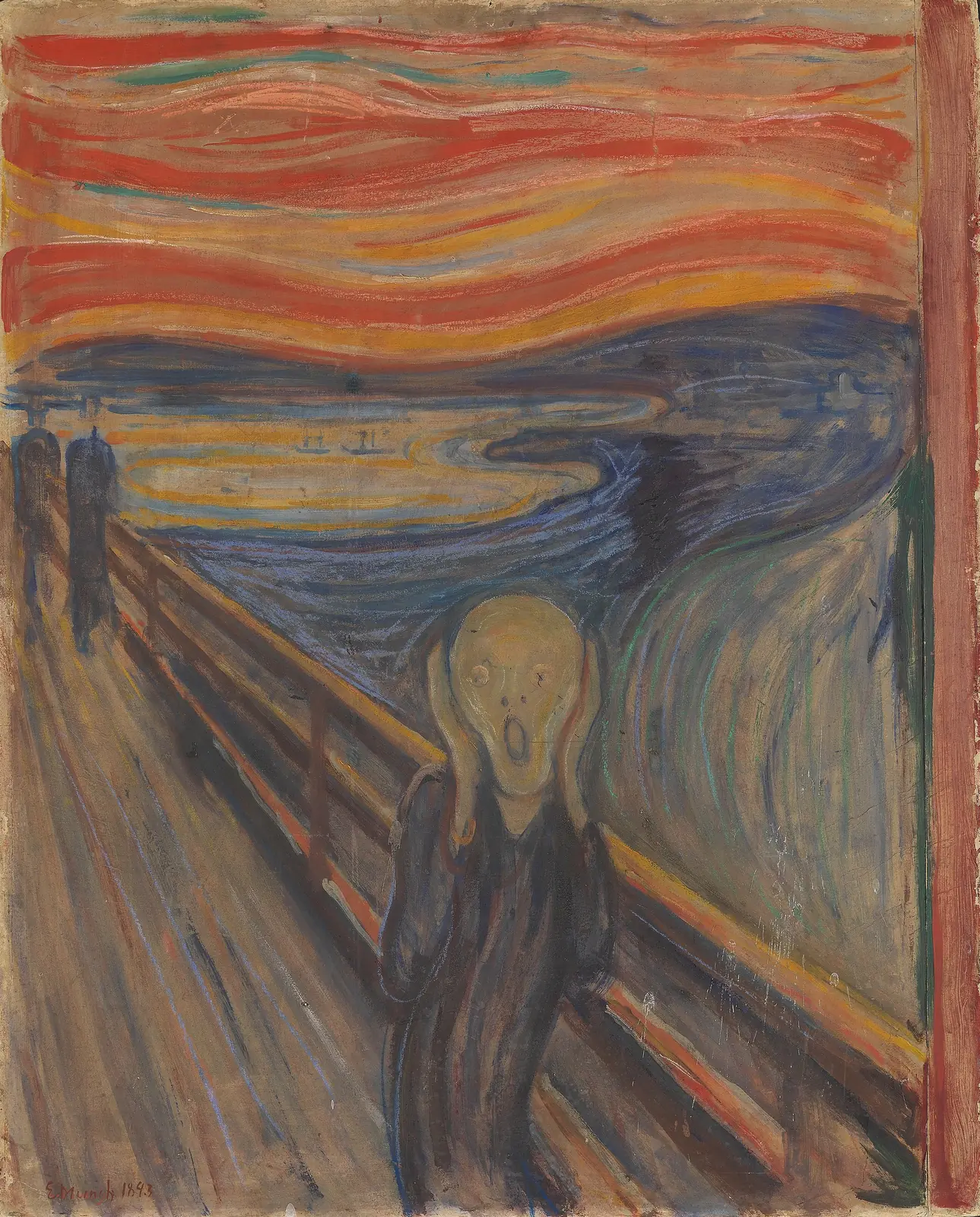
On a bridge at dusk, the sky ripples and the figure becomes the shape of anxiety. The Scream does not rely on facial expression alone. Edvard Munch makes line, color, and perspective carry panic before the viewer has fully decoded the face.
The meaning in one view
The Scream turns anxiety into an environment. The figure may be screaming, but Munch's own account also points to a scream passing through nature. Read the painting through the bridge, the vibrating sky, and the distorted body before reducing it to an emoji-like face; that structure is what connects it to Expressionism.
What the painting shows
At the center stands a figure on a bridge or walkway, hands pressed to the face, with two smaller figures receding in the background. Behind them stretch the fjord, the shoreline, and a violently agitated sky. Even without prior knowledge, the scene is easy to grasp: one body is overwhelmed while the world around it seems to vibrate in sympathy.
That clarity matters. Munch is not telling a complicated story with many actors. He reduces the image to a few essential elements so that the emotional effect lands immediately. The figure is almost mask-like, less an individual portrait than a vessel for fear.
Munch's context
The Scream was first painted in 1893, during the period when Munch was developing the cycle later known as The Frieze of Life, in which love, anxiety, illness, and death are treated as connected themes. The painting belongs to the broader history of Expressionism, but it also predates the classic German movement and helps explain why emotion would become such a central modern subject.
Munch also left a famous written account of the experience behind the image: he described walking at sunset, feeling exhausted, and sensing "a great scream through nature." Whether the figure is producing the cry or hearing it is deliberately unclear. That ambiguity is one reason the image remains so effective.
How the composition makes panic visible
The painting is built on a clash between straight and curved lines. The bridge railing is rigid, almost architectural, while the sky and fjord move in waves that seem to pass through the figure. That contrast is the basic structure of the image: fixed order against inner collapse.
Color does the same work. The orange-red sky presses against the blue water and dark bridge, creating tension even before the viewer focuses on the face. The two distant figures keep walking, and their calm presence makes the foreground panic feel more isolated. Munch turns anxiety into a total environment rather than a single gesture.
What to look at first
- Follow the diagonal railing before looking at the face.
- Notice how the sky repeats the curves of the head and body.
- Compare the stillness of the two background figures with the instability of the foreground figure.
- Watch how color carries emotional pressure, not just description.
A good first reading is to ignore the face for a moment and ask whether the painting still feels anxious through the railing, the horizon, and the color bands alone. If it does, you are already seeing Munch's method at work.
Versions and legacy
There is not just one Scream. Munch returned to the motif in painting, pastel, and print, which helped circulate the image widely during his lifetime. That repetition matters because it shows the work was not a single accident of inspiration. It was a motif Munch understood as central to his art.
The image became one of modern culture's most recognizable symbols because it stays legible under reproduction. Its distortions are simple enough to remember and strong enough to survive posters, textbooks, memes, and museum branding. If you want to understand that afterlife, the best next stop is Why Art Goes Viral. The art quiz is a useful quick check afterward.
Explore more
Related works
Primary sources
Frequently asked questions
The Scream converts panic into structure. Curved lines, unstable perspective, and violent color contrast make anxiety feel like part of the environment, not only a facial expression.
Munch described feeling a scream "passing through nature," which suggests the figure may be reacting to a cosmic sound rather than producing it. The ambiguity is part of the image's power.
Munch revisited the motif in different media, including tempera, pastel, and print, because he treated it as a central emotional theme. The repeated versions helped circulate the image widely during his lifetime.