
Realism / Musée d'Orsay
The Angelus
In short: Painted between 1857 and 1859, The Angelus shows two peasants pausing their potato harvest for the evening Angelus prayer. Its meaning lies in the way Jean-François Millet turns ordinary rural labor into a scene of silence, dignity, memory, and shared time.
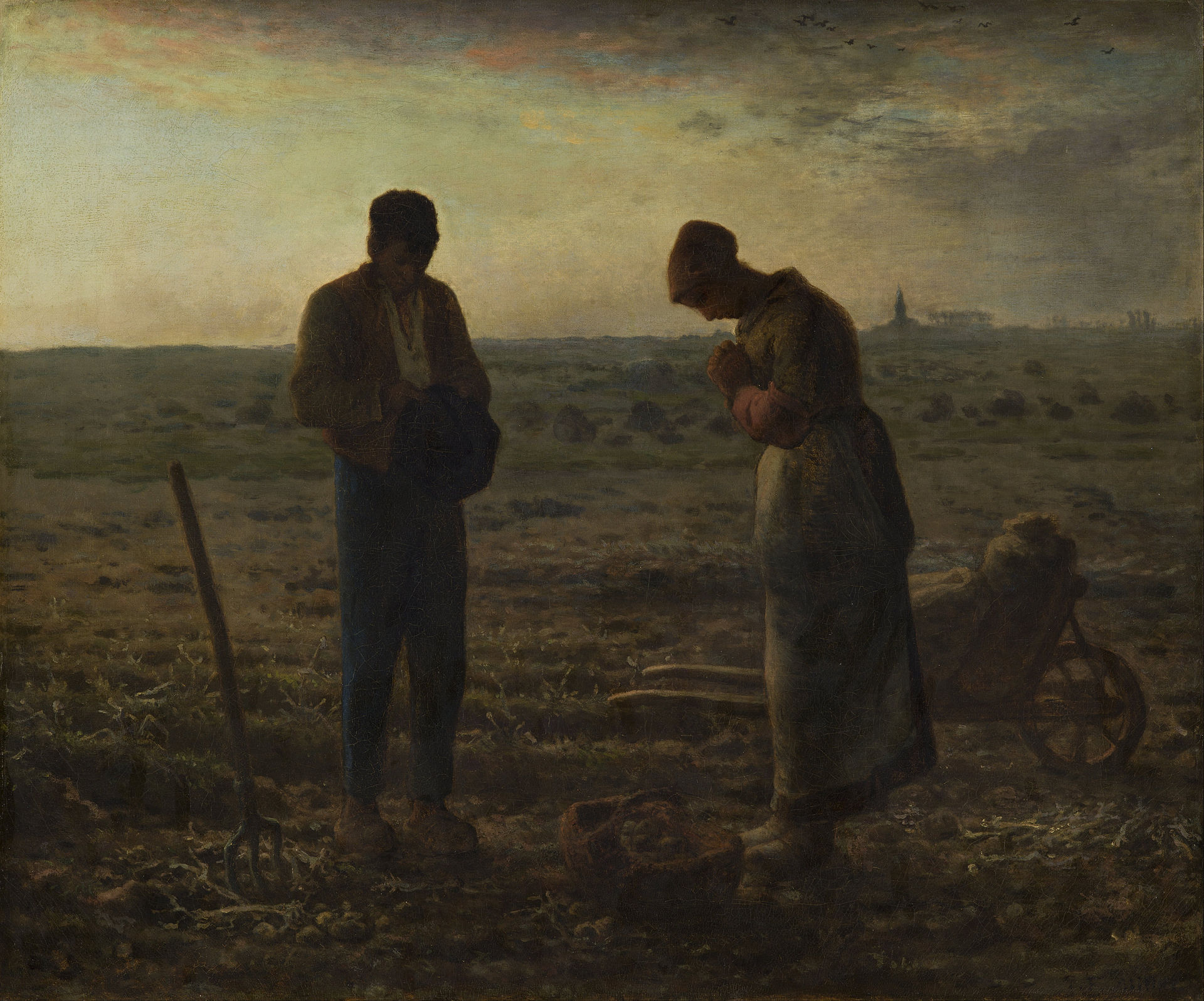
A man and a woman stand in a potato field, heads lowered, while a church spire almost disappears on the horizon. Jean-François Millet makes almost nothing happen: work stops, hands fold, the evening light thins, and the field goes quiet. Yet this small canvas became one of the most charged rural images of the nineteenth century.
The Angelus is powerful because it turns a pause into structure. The workers are not idealized saints, but their stillness gives them weight. The tools around them keep the scene attached to labor, while the distant bell implied by the prayer opens the image toward memory, ritual, and collective time.
A small painting with an enormous afterlife
Millet painted The Angelus between 1857 and 1859. The Musée d'Orsay records it as an oil on canvas measuring 55.5 by 66 cm, far smaller than the huge public canvases often associated with major art. Its scale is intimate, but its effect is not small.
The work was commissioned around 1857 by Thomas Gold Appleton, who did not take delivery. It later passed through several collections before entering the French national collections through the Alfred Chauchard bequest in 1910. In 1986 it was assigned to the Musée d'Orsay. The painting's later history became unusually intense: patriotic enthusiasm, reproduction, Dalí's fascination, and even an attack in 1932 all gathered around this quiet image of rural prayer.
What the painting shows
Two peasants have stopped harvesting potatoes. The man stands on the left, cap in hand. The woman stands on the right, hands clasped, head bowed. Around them are a fork, a basket, sacks, a wheelbarrow, and the low earth of the field. Far back, on the horizon, a church steeple gives the silence a source: the evening Angelus bell.
Millet keeps the figures dark. Their faces are not opened for easy expression. The light catches their outlines, their posture, and the small zone of ground around them. The image therefore asks us to read bodies rather than psychology: bowed head, still hands, halted work, tools set aside.
Work interrupted by prayer
The Angelus prayer recalls the Annunciation, but Millet does not paint a sacred apparition. He paints ordinary people stopping in an ordinary field. According to the Orsay record, Millet later linked the painting to a childhood memory of his grandmother making the family stop work when the bell rang. The image grows from remembered rhythm more than from religious display.
The prayer does not erase labor. It interrupts it. The basket, sacks, fork, and wheelbarrow remain visible because the field is not a stage set for piety; it is the place where work will resume. Millet makes devotion and fatigue occupy the same ground.
Monumentality without scale
The canvas is modest in size, but the two figures become monumental because Millet isolates them in a broad empty plain. Nothing crowds them. The horizon sits low enough to make the sky expand, while the silhouettes rise like dark vertical forms against the evening light.
Millet's method is restraint: he leaves the faces in shadow, keeps the tools plain, and lets posture, distance, and light carry the meaning. The painting asks the eye to understand the pause through form rather than expression.
Millet gives rural workers gravity without dramatic action. He uses separation, stillness, and light. The faces stay shadowed, but the postures become unforgettable. The painting moves beyond anecdote because it makes one pause stand for a whole rhythm of rural life.
Memory, nostalgia, and Realism
The Angelus belongs inside Realism, but not because it copies the world with photographic accuracy. It is realist because it keeps ordinary rural bodies, tools, labor, and social time at the center of serious painting. Millet gives a field pause the seriousness usually reserved for religious, historical, or heroic subjects. The field is not decorative countryside. It is a place of work, pause, and repetition.
The painting also became vulnerable to nostalgia. Later viewers often turned it into an emblem of rural France, piety, or national memory. Millet's image can carry those projections because it is simple, but it is not empty. The tools, rough earth, and darkened bodies prevent the scene from dissolving into pure sentiment.
Why Salvador Dalí was fascinated by The Angelus
The painting's afterlife did not remain simply devotional or nostalgic. Salvador Dalí returned to The Angelus because he sensed something more disturbing in its stillness: the bowed figures, the distance between them, and the empty field seemed to hold an ambiguity that a simple reading as rural prayer could not exhaust.
Dalí's interpretation belongs to Dalí, not to Millet's documented intention. It shows how much pressure the image can hold. A painting built from restraint could become, for a modern artist, a scene of anxiety, desire, and projection. That fascination helped give The Angelus a second modern life beyond rural piety and national memory.
Where to look first
- Start with the bowed heads. The scene is built around interruption and inward attention.
- Move to the tools on the ground. They keep prayer tied to real work.
- Look at the church spire on the horizon. It explains the pause without becoming the main subject.
- Follow the evening light around the figures. The faces stay dark, but the postures become clear.
- Step back to the whole field. A small painting has become an image of work, memory, and shared time.
Beside The Gleaners
The Gleaners clarifies the difference. There, bodies bend through repeated survival labor while the main harvest remains in the distance. In The Angelus, the same rural world slows to a halt. One painting turns repetition into social pressure; the other turns interruption into gravity.
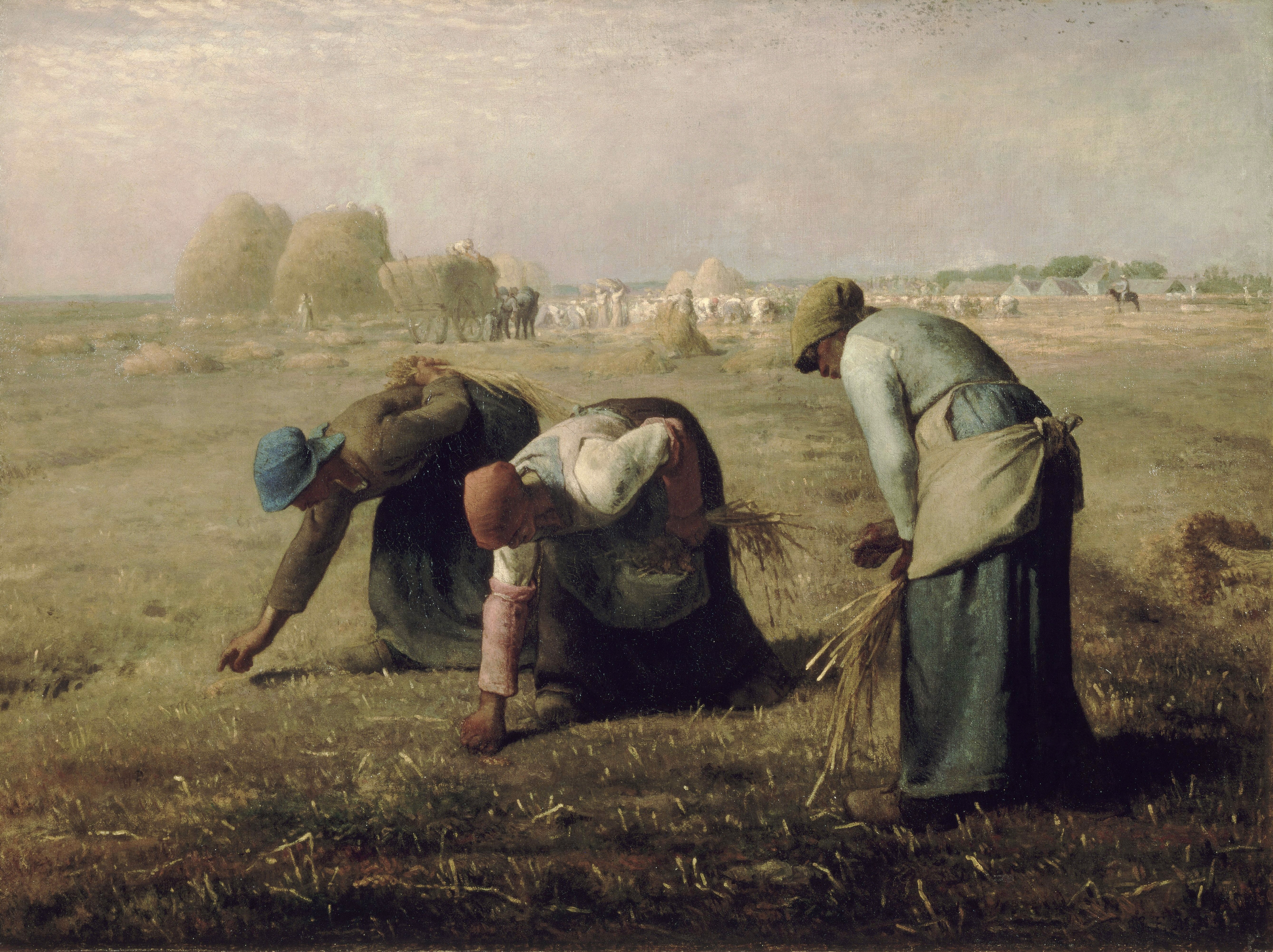
Read together, the two works show why Millet is not simply a painter of rustic feeling. He studies how rural life is structured by labor, season, poverty, custom, and bodily repetition. Prayer in The Angelus has force because it arrives inside that structure, not outside it.
Why the painting still holds attention
The Angelus remains compelling because it refuses easy drama. No miracle appears. No face explains itself. No narrative climax arrives. Instead, Millet lets an ordinary pause carry the pressure of work, memory, faith, fatigue, and evening light.
That restraint is the painting's strength. The field stays rough, the tools stay plain, and the figures remain almost anonymous. Yet the image is difficult to forget because the pause feels larger than the two people who enact it. Millet makes the sound of an unseen bell visible through still bodies.
The painting is not quiet because nothing happens. It is quiet because everything stops.
Continue from Millet
Primary sources
Frequently asked questions
The Angelus shows two peasants stopping work for prayer, but its meaning is wider than devotion. Millet turns an ordinary break in rural labor into an image of silence, dignity, memory, and collective time.
Yes, the painting refers to the Angelus prayer, traditionally recited at set times of day. Millet does not paint a miracle or apparition, however; he ties religious feeling to tools, labor, dusk, and daily routine.
They have paused the potato harvest for the evening Angelus bell. The distant church spire suggests the source of the call, while the tools and basket show that work will resume after the prayer.
Dalí saw a more disturbing and ambiguous tension in the painting than simple rural prayer. His interpretation was personal rather than Millet's factual meaning, but it helped shape the work's modern afterlife.
The Gleaners shows repeated rural labor and social pressure. The Angelus shows labor interrupted by prayer, turning stillness, dusk, and silence into the main subject.