
Impressionism
The Dance Class by Edgar Degas: Meaning and Analysis
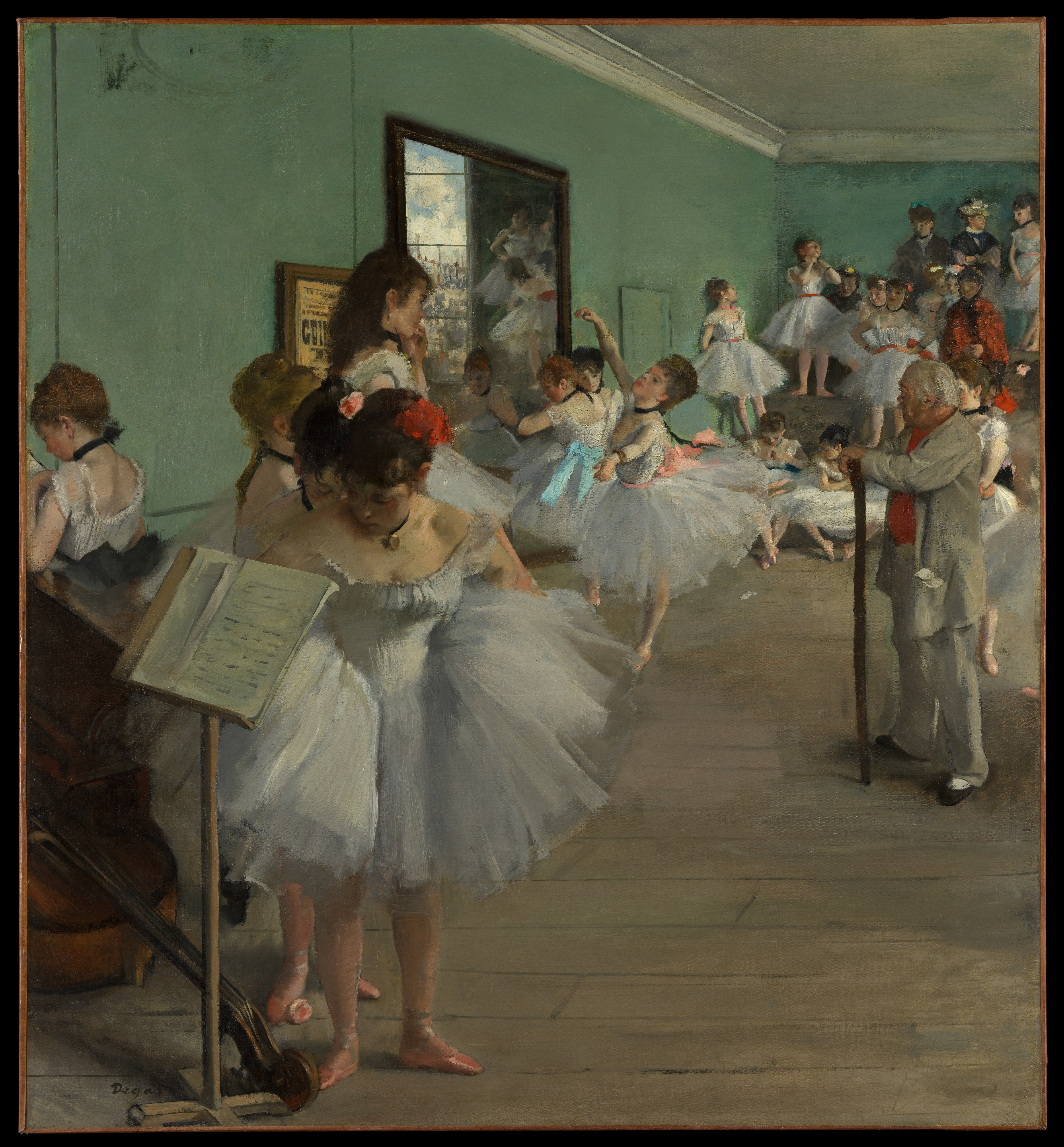
What is The Dance Class by Degas about? It is about ballet as rehearsal, correction, waiting, and work rather than pure spectacle. Commissioned around 1873 by the collector and singer Jean-Baptiste Faure, The Dance Class turns a rehearsal room into one of the sharpest modern images inside Impressionism. The point is not theatrical climax. It is the structure of a room where bodies are trained, watched, adjusted, and briefly allowed to rest.
What the room is really showing
At first glance, the picture seems easy to identify: young dancers in white dresses, a ballet master at the far right, and an interior tied to the Paris Opera world. But Degas refuses the clean unity of a performance image. Some dancers listen, some stretch, some drift, some wait. Attention is uneven, and that unevenness is the subject. The painting is built from pauses rather than from a decisive action.
That choice matters because it changes what ballet means on the canvas. Degas does not offer the stage from the audience's ideal seat. He gives a working room full of correction and delay. The dancers are not symbolic muses or decorative ornaments. They are bodies inside a system of repetition. Even the empty floor space feels active, because it measures distance, hierarchy, and the pressure of movement that has just happened or is about to happen again.
Ballet as labor, not glamour
This is one reason Degas is so central to modern art. He understands that a ballet institution is also a labor system. Training, exhaustion, supervision, and social display all overlap there. The dancers belong to a public culture of spectacle, but the painting keeps pulling us back behind the finished image and toward the work required to produce it.
That is why the canvas feels so different from an academic scene of idealized grace. Legs are extended, but not always elegantly. Bodies bend, pause, and recover. The room includes fatigue as well as skill. Degas is interested in precision, but not in polish for its own sake. He shows how a supposedly graceful art depends on correction, repetition, and strain.
Cropping, asymmetry, and the modern glance
The composition is modern not only because of the subject, but because of the way it organizes vision. Figures are pushed to the edges, space opens awkwardly in the center, and the scene seems caught from a position that is neither monumental nor neutral. Degas does not balance the room into a classical tableau. He lets it feel partial, interrupted, and observed from within lived experience.
That is where his importance inside Impressionism becomes clearer. Monet often tests outdoor light; Degas tests how modern seeing works indoors, through oblique viewpoints and discontinuous attention. The painting shares the movement's refusal of academic finish, but its real wager lies in framing. It asks how a fleeting social situation can be structured without being idealized.
Degas's intention and method
Degas's intention is not to idealize ballet or to isolate a perfect step. He wants painting to register rehearsal as a social structure: a room where authority, correction, delay, and effort remain visible at the same time. His method follows that intention. He spreads attention unevenly across the canvas, uses off-balance framing, and lets empty floor space do compositional work so that discipline itself becomes legible.
A rehearsal room against Renoir's public pleasure
A useful comparison runs to Bal du moulin de la Galette. Renoir paints leisure in public, where flickering light and social pleasure spread across the crowd. Degas paints a more controlled and inward world. One gives modern sociability at full surface; the other gives rehearsal, correction, and the strain behind visible elegance.
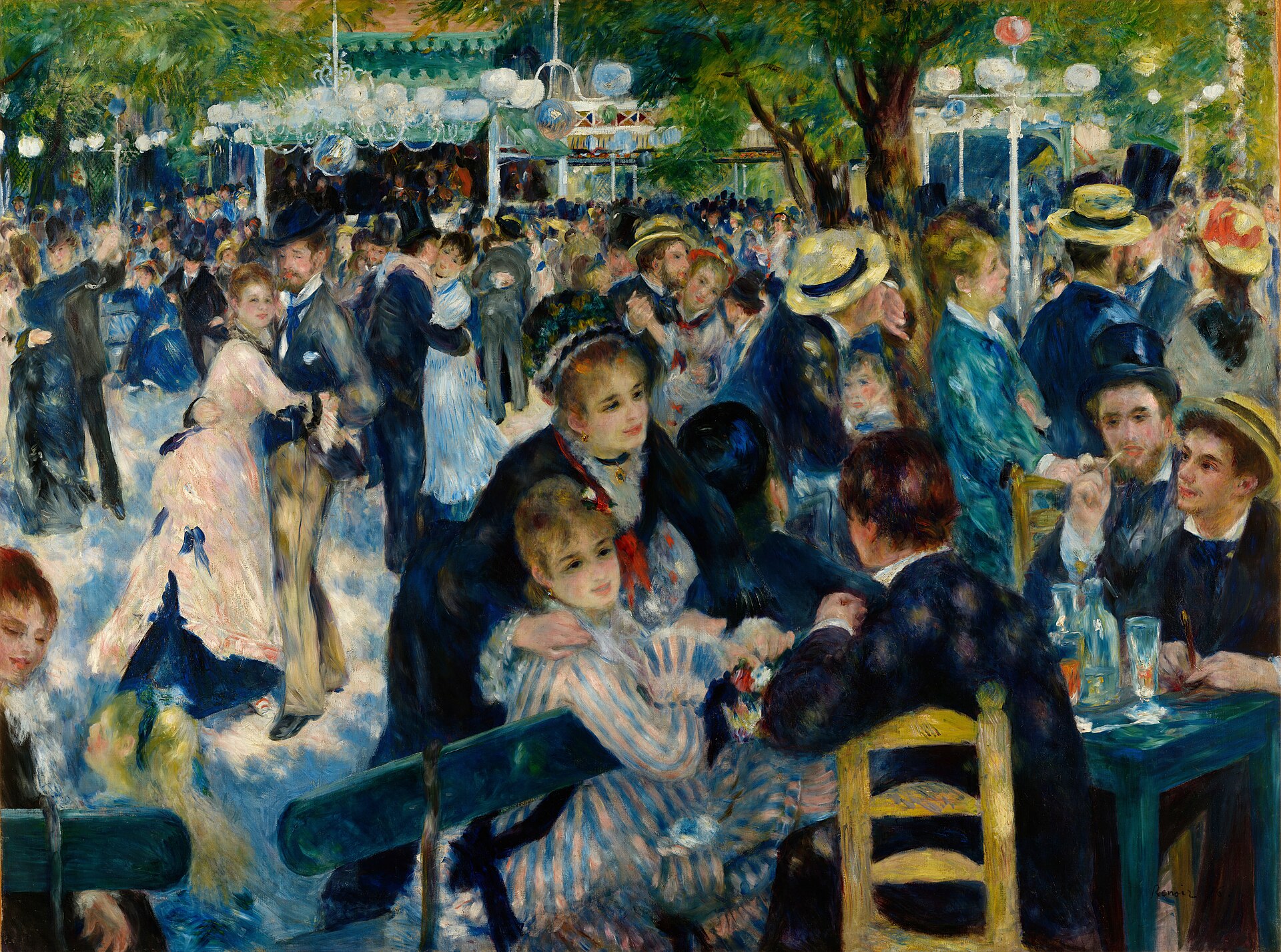
Read together, the two paintings correct a lazy idea of Impressionism as a single look. The movement includes sunlight, gardens, and boulevards, but it also includes rehearsal rooms, gaslight interiors, and bodies observed when performance pauses. Degas widens the field without abandoning the movement's core interest in unstable, modern experience.
Why this classroom changed modern painting
The Dance Class matters because it makes serious painting out of a moment that older art would have treated as preparatory or secondary. Degas understands that modern life is often built out of intervals: waiting, practicing, adjusting, recovering, watching others work. He finds form there. That decision helped later artists see that the ordinary mechanisms behind spectacle could be as revealing as spectacle itself.
The painting also lasts because it never flatters its own subject. It neither mocks ballet nor sentimentalizes it. Instead, it measures how a social world trains the body and how painting can register that training through spacing, cropping, and repetition. Degas does not simply show dancers. He shows a room organized by attention and control.
Related works
Test yourself with the quiz
Then try the art quiz.
Primary sources
Frequently asked questions
It is less about performance than about rehearsal. Degas shows dancers waiting, stretching, correcting, and being watched inside a room governed by discipline and repetition.
Because it studies modern life through unstable observation rather than academic finish. Degas applies Impressionist attention to the rehearsal room instead of to outdoor light.
He is the ballet master directing the room. Degas uses that figure to make supervision, correction, and hierarchy part of the painting's structure.