
Realism
The Horse Fair
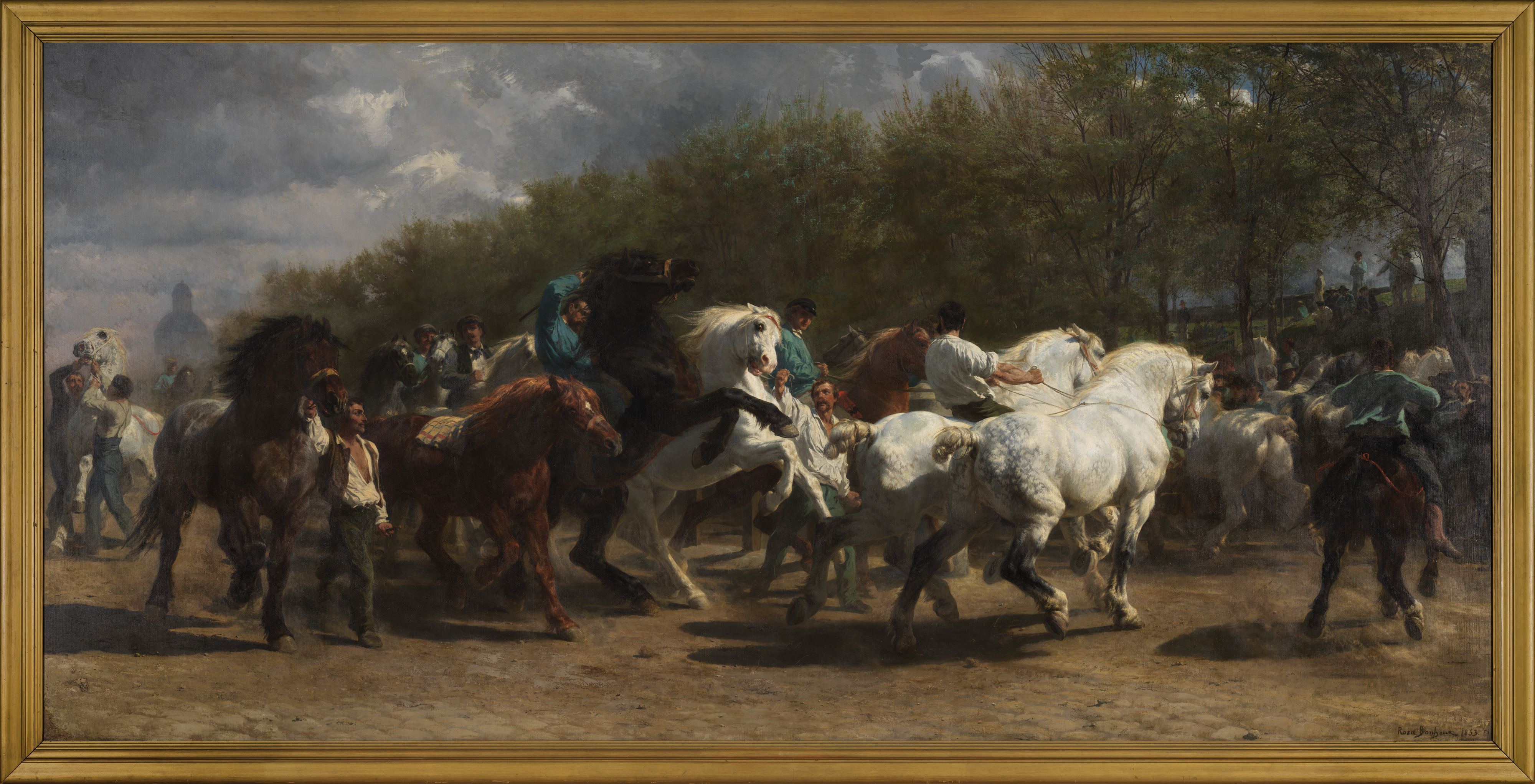
Rosa Bonheur turns a Paris horse market into one of the nineteenth century's largest realist paintings. The scale tells you immediately that the picture is not about an anecdote or a single heroic rider. It is about a whole public world of dealers, handlers, circling animals, and contested control. Painted between 1852 and 1855, The Horse Fair proves that Realism could monumentalize commerce and animal force as convincingly as Courbet monumentalized a funeral or Millet monumentalized rural labor.
A market made into a public image
The scene comes from the horse market then held on the Boulevard de l'Hôpital in Paris, near the Salpêtrière. Bonheur spreads it across a canvas more than five meters wide. The breadth changes the way the subject works. You do not read one isolated moment. You read waves of movement: horses rearing, horses being turned, handlers leaning in, bodies pulling against bodies. The market becomes a system rather than a vignette.
That is the central formal fact of the painting. Bonheur does not use the horse only as a noble creature or picturesque accessory. The horses are the structure of the image. Their mass, momentum, and nervous energy determine the composition, while the people exist in relation to that force. Realism here means making a real, organized social scene legible without reducing it to mere documentary flatness.
Why the subject was so ambitious
In the middle of the nineteenth century, a canvas of this scale still carried the memory of history painting. Viewers expected battles, myths, saints, emperors, or major political events to occupy such space. Bonheur offers none of that. She gives the room to horse traders, working animals, and a Paris market. The wager is direct: this subject is important enough to command the same physical and pictorial ambition.
That is why the picture matters beyond animal painting. Bonheur is not asking to be treated as a specialist in a minor genre. She is pushing animal life, commercial exchange, and public spectacle into the zone of major art. The result enlarges what nineteenth-century painting can take seriously.
How Bonheur built authority
Bonheur's authority comes from close observation, not from theatrical invention alone. She studied horses obsessively, visited markets and stables, and pursued anatomical accuracy with unusual discipline. Her famous permission to wear trousers in public was not a mere eccentric detail. It helped her move through spaces such as horse markets and slaughterhouses more freely, where she could observe animal movement and muscular tension at close range.
That practical seriousness changes the painting. The horses do not feel generic or decorative. They feel heavy, quick, resistant, and difficult to master. Bonheur does not sentimentalize them. She paints them as bodies under pressure, with flared nostrils, twisting necks, taut legs, and shifting weight. The market is therefore not only a place of display. It is a place where force has to be managed in public view.
Animal power, human control, public spectacle
One reason the painting stays so alive is that control never looks complete. The men handling the horses are not effortless masters. They pull, brace, guide, and react. The composition depends on that instability. If the animals were already calm, the picture would collapse into parade. Bonheur wants the viewer to feel that order is being produced in real time and could fail at any moment.
That makes The Horse Fair a realist image of labor as much as an animal picture. The scene is about buying, selling, showing, restraining, and evaluating. It turns market exchange into visible physical work. Instead of rural poverty, as in Millet, or provincial ritual, as in Courbet, Bonheur gives Realism another subject: the disciplined management of energy, value, and spectacle.
Another route through Realism
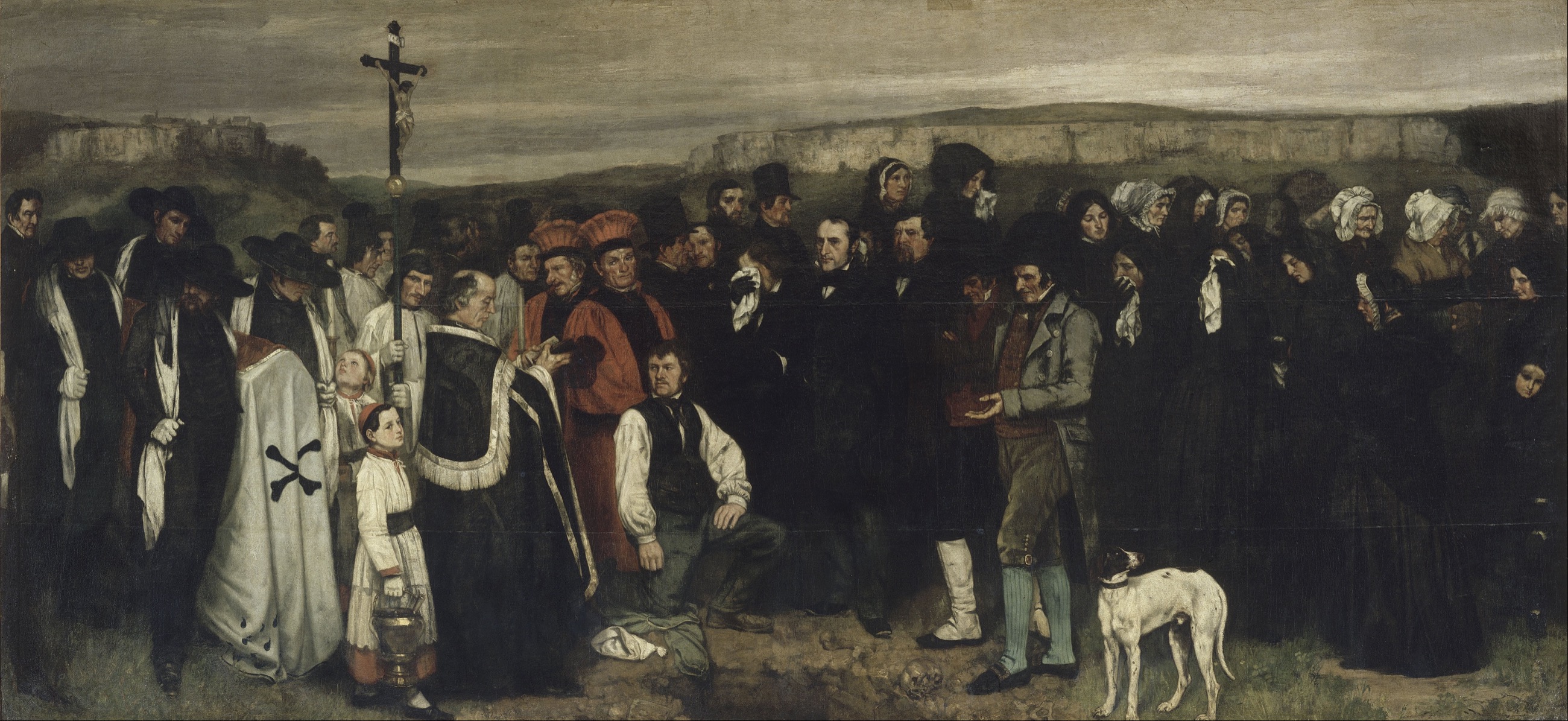
Set the painting beside A Burial at Ornans and the breadth of Realism becomes clearer. Courbet makes ordinary provincial people occupy the space of grand history painting. Bonheur makes an urban market of horses and handlers do the same. Both reject ideal subject hierarchies. Both insist that modern life already contains enough gravity if painting is willing to look at it directly.
Read with The Gleaners, the contrast sharpens further. Millet compresses Realism into slow, repetitive bodily labor. Bonheur widens it into motion, trade, and animal force. The movement is not one pictorial recipe. It is a choice about seriousness.
Precision without stiffness
The Horse Fair endures because it solves several problems at once. It is precise without becoming dry. It is dramatic without becoming melodramatic. It is deeply observational, yet it still feels like a public claim about what painting can do. Bonheur shows that animals can carry social meaning, that markets can produce spectacle, and that control itself can be made visible.
The painting also clarifies why Bonheur mattered so much in her own century. She was not simply a successful painter of animals. She expanded the scale, ambition, and seriousness of the genre, and she did so in a career that became famous on both sides of the Atlantic.
Related works
Test yourself with the quiz
Then try the art quiz.
Primary sources
Frequently asked questions
It shows horse dealers, handlers, and powerful animals circling through the Paris horse market on the Boulevard de l'Hôpital. Rosa Bonheur spreads the scene across a vast canvas so that control, movement, and animal force become the real subject.
Bonheur gave a commercial animal market the size and ambition usually associated with history painting. Instead of myth or battle, she made labor, trade, and bodily power carry a monumental public image.
The painting shows that Realism was not limited to funerals, peasants, or urban modern life. Bonheur uses the movement's seriousness to treat a horse market as a structured world of commerce, discipline, spectacle, and force.