
Realist Artist
Rosa Bonheur
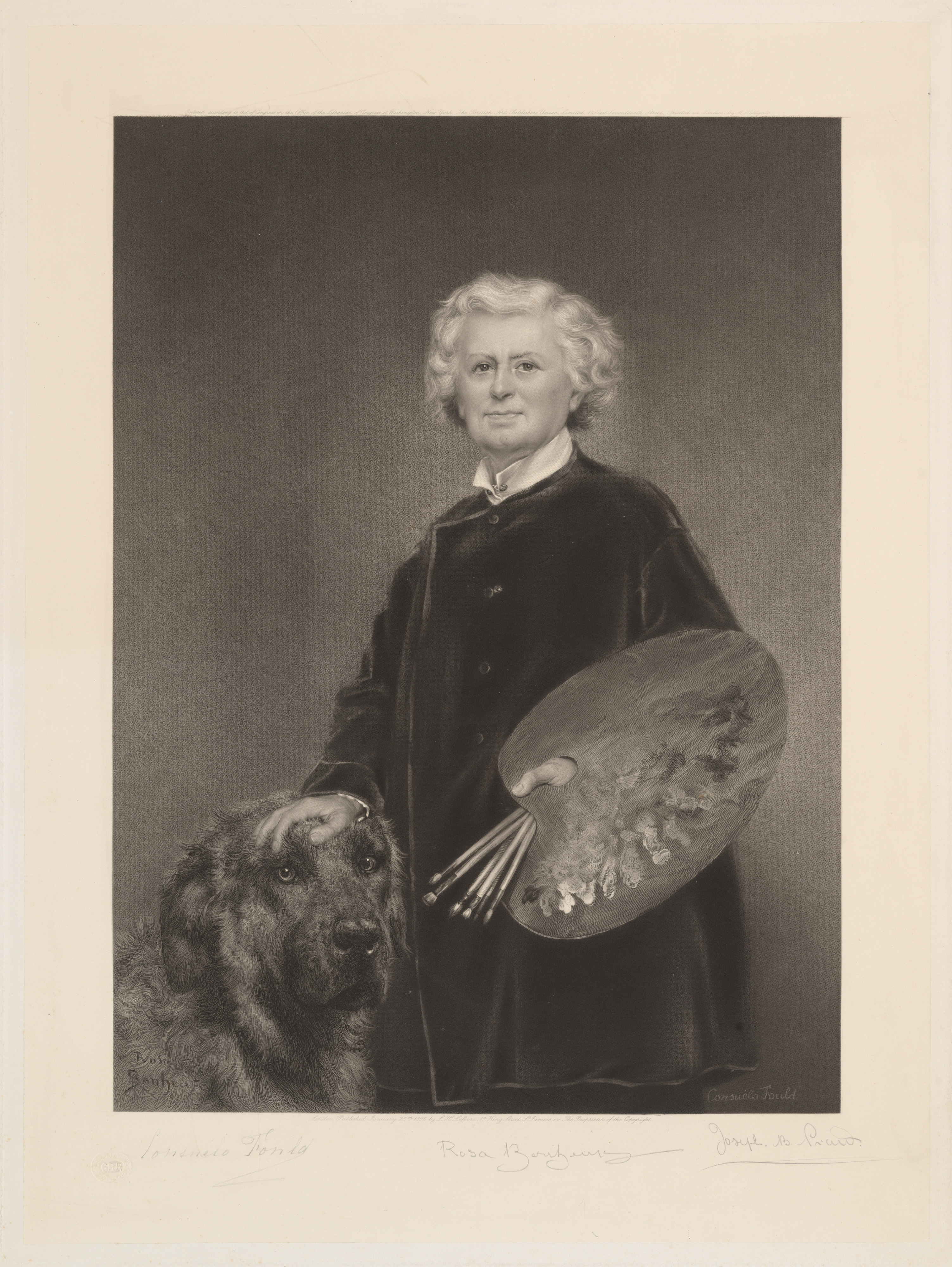
Rosa Bonheur made animal painting large, exact, and ambitious enough to compete with the grandest subjects of the nineteenth century. She is often remembered through The Horse Fair, but her importance exceeds one famous canvas. Bonheur built a career in which cattle, horses, plowing teams, and wild animals were treated not as decorative side subjects, but as carriers of labor, force, and public seriousness inside Realism.
From Bordeaux to a self-made career
Born Marie-Rosalie Bonheur in Bordeaux in 1822, she grew up in a family of artists and moved to Paris as a child. Her father, Raymond Bonheur, trained her, but the career that followed was her own. She exhibited early, worked relentlessly, and developed a reputation for technical precision and unusual authority in the study of animals. By the middle decades of the century, she had become one of the most famous artists in France.
That public success matters because Bonheur was not entering an easy field for a woman painter. She had to build credibility in a culture that still treated large-scale ambition and public seriousness as masculine territory. Her answer was not to soften her work. It was to make it more exact, more forceful, and harder to dismiss.
Why animals became central
Bonheur's animals are never just lovable creatures. They are working bodies, market bodies, breeding bodies, and bodies under observation. She studies musculature, gait, strain, and weight with a rigor that often brings her closer to scientific attention than to pastoral charm. That is why her paintings matter beyond genre. They show how animal life intersects with agriculture, trade, transport, and the whole rural and urban economy of the nineteenth century.
This is also what keeps her connected to Realism. Bonheur does not use animals as an escape from social reality. She paints them where they are bought, sold, driven, harnessed, or displayed. The point is not anecdote. It is structure. Who controls movement, who profits from labor, and how force is managed in public all become visible through the animal subject.
Observation as method, independence as practice
Bonheur's authority came from patient fieldwork. She studied in horse markets, livestock fairs, abattoirs, and the countryside, always pushing beyond studio memory. Her official permission to wear trousers is often repeated as biography, but it matters because it made that fieldwork easier. She insisted on entering spaces from which women were often excluded or discouraged, not to stage scandal, but to get the work right.
Her independence was broader than costume. Bonheur built an unusually autonomous life, shared for decades with Nathalie Micas and later with Anna Klumpke, while maintaining a major studio practice, international collectors, and public honors. In 1865, Empress Eugénie awarded her the Legion of Honour, confirming a visibility that few women artists of the century achieved.
One major case: The Horse Fair
In The Horse Fair, Bonheur takes a horse market on the Boulevard de l'Hôpital in Paris and gives it the scale of major public painting. The canvas is not driven by one heroic rider or one anecdotal incident. It is driven by repeated attempts to control animal power in front of buyers, sellers, and spectators. That is a broader statement about modern life than the title first suggests.
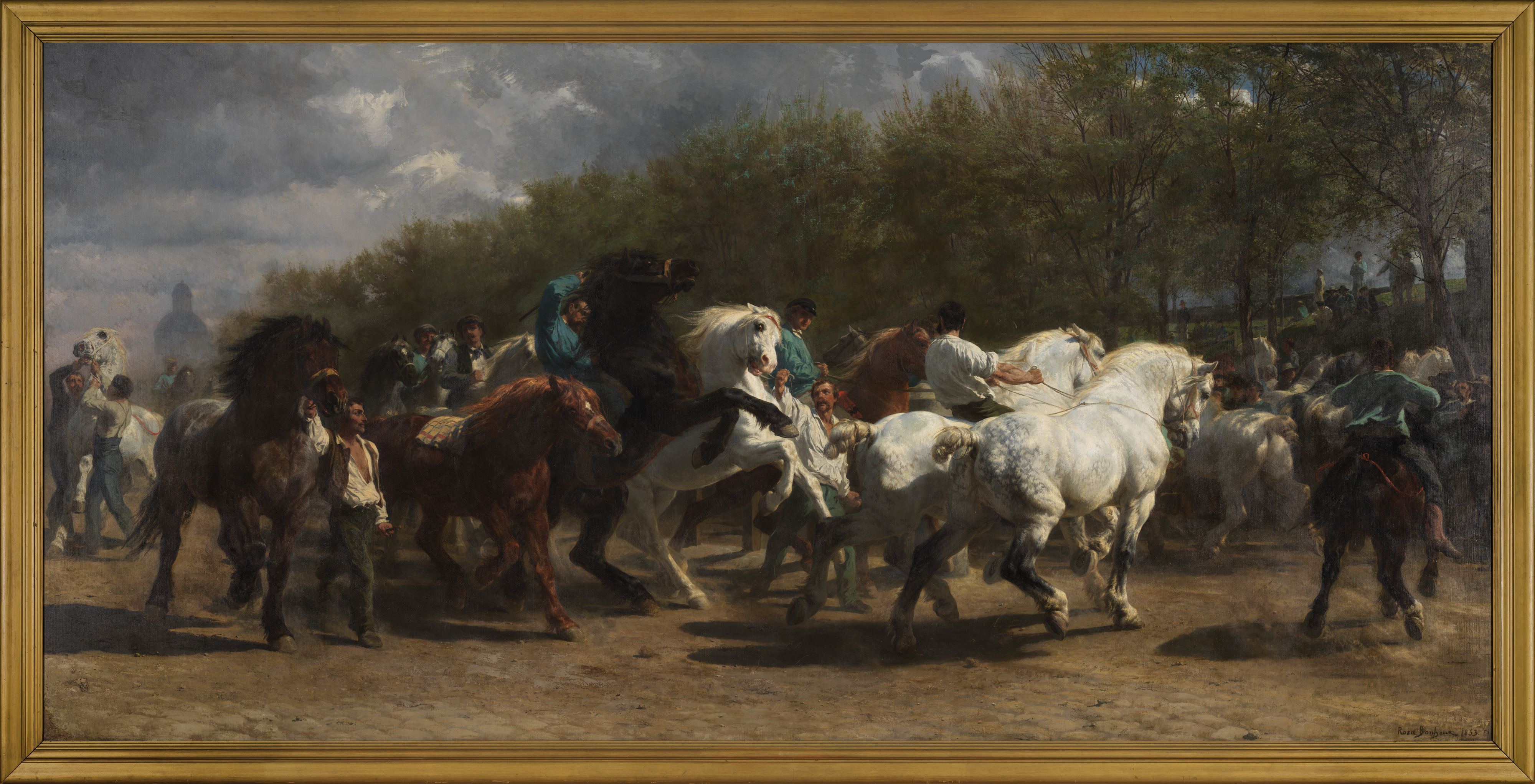
The painting clarifies Bonheur's place in art history. She does not merely excel inside animal painting as a niche. She expands what the genre can do. Movement, trade, discipline, and spectacle all become structurally serious on her canvas.
Why Bonheur matters beyond one painting
Bonheur changes both subject hierarchy and professional expectation. She proves that animal painting can be exact without becoming dry, grand without becoming empty, and popular without surrendering seriousness. She also proves that a woman artist can build a public, international, and technically commanding career in a field that did not expect her to dominate it.
Beside Millet and Courbet, the breadth of Realism becomes clearer. Beside later American images of rural identity such as American Gothic, another difference appears: Bonheur is less interested in stillness or emblem than in energy under management. That distinction is one reason her paintings remain so immediate.
Legacy and influence
Bonheur's legacy is larger than the familiar anecdote of a woman who succeeded against the odds. Her influence runs through later animal painting, through the visibility of women artists claiming public ambition, and through the international market for serious nineteenth-century art. During her lifetime, she was collected in Britain and the United States as well as France, which helped make her one of the most globally visible French painters of the period.
Her posthumous afterlife has also changed. For a time, Bonheur was remembered more as an exception than as a central artist. Recent scholarship and museum work have restored her to a clearer position: not on the edge of Realism, but as one of the painters who widened its range. That legacy matters because it shows how subject hierarchy, gender history, and artistic influence can all be revised at once.
Reading paths from Rosa Bonheur
The Horse Fair leads directly into Realism, and the comparison with Millet and Courbet shows what Bonheur adds to the movement. Then try the art quiz.