
Photography
The Steerage
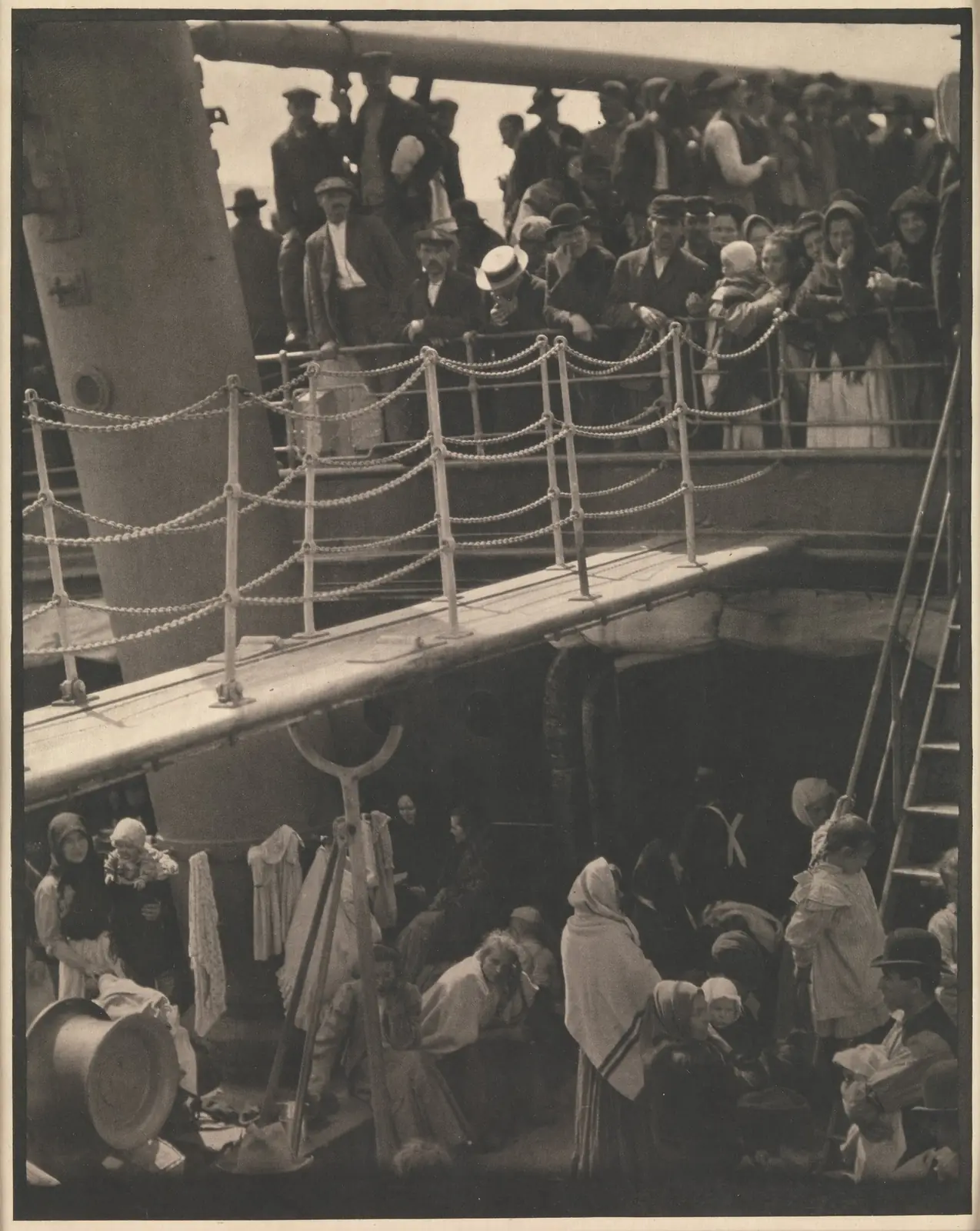
The Steerage is one of those rare photographs that changed how an entire medium understood itself. Stieglitz made it in 1907 on a transatlantic ship and later described it as the moment he fully recognized photography as a modern art form.
A social structure rendered as visual structure
The subject is not abstract at all: class separation on an ocean liner. Passengers in steerage occupied restricted lower-deck space while wealthier travelers remained elsewhere. Stieglitz does not preach this divide; he maps it. Gangways, railings, stair elements, and deck partitions turn hierarchy into architecture.
That translation is the image's first achievement. Social order appears as spatial order. You see inequality not through caption rhetoric but through how bodies are distributed and constrained.
Why the composition feels almost abstract
The photograph is built from a tight interplay of diagonals, circles, and horizontal bands. A gangplank cuts the frame; hats and rounded forms punctuate harder lines; shadow masses stabilize bright areas. The eye moves rhythmically, almost musically, before it even registers individual faces.
This is what made the image so important for modernism: form and meaning arrive simultaneously. The geometry is not decorative surface over social content. It is the mechanism by which social content becomes legible.
Between Pictorialism and straight photography
Stieglitz had deep roots in Pictorialism, a mode that often emphasized atmospheric softness and painterly effects. The Steerage points in a different direction: sharper structure, harder edges, and a confidence in the camera's own visual intelligence. It does not imitate painting; it argues for photography's specific language.
That shift mattered historically. It helped open the way for later photographic modernisms that valued precision, seriality, and compositional rigor without abandoning real-world subjects.
Stieglitz's intention and method
Stieglitz's intention was to show that photography could carry social meaning and formal invention in the same image. His method here is explicit: he uses the gangway as a compositional hinge, arranges attention through geometric rhythm, and lets class separation emerge from the ship's architecture rather than editorial commentary. The purpose is analytical clarity, not sentimental anecdote.
Migration, waiting, and constrained movement
The people in the frame are not generic "types." They are travelers suspended in transit, physically near departure and arrival yet socially fixed by class codes. This tension gives the photograph its quiet charge: movement everywhere, mobility unevenly distributed.
Seen today, the image resonates with ongoing debates about borders, transit systems, and the visual politics of migration. Its durability comes from exactness, not slogan.
Why the image remains current in 2026
Contemporary visual culture is full of images that oscillate between data-like structure and human narrative. The Steerage anticipated that grammar: it can be read as a social document, a formal composition, or both at once. Few works sustain those two readings without reducing one to the other.
That is also why the photograph is a useful teaching image. It trains viewers to connect line, mass, and rhythm with historical meaning instead of treating form and context as separate tasks.
By comparison, The Third of May 1808 concentrates conflict in one execution scene, while Cholera Plague, Quebec diffuses crisis across an entire city. For circulation logic, read why art goes viral.
How to read The Steerage closely
First map large geometry: dominant diagonals, circular anchors, and deck stratification. Second, track light and shadow blocks to see where attention is directed. Third, integrate context: transatlantic migration, early twentieth-century class infrastructure, and photographic self-definition.
- Treat deck architecture as evidence, not background.
- Read formal balance and social imbalance together.
- Compare with later documentary photography to see what Stieglitz prefigures.
Stieglitz does not choose between social reality and formal innovation; he proves they can occupy the same frame.
Use the art quiz as a quick check: can you connect The Steerage to Alfred Stieglitz when the options are mixed?
Explore more
Related works
Primary sources
Frequently asked questions
The diagonal gangway is the structural hinge. It separates classes while linking them in one frame, turning social hierarchy into pure composition.
The image emerges from early twentieth-century transatlantic migration, where photography could register class division with documentary and modernist force.
Compare it with Migrant Mother and realist crowd paintings to see how images of social structure evolve across media.