
Photography
Migrant Mother
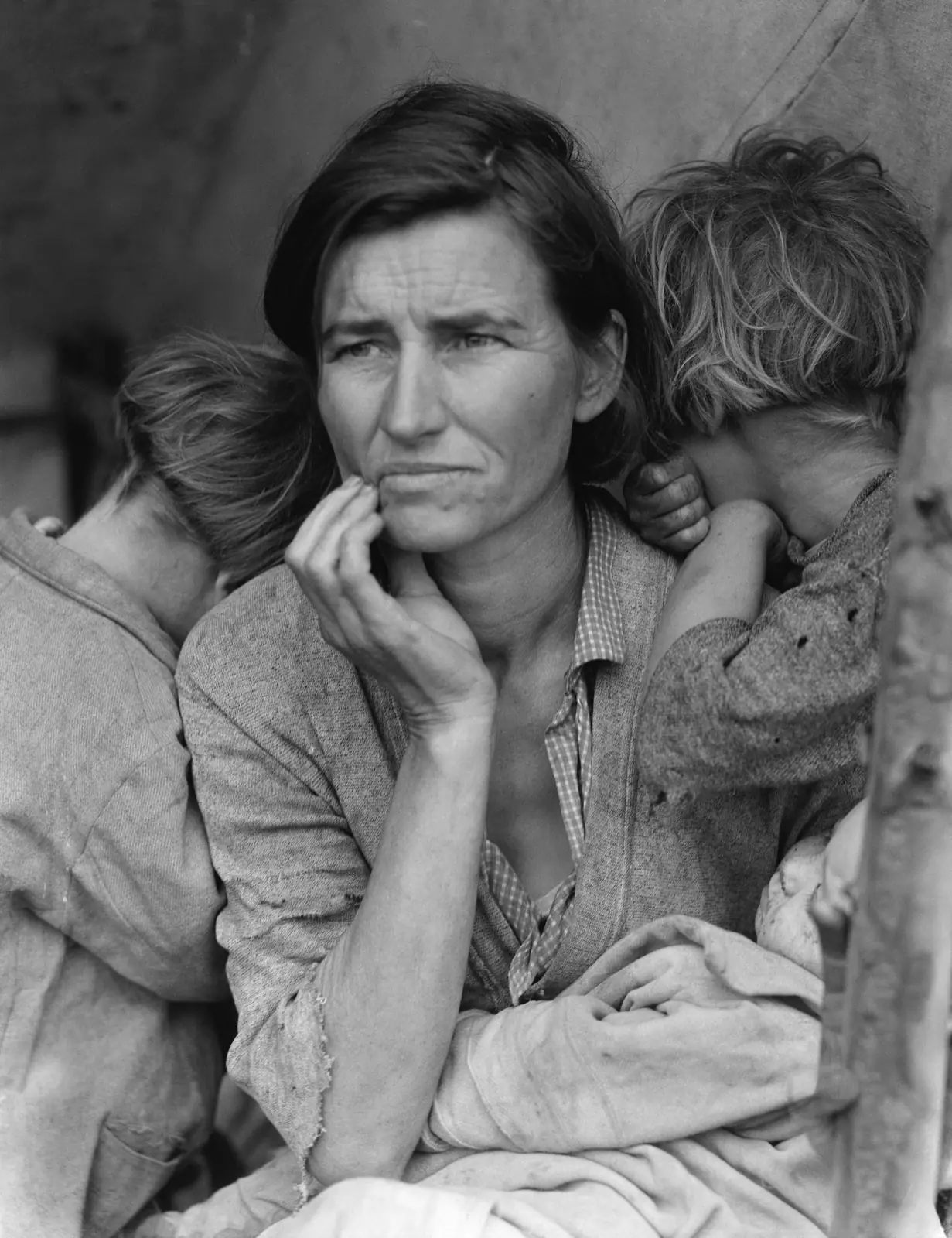
Few photographs have travelled as far, or as fast, as Migrant Mother. Lange made it in March 1936 in a pea-pickers' camp near Nipomo, California; within days, it became a national shorthand for economic distress and federal neglect.
How Lange builds urgency in one frame
The image looks spontaneous, but its force depends on exact structure. Florence Owens Thompson sits at the center, hand against face, while two children turn away and fold into her shoulders. Their averted faces do two things at once: they protect family privacy and intensify the mother's expression as the emotional pivot.
Compositionally, Lange constructs a triangle. Thompson's face is the apex; the children create the base. Triangles are stable forms, yet this one feels strained because every line points back to worry. Stability and pressure coexist - a key reason the photograph feels both intimate and historical.
Documentary context: the FSA and the Depression
Lange was working for the Farm Security Administration, whose photographers documented rural poverty during the Great Depression. These assignments were not neutral archives. They were also political communication: images that could make distant hardship legible to urban publics and policymakers.
In Nipomo, crop failure had left migrant workers without wages or food security. Migrant Mother condensed that structural crisis into one human encounter. Its publication reportedly accelerated emergency food aid to the camp. The photograph is therefore not only representation; it is intervention.
Lange's intention and working method
Lange's intention was not to stage pity but to make a structural crisis readable through one concentrated image. Her method combined rapid field observation, close framing, and sequence shooting, then selective editing for publication. The aim was civic legibility: an image clear enough to circulate in newspapers and policy channels without losing human specificity.
Ethics, editing, and the power problem
The picture's fame can obscure its ethical complexity. Lange shot a short sequence, then selected and cropped for maximum impact. One related frame includes a visible thumb on a tent pole that later versions minimized. Such decisions are standard photographic practice, but they remind us that documentary authority is always constructed.
Later, when Florence Owens Thompson's identity became widely known, debates sharpened around consent, compensation, and narrative control. The image humanized poverty for millions, yet the person depicted did not control its circulation or symbolic afterlife. Any serious reading of Migrant Mother has to hold both facts together.
Why the photograph still works in 2026
The frame remains contemporary because it links micro-gesture to macro-system. You can read fatigue in a hand, weather in clothing texture, and structural insecurity in the camp setting. It anticipates today's visual politics, where single images can drive mass attention while still demanding slow interpretation.
Its durability also comes from restraint. Lange avoids spectacle. There is no theatrical suffering, no visual excess. She relies on proximity, light, and posture, trusting viewers to infer the wider economy from concrete details.
By comparison, Cholera Plague, Quebec turns crisis into civic panorama rather than intimate portrait. For circulation dynamics, pair this page with why art goes viral and track how visual economy affects public response.
How to read Migrant Mother well
Start with geometry before symbolism: identify the triangular scaffold and directional lines of gaze. Next, examine hand, clothing, and skin texture as indicators of labor and environment. Only then add historical context: 1936, migratory farm labor, and FSA distribution channels.
- Read gesture as social information, not sentiment alone.
- Treat editing choices as part of meaning, not postscript.
- Compare with other documentary works to separate style from historical circumstance.
Lange's image is powerful not because it explains everything, but because it makes social structure visible through one face.
Use the art quiz as a quick check: can you connect Migrant Mother to Dorothea Lange when the options are mixed?
Explore more
Related works
Primary sources
Frequently asked questions
The triangular grouping around the mother's face is decisive: it concentrates anxiety and endurance while keeping the social context readable in one glance.
The photograph was made during the Great Depression within the Farm Security Administration project, where documentary images shaped public understanding of poverty.
Compare it with The Steerage and modern political paintings to see how composition can carry both empathy and structural critique.