
Movement Guide
Photography
Photography unsettled the nineteenth century because it seemed to let the world picture itself. Light touched a sensitized surface, and an image appeared with a degree of physical contact that painting could never claim. That promise of direct evidence is the medium's power and its permanent complication.
Photography is not one style like Impressionism or one school like Realism. It is a medium that produces portraits, documents, family albums, police files, advertisements, and art objects. Read it well by holding four things together from the start: process, framing, circulation, and afterlife.
How photography begins
Early photography makes more sense if you start with its first technical split. The daguerreotype, announced in 1839, produced a unique image on a polished metal plate. William Henry Fox Talbot's calotype used a paper negative, which meant one exposure could generate multiple prints. From the beginning, photography is therefore both singular object and reproducible image.
That split shapes everything that follows. The medium moves quickly from scientific wonder to portrait studios, topographical surveys, police records, travel views, and the illustrated press. Photography is never only art. It becomes a modern tool for storing a face, a place, an event, a property, or a file.
Why the nineteenth century was ready for the camera
Photography arrives at exactly the right historical moment. Industrial cities are expanding, newspapers and publishing are accelerating, states want identification and archives, science wants records, and middle-class clients want portable likenesses. The camera fits a culture already organized around mobility, bureaucracy, and reproduction.
Painting does not become obsolete under that pressure, but it does change. Realism keeps pushing ordinary life into major art, while artists such as Edgar Degas and Gustave Caillebotte absorb abrupt crops, off-center views, and the feeling that an instant can be cut from a longer visual flow. The camera does not replace painting. It changes the visual field in which painting now works.
Why photographs feel more truthful than they are
People trust photographs because the image depends on light that once came from something in front of the lens. That indexical bond gives photography unusual evidentiary force. Compared with Realism, which has to argue through paint, a photograph begins with physical contact.
But physical contact is not neutrality. Lens choice, distance, shutter moment, crop, caption, archive, and publication venue all shape meaning. A photograph never says only that something was there. It also says that this scene was shown from here, for this use, under these conditions.
The Steerage: modernism without leaving the world behind
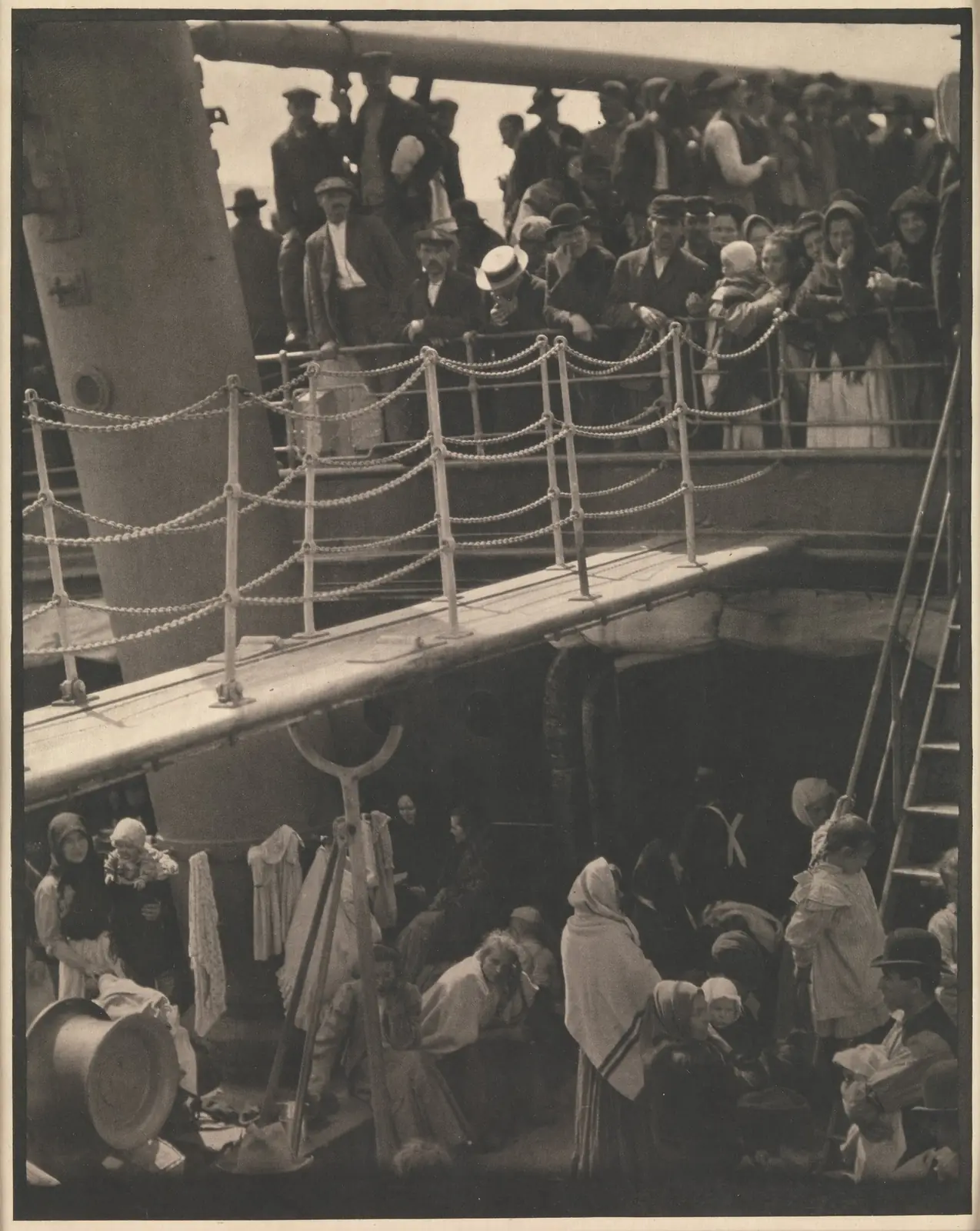
Alfred Stieglitz shows that photography does not need to choose between documentary content and formal rigor. In The Steerage, made in 1907 aboard a transatlantic ship, class separation appears not as editorial slogan but as architecture. The gangway slices the composition, decks stack social position vertically, and railings keep turning hierarchy into geometry.
Stieglitz moves beyond the softer ambitions of Pictorialism without abandoning beauty. He proves that a photograph can be structurally exact, socially alert, and formally radical at once. The medium stops asking to be accepted as imitation painting and begins asserting its own visual intelligence.
Migrant Mother: when an image enters public life
With Migrant Mother, Dorothea Lange reveals a different power of photography: not just to describe the world, but to push it into public consciousness. Made in 1936 during the Great Depression, the photograph condenses economic collapse, maternal strain, and state neglect into one image built for circulation. It is intimate, but never private.
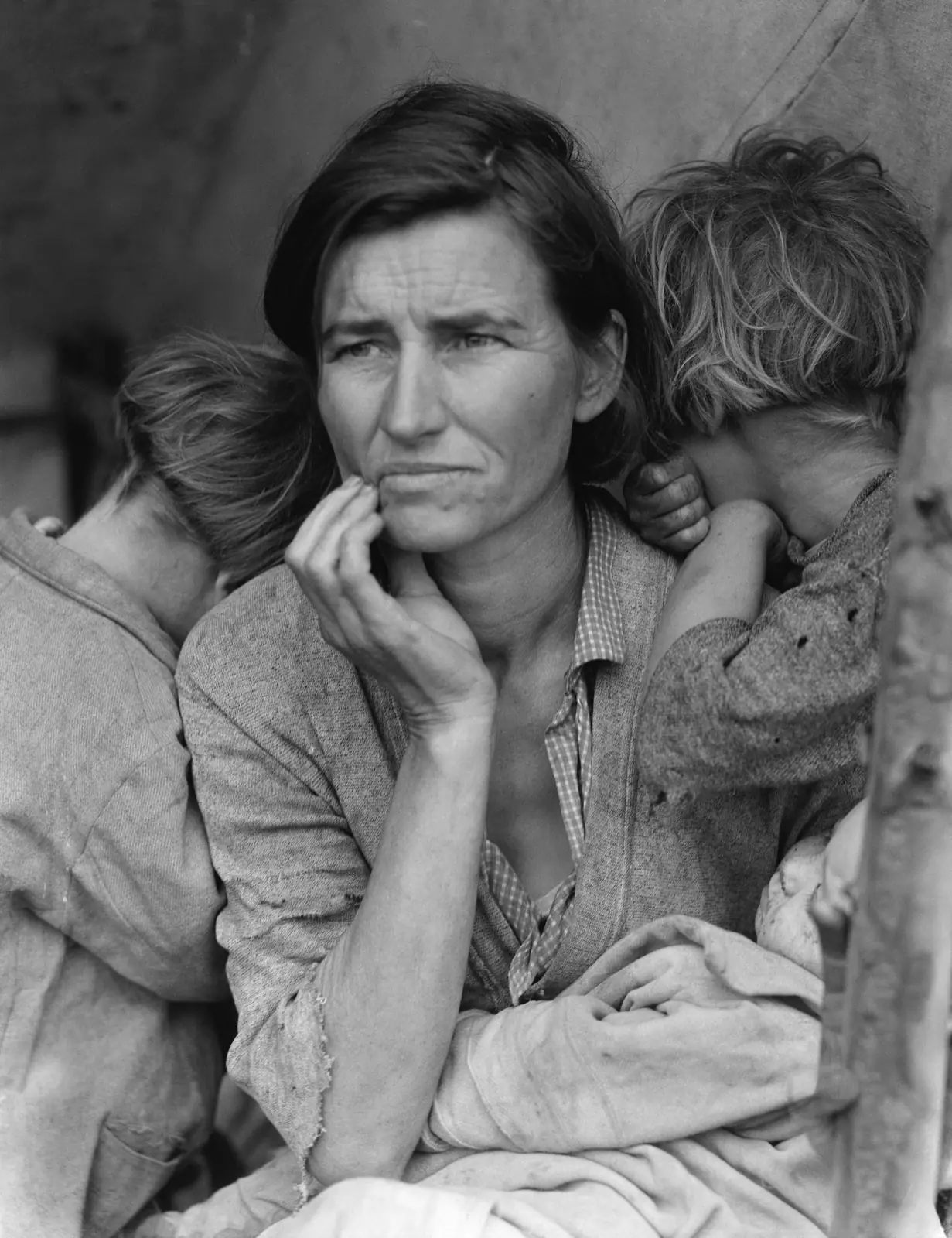
The image also exposes the medium's ethical difficulty. Documentary authority can make distant suffering visible, but it can also turn vulnerable people into lasting symbols they do not control. Photographic analysis cannot stop at composition. It has to include captioning, editorial selection, republication, consent, and the afterlife of the image in institutions and mass culture.
From albums to passports, photography reorganizes social life
Once the medium becomes faster, cheaper, and easier to reproduce, it settles everywhere: family albums, passports, police mugshots, scientific atlases, advertising, war reporting, fashion magazines, and now phone feeds. Photography does not simply preserve appearances. It trains modern societies to sort people, events, and places into visible records.
This spread makes photography more than one artistic movement among others. It changes memory, stabilizes identity, expands evidence, and sharpens surveillance. The same medium lets families keep faces close and institutions keep populations legible.
How to read a photograph now
- Ask what had to exist in front of the lens, and what may lie outside the frame.
- Study angle, distance, and crop before jumping to symbolism.
- Check caption, date, source, and publication venue before trusting interpretation.
- Ask who benefits from the image circulating in this form.
- Separate emotional impact from factual claim, then test how the two are being made to support each other.
In 2026 this is basic visual literacy. Synthetic images, context collapse, and aggressive platform recirculation make photographic authority easier to fake, redirect, or exhaust. Historical reading is now a civic skill.
Key artists in Explainary
Key works in Explainary
Connected movements in Explainary
Read The Steerage for structure, Migrant Mother for public consequence, then return to Realism and Impressionism to see what the camera inherits from painting and what painting learns back from the camera. Stieglitz and Lange do not contain the whole history of photography, but together they make its central tensions easy to grasp.
Use the art quiz as a quick check: can you recognize photography not only by subject matter, but by the medium's constant negotiation between evidence, framing, and public use?
Primary sources
Frequently asked questions
Photography begins with light from a scene making a physical trace on a sensitive surface. That gives it an evidentiary force painting cannot claim, even though every photograph is still shaped by framing, printing, captioning, and use.
No. A photograph records light from the world, which gives it unusual evidentiary force, but framing, timing, captioning, editing, and circulation always shape what the image means.
Because it answered several new needs at once: portrait markets, scientific recording, journalism, state bureaucracy, travel, archives, and the growing desire for reproducible images. It was both a technical invention and a social infrastructure.
Because synthetic images, platform recirculation, and aggressive editing make visual authority easier to fake or distort. Reading a photograph now means checking form, provenance, caption history, and publication context together.