
Post-Impressionism
The Starry Night
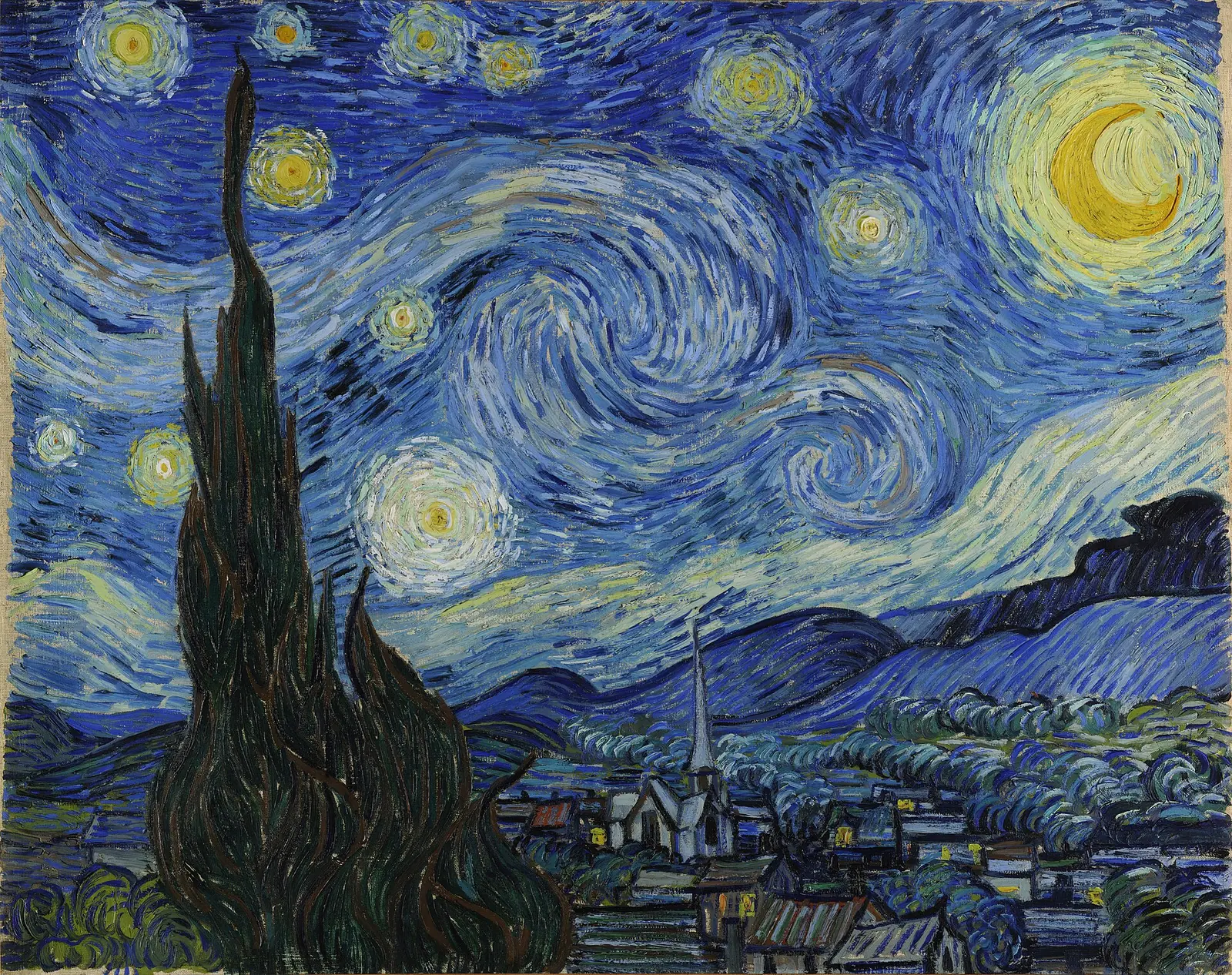
The Starry Night is so famous that it can look spontaneous. It is not. Vincent van Gogh turns a night landscape into a controlled collision between three kinds of movement: the nearly still village, the vertical cypress, and the sky that rolls in long rotating bands.
That is why the canvas stays legible even at maximum intensity. The painting is not raw emotional overflow. It is a highly ordered image about pressure, scale, and motion, built carefully enough that the eye never loses its path.
The image is built from three motions
Start with the simplest fact: most of the canvas is sky. The horizon sits low, the village is compressed into a narrow strip, and the cypress rises at the left like a dark counterweight. Van Gogh gives the night almost all the available space, then prevents it from dissolving by dividing the scene into clearly different rhythms.
- The village stays comparatively still, built from short rooflines, verticals, and compact blocks.
- The cypress climbs in one dark, flame-like surge that ties ground to sky.
- The sky moves laterally and rotationally, with arcs, eddies, and halos that keep the eye circulating.
This mismatch is the key. If every zone moved the same way, the painting would collapse into noise. Because each zone obeys a different rhythm, the composition produces tension without losing order.
Not a literal transcription of the window
Van Gogh painted the canvas in June 1889 during his stay at the asylum of Saint-Paul-de-Mausole in Saint-Rémy, where he had admitted himself after the crisis in Arles in the hope of being treated and able to keep working. The starting point was the east-facing view from his room, but the finished painting is not a documentary record. The hills come from observation; the village below is reshaped from memory; the church spire feels more Dutch than Provençal.
That matters because the picture is often described as if it were either pure hallucination or pure observation. It is neither. Van Gogh takes a real motif and reconstructs it until it becomes structurally useful. The image is more invented than the legend of the window suggests, but also far more deliberate than the myth of uncontrolled emotion implies.
Saint-Rémy without the cliché
The asylum context is real and important, but it should not do all the explanatory work. During this period Van Gogh painted and drew with remarkable discipline, sending work to Theo, judging what should be shown, and worrying about excess. In one June 1889 letter he described the canvas simply as "a new study of a starry sky." In another, he warned against exhibiting something "too mad."
That is the useful balance. The painting comes out of illness, isolation, and real instability, but it also comes out of method, selection, and self-critique. Reading the canvas only as symptom makes it less, not more, intelligible.
Why the sky feels engineered, not random
The sky feels alive because Van Gogh gives it both turbulence and structure. Stars are surrounded by repeated halos; the moon and stars concentrate yellows and whites against deep blues; curving strokes gather into large directional streams rather than scattering arbitrarily. The whole upper zone is orchestrated.
Impasto matters here, but not as mere texture. Thick paint catches actual light, which makes the surface pulse when seen in person. Just as important is color logic. The blue-yellow opposition makes the sky vibrate, while darker blue-green passages create slower intervals inside that vibration. The result feels emotional because it is formally exact.
The cypress and the village are not symbols first
It is tempting to jump immediately to symbolism: the cypress as death, the church as faith, the stars as transcendence. Those meanings are available, and Van Gogh's letters justify taking them seriously. But composition comes first. The cypress is above all the dark vertical that stops the left side of the painting from opening out. The village is above all the steady register that makes the sky's motion legible.
Only after that structural reading should interpretation deepen. The cypress can indeed carry funerary associations, and the church spire can indeed sharpen the painting's upward pull. But these meanings work because the shapes are already doing visual labor, not because Van Gogh planted a series of symbols that can be decoded one by one.
A useful comparison: Van Gogh and Munch
A productive next comparison is The Scream. Edvard Munch also bends landscape into emotional pressure, but he compresses the whole scene around a frontal figure and a single scream-like contour. Van Gogh distributes pressure across the whole field instead: village, tree, hill, and sky all participate.
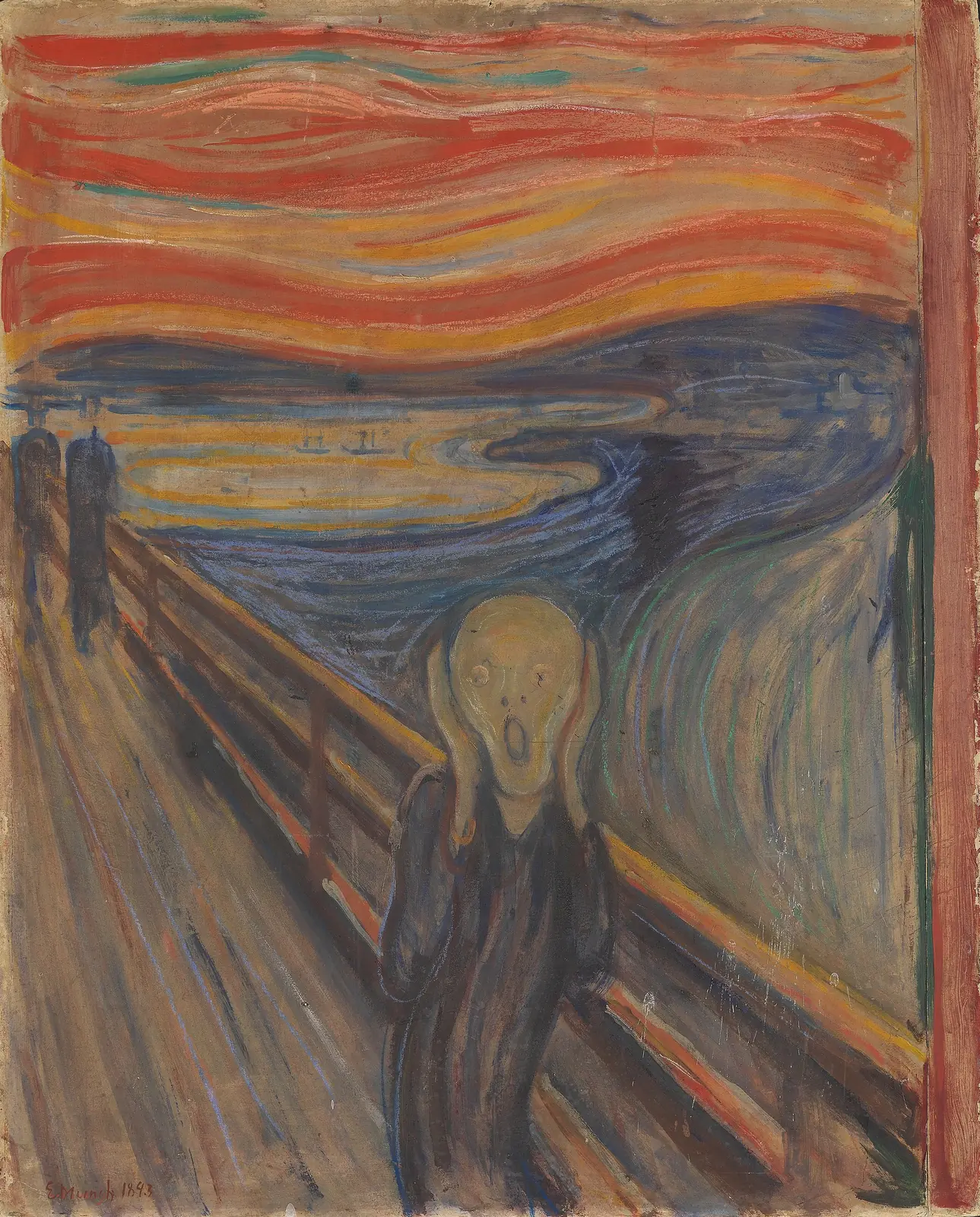
That difference clarifies what is singular here. The Starry Night is not an expressionist shout before Expressionism. It is a post-impressionist landscape in which sensation, memory, and design are forced into unusual agreement.
Why this image became global
The painting's afterlife depends on more than biography. It reproduces unusually well because its silhouette survives scale reduction: dark cypress, low village, bright orbs, sweeping sky. Even as a thumbnail, the structure holds. That visual durability helped make it one of the most circulated images in modern art.
Institutional history reinforced that strength. MoMA showed the work in its 1935 Van Gogh retrospective and acquired it in 1941, helping turn the canvas into one of the museum's defining pictures. Public fame followed from that museum life, but it lasts because the image is genuinely built to stay in the eye.
The painting feels turbulent, but it is built with remarkable discipline.
Reading paths from The Starry Night
Move next to Van Gogh, then to Post-Impressionism, then outward to The Scream or Impression, Sunrise. That route makes the difference clearer: Monet registers atmosphere, Van Gogh intensifies it, and Munch breaks it toward existential shock. After that, try the art quiz.
Primary sources
One final reading habit helps. Trace the picture from cypress to village to sky before reaching for biography or symbolism. The canvas explains itself formally before it asks for interpretation.
Frequently asked questions
The Starry Night is famous because it combines immediate visual force with strong structure. The image is instantly recognizable, and its museum life at MoMA helped turn that formal power into global public fame.
Partly. The east-facing window at Saint-Paul-de-Mausole provided the starting motif, but Van Gogh transformed it heavily. The final painting is a constructed synthesis, not a literal transcription.
Not as shown. The surrounding hills come from Saint-Rémy, but the village is reworked from memory and invention, and the church spire feels more Dutch than Provençal.
The sky swirls because Van Gogh builds it through directional brushwork, repeated curved bands, and strong blue-yellow contrast. The effect feels emotional, but it is also highly organized.
He was ambivalent. In his letters he sometimes defended the work, but he also worried about paintings that drifted too far into abstraction or looked affected. That hesitation is part of the canvas's history.