
Collective Medieval Workshop
Bayeux Tapestry Workshop
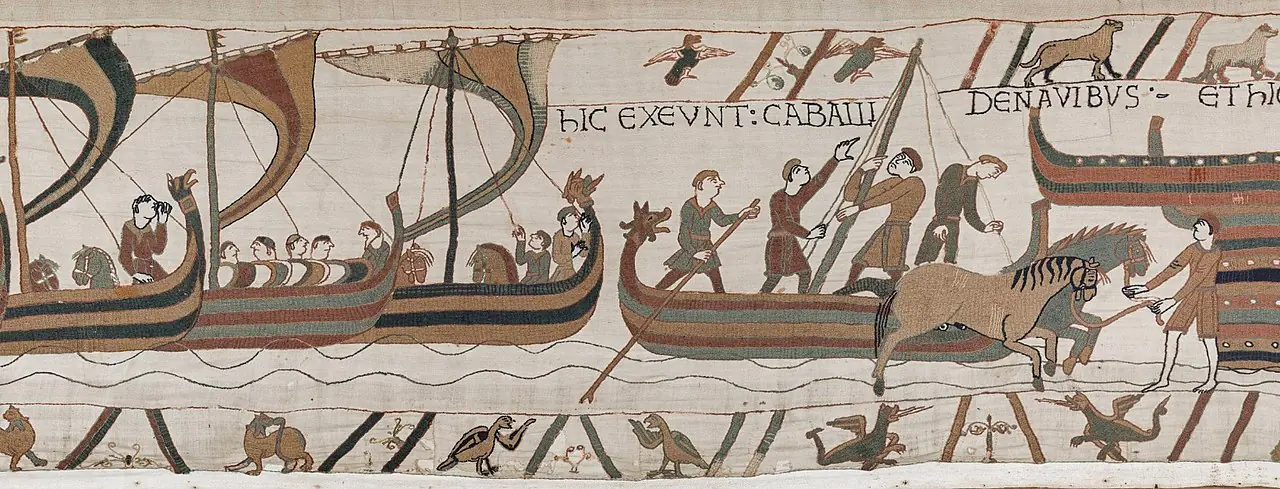
No one signed the Bayeux Tapestry, but it did not make itself. The object is too long, too coherent, and too technically controlled to be reduced to vague anonymity. The right maker here is a workshop: people who designed the sequence, prepared the linen, managed the wool, added the inscriptions, and stitched conquest into durable memory.
That shift matters because Bayeux is often flattened in two bad ways. It gets treated either as a lone masterpiece with no real makers, or as a neutral document that merely records 1066. It is neither. It is organized collective labor. Once you read it that way, the embroidery becomes less mysterious and much more concrete.
Why a workshop is the right unit
Calling this page a workshop profile is not a gimmick. It is a way of describing the object honestly. The Bayeux Tapestry is nearly 70 meters long, made of nine linen panels joined together, and stitched with a small range of wool colors using a limited set of embroidery techniques. That level of consistency implies coordinated labor, shared models, and some form of supervision. "Unknown artist" is too vague. "Workshop" tells you more about how the thing was actually made.
It also helps with authorship. Medieval monumental objects often come from collective systems rather than from the modern figure of the solitary creator. In Bayeux, what matters most is not a missing signature. It is the successful coordination of drawing, stitching, pacing, and political emphasis across a very long surface that still reads clearly today.
Who may have worked on it
The most useful recent summary comes from the British Museum: likely commissioned by a Norman patron, made by English embroiderers, and based on manuscript drawings from Canterbury. That does not give us individual names, but it gives us a plausible structure. A patron defines purpose. A designer or group of designers shapes the sequence. Skilled embroiderers execute it. Someone literate oversees or supplies the Latin tituli.
This is much more concrete than the old myth of a single unknown master. The Bayeux makers were probably not all doing the same job. Some people had to think in images. Others had to translate those images into wool on linen without losing clarity. Others may have prepared support, managed joins, or controlled the regularity of the stitch work. The object reads like a coordinated chain of tasks, not like one hand doing everything.
How the work was organized
The Bayeux Museum is right to insist that the object is an embroidery, not a true tapestry. That technical fact tells us a lot about labor. Embroidery allows direct outlining and filling on a prepared ground. It also allows work to be distributed more easily across sections while preserving a shared visual language. The workshop did not need to invent illusionistic depth. It needed strong contours, stable figure types, readable animals, and a pace that viewers could follow.
Training matters here as much as authorship. The makers had to know how to hold a line, fill broad shapes quickly, and keep ships, horses, helmets, and marching bodies consistent over dozens of scenes. This is why the Bayeux workshop is best understood not as a mystery genius, but as a trained production network able to turn design discipline into public storytelling.
Probably made in England, not in Bayeux
The name is slightly misleading. Despite being preserved in Bayeux, the embroidery was probably made in England, quite possibly in Canterbury, for a Norman patron. The figure most often proposed is Odo, bishop of Bayeux and half-brother of William the Conqueror, though certainty is impossible. The safest version is simple: Norman purpose, likely English production, later Bayeux preservation.
That distinction matters because it changes how the object is read. Bayeux is not just "French medieval art" in a broad sense. It belongs to the Anglo-Norman world that forms after 1066, where conquest, administration, church networks, and visual culture are being reorganized at speed. The workshop stands exactly inside that historical crossing point.
What can actually be known
There are limits, and those limits matter. We cannot identify the embroiderers by name. We cannot reconstruct the entire chain of decision-making scene by scene. We cannot prove exactly who drew the original models. But we can say a great deal from the object and from comparison with manuscript culture: multiple hands were involved, visual planning was strong, and the work sits close to the artistic world of late Anglo-Saxon England.
That is often enough for good history. The goal is not to pretend certainty where there is none. It is to replace lazy mystery with a clearer account of probable work: Norman patronage, English making, manuscript-trained design, literate supervision, and disciplined embroidery.
Legacy
The legacy of the Bayeux workshop is larger than a single medieval object. It proves that embroidery can function as historical media, not merely as ornament. It also leaves behind one of the clearest early demonstrations of how sequence, repetition, and selective emphasis shape public memory.
That legacy still matters because later visual cultures keep reusing the same logic. Historical scrolls, battle cycles, documentary illustration, comics, storyboards, and timeline-based digital narratives all depend on controlled succession rather than on one isolated image. Bayeux does not invent narrative images, but it remains one of the sharpest medieval lessons in how narrative design can carry authority.
Reading paths from Bayeux
A productive route is to start with The Bayeux Tapestry (Scene Detail), then move to Romanesque, then compare Bayeux with Lindisfarne and Kells. That sequence shows two different kinds of medieval collective making: one built around narrative movement, the other around page density and devotional concentration. Then try the art quiz.
Primary sources
Frequently asked questions
Probably not. Most historians place its making in England, perhaps Canterbury, for a Norman patron. Bayeux is where the embroidery was preserved and later displayed, not necessarily where it was produced.
No. Technically it is an embroidery: wool threads stitched onto linen, not an image woven directly on the loom like a true tapestry.
The safest answer is a mixed team: a Norman patron, designers close to the manuscript culture of Canterbury, and English embroiderers capable of carrying out a large and disciplined narrative project. Individual names remain unknown.
The Bayeux workshop matters because it turns conquest into durable public memory. The embroidery is at once a work of art, a political argument, and a major visual source for eleventh-century life.