
Artist Guide
Hieronymus Bosch
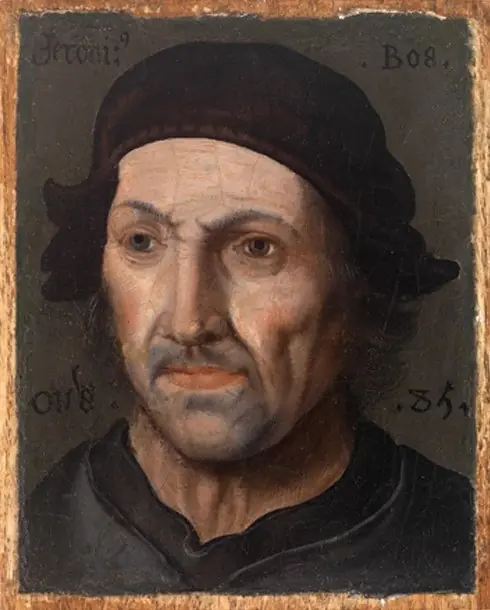
Bosch engineered moral anxiety through image density. Hieronymus Bosch built visual worlds where desire, folly, and fear become concrete. His panels reward slow looking because every corner carries symbolic pressure.
Late medieval workshops, devotional culture, civic audiences
Working in the late medieval and early Renaissance Netherlands, Bosch developed his career inside an urban workshop environment where religious instruction, popular proverb culture, and elite patronage interacted closely. His viewers were trained to read layered allegory, but Bosch pushed that habit to unusual density.
The result is not random fantasy. It is a disciplined narrative strategy that uses excess to test moral interpretation.
Narrative density as a compositional method
Bosch fills panels with hybrid bodies, strange tools, unstable architecture, and miniature episodes that challenge linear reading. Yet the compositions are tightly staged: the eye is guided through temptation, consequence, and judgment by shifts of scale, horizon structure, and clustered movement.
This is why Bosch remains central to Northern Renaissance debates. He does not abandon structure; he overloads it on purpose.
The Garden of Earthly Delights as moral choreography
The Garden of Earthly Delights is best read as a sequence rather than a single image: origin at left, seductive excess at center, punitive inversion at right. Bosch forces viewers to oscillate between macro order and micro incident, producing both fascination and unease.
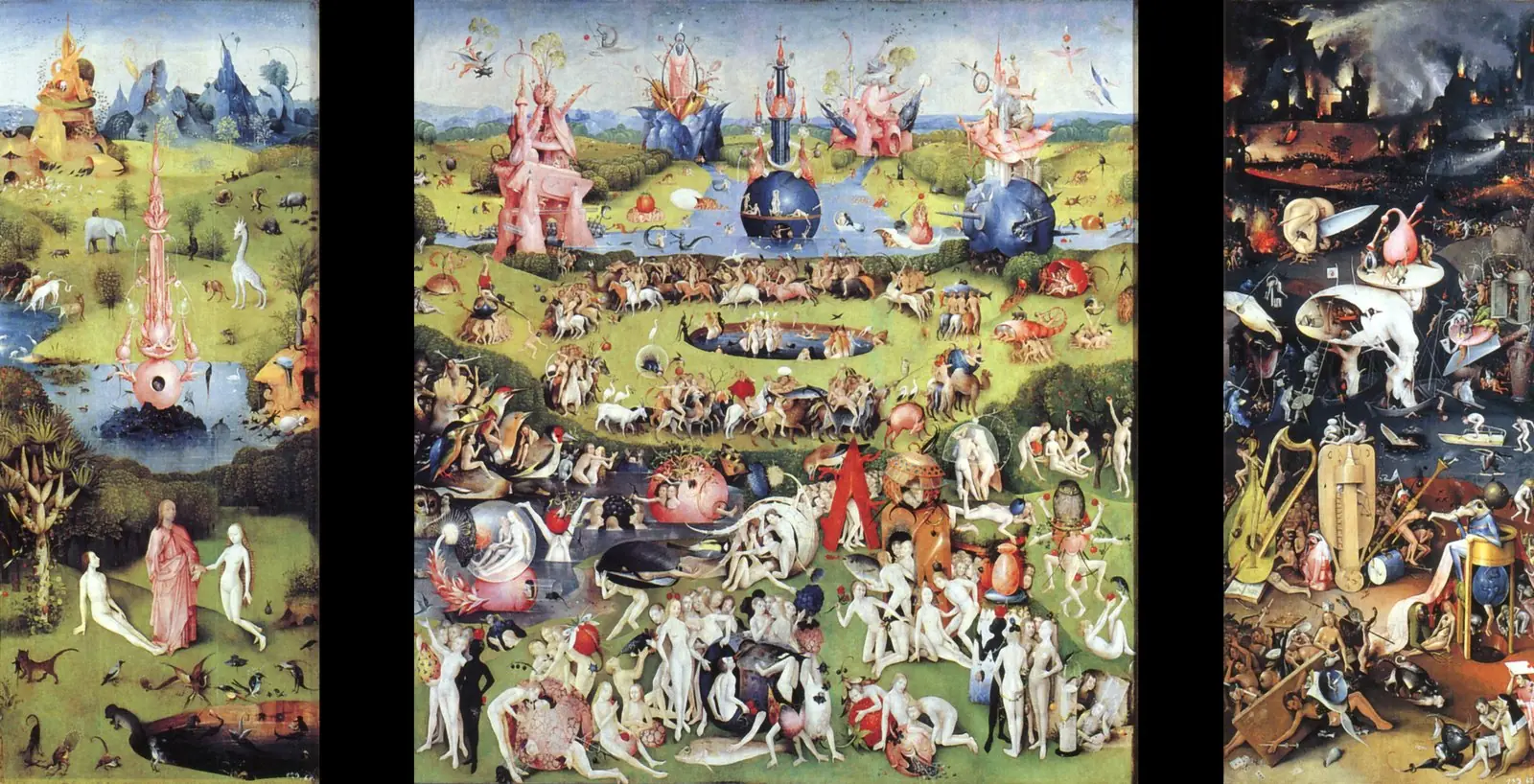
That sequencing explains why each new viewing yields new links. Bosch's images are engineered for rereading, not one-pass interpretation. Technical imaging has reinforced this point: infrared and workshop studies reveal a controlled process of planning and revision, not spontaneous hallucination. Bosch's strangeness is engineered, which is exactly why it remains durable.
Humor, fear, and social criticism in one system
Bosch uses hybrid creatures, absurd tools, and grotesque punishments to make vice legible, but the tone is never one-dimensional terror. Dark comedy, urban satire, and observation of everyday behavior all coexist. The paintings criticize appetite, vanity, and corruption without pretending that moral order is simple or stable. This blend of entertainment and warning helps explain why his imagery worked across elite and broader publics.
A concrete historical detail matters here: Bosch belonged to the Illustrious Brotherhood of Our Blessed Lady in 's-Hertogenbosch, a civic-religious network that connected devotion, status, and patronage. That context clarifies why his works can be both intensely spiritual and sharply social. They are not private nightmares. They are public moral technologies for a literate urban culture.
Afterlives from Bruegel to modern visual culture
Bosch's image-world circulated through copies, prints, and collecting culture, then resurfaced in modern debates about the irrational. Pair this profile with The Garden of Earthly Delights, Northern Renaissance, Dürer, and Melencolia I to track how symbolic density migrates across formats. A more distant counterpoint with Malevich helps clarify two extremes of modern visual logic: Bosch overloads narrative content, while abstraction strips it away.
His legacy lies in coupling imaginative excess with compositional discipline. Bosch rewards slow reading in the same way contemporary complex images do: meaning is distributed, layered, and never exhausted at first glance. That is why he remains foundational for teaching visual literacy beyond medieval art history.
Another practical point is workshop transmission. Bosch's designs were copied, adapted, and reassembled in early modern markets, which stabilized a recognizable visual grammar even when attribution remained uncertain. This matters for interpretation today: we should read Bosch not only as an isolated genius, but as a node in a larger production ecosystem where invention, replication, and reception interact. That broader frame makes his historical influence easier to measure and less mythical.
Key works in Explainary
Associated movements
Continue with the art quiz to validate recognition, context, and comparison.