
Northern Renaissance
The Garden of Earthly Delights
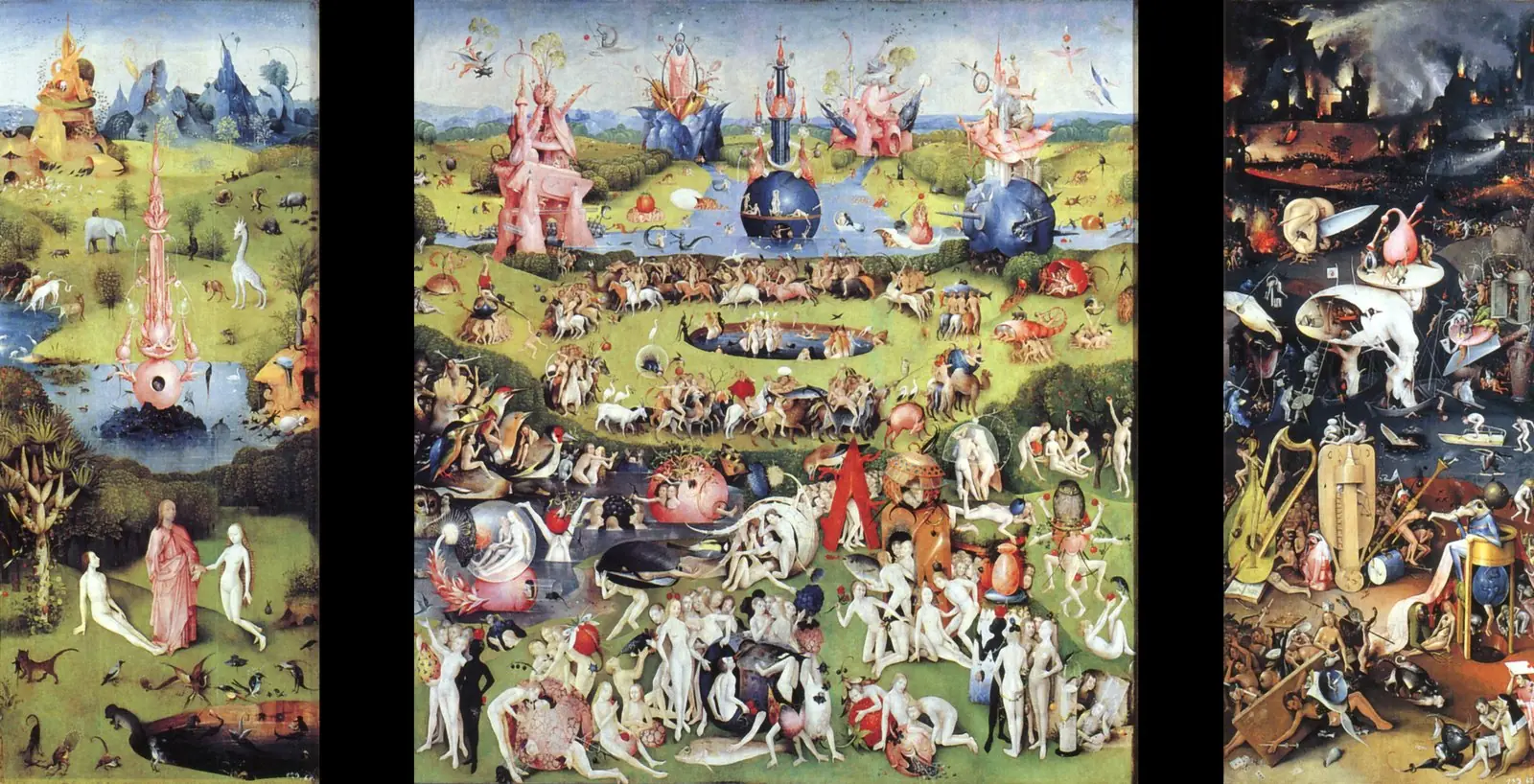
Few paintings punish fast interpretation as brutally as this one. The Garden of Earthly Delights is not a pile of eccentric symbols; it is a tightly engineered triptych where meaning emerges from sequence, scale, and tonal shift.
Context of making: a court object with moral ambition
Painted around 1490-1510 and documented in elite collections by the early sixteenth century, the work was made for viewers trained to read religious and moral imagery across multiple registers. Bosch works inside late medieval devotional culture, but he pushes that culture toward visual excess and interpretive risk.
This context helps avoid a common mistake: treating the triptych as random fantasy. The panel structure signals deliberate argument, not decorative accumulation.
What the three panels show, concretely
Left panel: a world of creation and ordered beginnings, with God introducing Eve. Center panel: nude figures, oversized fruits, birds, pools, and hybrid architectures in a proliferating landscape of appetite. Right panel: a dark infernal zone where music, tools, and bodies become instruments of punishment.
Bosch's descriptive precision is crucial here. Even the strangest forms are painted with enough clarity to feel legible, which is why viewers keep trying to decode them.
Intention: moral instability, not single-message doctrine
The triptych does not deliver one simple sermon. It stages how quickly delight, curiosity, and sensory abundance can slide into disorder. Bosch lets pleasure appear seductive before showing its structural cost.
That temporal logic is the key: the painting teaches through progression, not through one emblematic detail.
Formal analysis: how the eye is guided panel to panel
Color is one of Bosch's strongest narrative tools. Luminous pinks, blues, and greens in the center panel expand the visual field, then collapse into compressed darkness on the right. The shift in light registers the shift in moral climate before any iconographic reading is complete.
Scale also destabilizes perception. Fruits become architectural, animals dominate human groups, and familiar proportions fail. This breakdown of scale is not ornament; it is the painting's way of showing a world where measure has been lost.
This triptych asks what a whole system looks like when proportion fails.
Why the work remains historically active
The triptych survives because it can be read at different levels without becoming empty: devotional warning, courtly spectacle, proto-psychological landscape, and media-era image labyrinth. Each reading captures part of the work, but none exhausts it.
Its endurance also comes from method: Bosch makes the viewer work through transitions, so interpretation stays dynamic rather than collapsing into a fixed moral slogan.
If this structure now feels clearer, use the art quiz to test whether you can identify Bosch quickly among other Northern Renaissance images.
Explore more
Related works
Primary sources
Frequently asked questions
The triptych format is decisive: meaning shifts as you move panel to panel, from creation to excess to punishment, turning interpretation into staged sequence.
Late medieval and early modern devotional culture framed pleasure, sin, and judgment in tightly linked moral narratives rather than modern ideas of private lifestyle.
Start with how the eye travels left to center to right: the sequence itself creates meaning before any isolated symbol does.