
Late Pre-Raphaelite Painter
John William Waterhouse
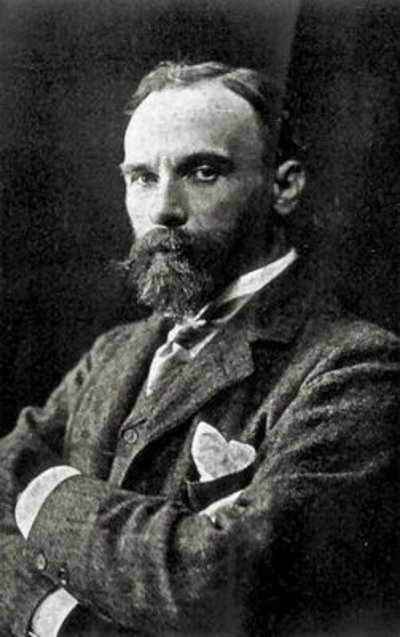
John William Waterhouse arrived after the original Pre-Raphaelite revolt, then gave its afterlife one of its most memorable languages. He made myth and poetry feel immediately legible: women at thresholds, stories caught before disaster, glowing color, historical costume, and a kind of narrative suspense that turns looking into anticipation.
A Roman-born painter trained for the Royal Academy
Waterhouse was born in Rome in 1849 to English painter parents and grew up with art as a family environment rather than a distant profession. The family later returned to England, and he entered the Royal Academy Schools in London. He first moved toward sculpture, then shifted to painting, exhibiting at the Royal Academy from the 1870s and building a career within the central exhibition system of late Victorian art.
That institutional path defines the tension in his career. Waterhouse was not an outsider rebelling from the margins. He became an Associate of the Royal Academy in 1885 and a full Royal Academician in 1895. His art combines academic control with a more seductive, literary, emotionally charged inheritance from the Pre-Raphaelite Brotherhood.
A modern Pre-Raphaelite, not an original brother
The phrase "Pre-Raphaelite" can blur chronology. The Brotherhood began in 1848 with artists such as John Everett Millais, William Holman Hunt, and Dante Gabriel Rossetti. Waterhouse was born the following year. He did not help found the movement, and his mature career belongs to a later Victorian world.
His link to Pre-Raphaelitism is still real. Like the earlier painters, he returns to poetry, medieval legend, Shakespeare, Tennyson, and myth. He gives intense attention to costume, color, hair, flowers, water, and symbolic objects. But his pictures often feel less hard-edged than early Pre-Raphaelite work. They are smoother, darker, more atmospheric, and more directly theatrical.
Stories at the point of no return
Waterhouse repeatedly chooses moments when a figure has already crossed into danger but the final event has not yet happened. That rhythm shapes The Lady of Shalott, his Ophelia subjects, Circe, Hylas and the Nymphs, and many of his mythological women. The viewer arrives in the interval between desire and consequence.
That interval gives his art its popular force. Waterhouse is not simply illustrating old stories. He isolates the instant that makes them emotionally clear: a glance, a departure, a listening body, a hand at the edge of action, a woman surrounded by signs she cannot fully control. The picture becomes a dramatic threshold rather than a summary.
The Lady of Shalott gathers the method
The Lady of Shalott gathers Waterhouse's strengths without reducing him to one subject. The painting takes Alfred Tennyson's poem and shows the heroine after she has looked directly toward the world she was forbidden to see. She sits in a boat, surrounded by candles, tapestry, crucifix, reeds, and dark water, beginning the journey toward Camelot and death.
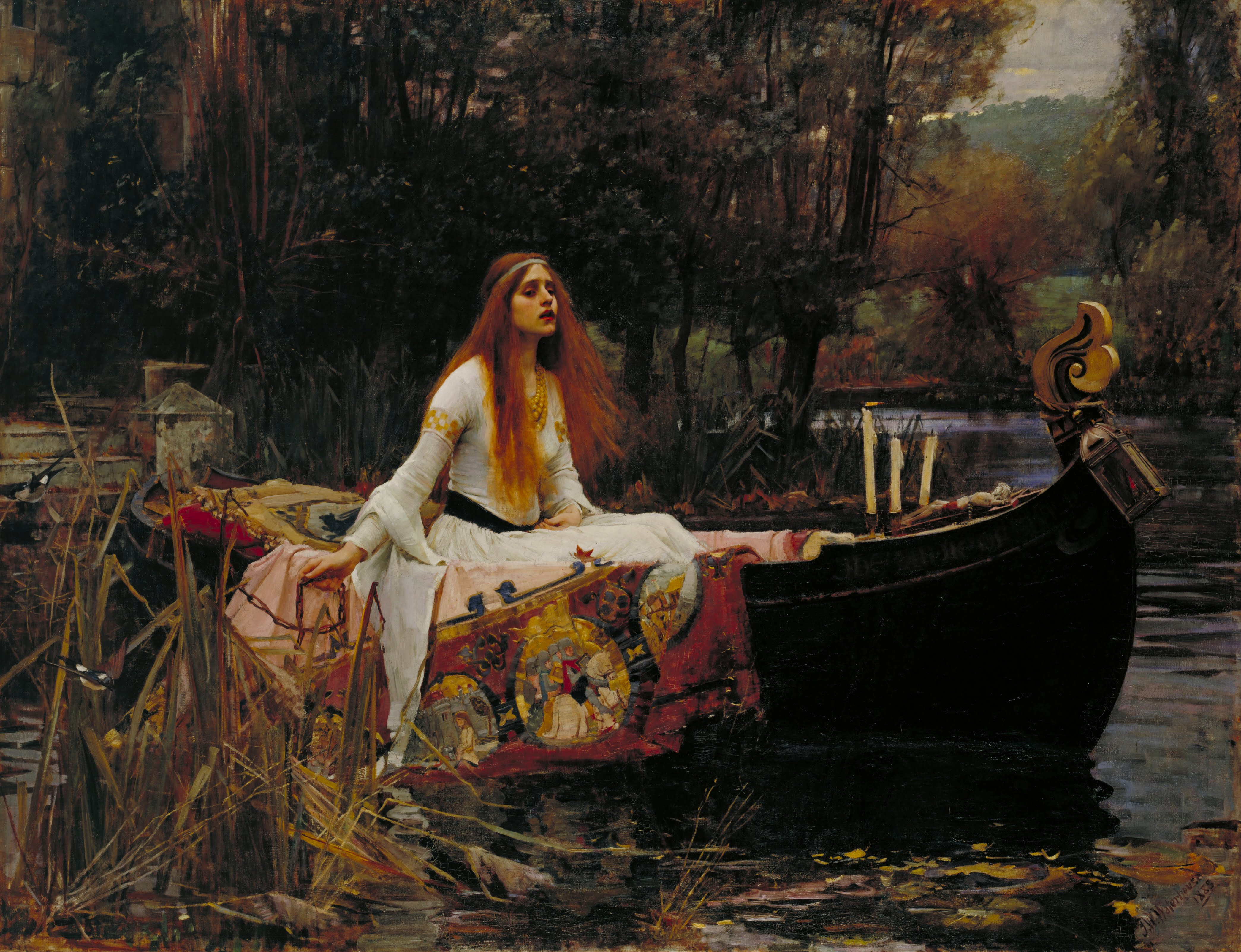
The painting clarifies Waterhouse's method. Literary source, costume, river, object, and facial expression all serve one dramatic pressure. The image can be understood quickly, but it rewards slower looking because every object in the boat sharpens the sense of passage.
Waterhouse and Millais: inheritance with a different temperature
The comparison with Millais's Ophelia shows the difference between first-generation Pre-Raphaelite discipline and Waterhouse's later language. Millais makes nature exact and almost forensic. His flowers and riverbank slow the eye until beauty becomes uncomfortable. Waterhouse keeps the literary woman near water, but he lets atmosphere and narrative clarity lead.
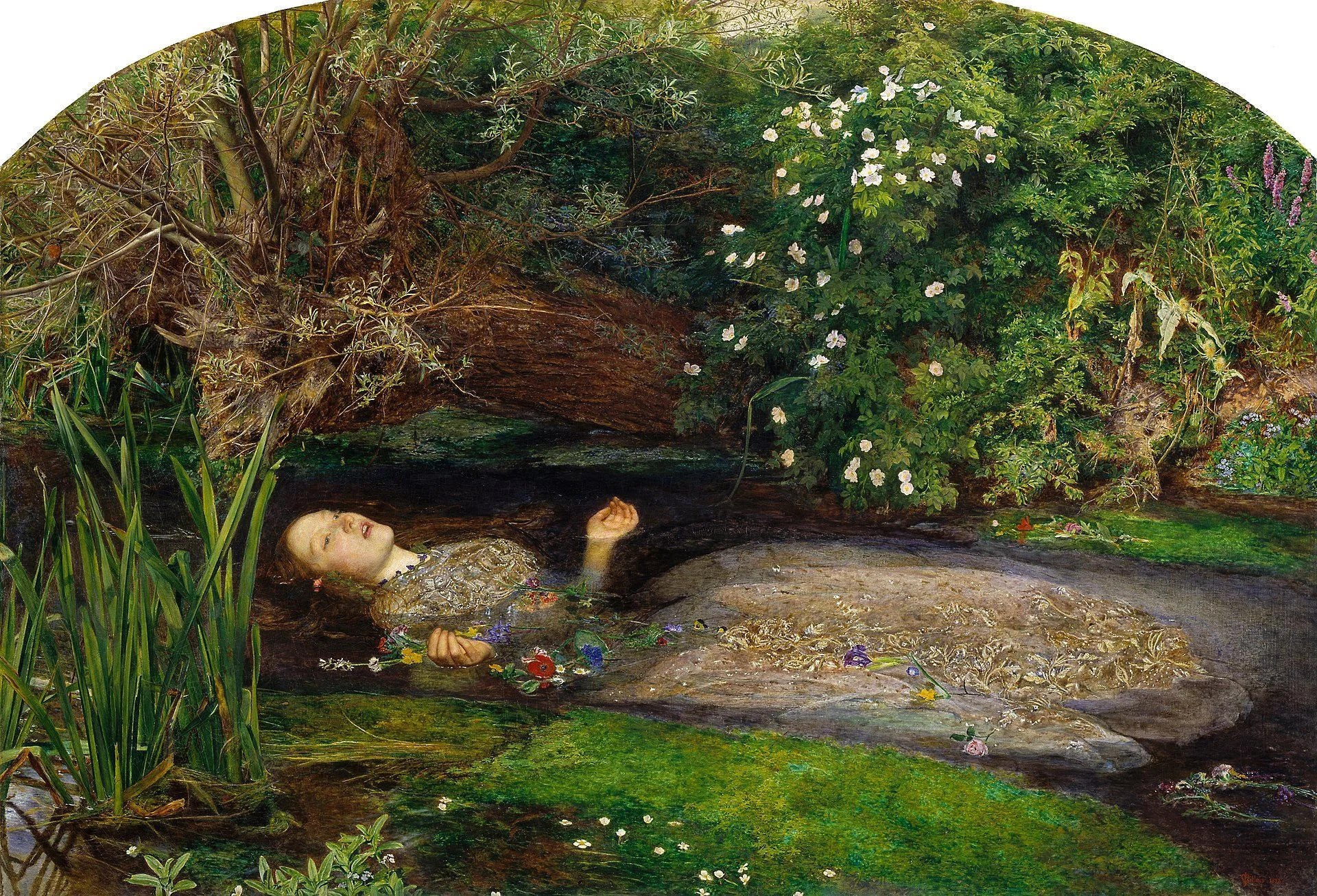
This difference keeps Waterhouse from being merely a late imitator. He translates Pre-Raphaelite memory into a more cinematic Victorian narrative. The surface is less manifesto-like, but the emotional route is exceptionally clear.
Color, atmosphere, and controlled seduction
Waterhouse's paintings often depend on strong color contrasts: pale skin against dark water, red hair against shadow, white fabric against reed and bank, blue or green surfaces against warm flesh. He uses academic figure drawing to keep bodies readable, then surrounds them with a poetic atmosphere that softens the boundary between story and dream.
His work also sits near Symbolism. He rarely dissolves narrative completely, but he makes stories feel like psychological states. Water, mirrors, flowers, boats, threads, cups, and thresholds become more than props. They are the visual means by which the painting turns action into mood.
Legacy and reputation
Waterhouse's reputation has moved in waves. His subject matter, once admired, looked unfashionable to many modernist histories that preferred rupture, abstraction, and visible formal experiment. Yet his images remained intensely alive in reproduction because they have immediate narrative pull. Viewers recognize the emotional situation before they know the source text.
His legacy is now clearer: not a founder of Pre-Raphaelitism, not a modernist rebel, but a painter who made late Victorian narrative art unusually durable. He gave literary painting a public face that still travels well because the images are structured around legible tension rather than decorative nostalgia.
Continue with Waterhouse
Then try the art quiz.