
Artist Guide
Piet Mondrian
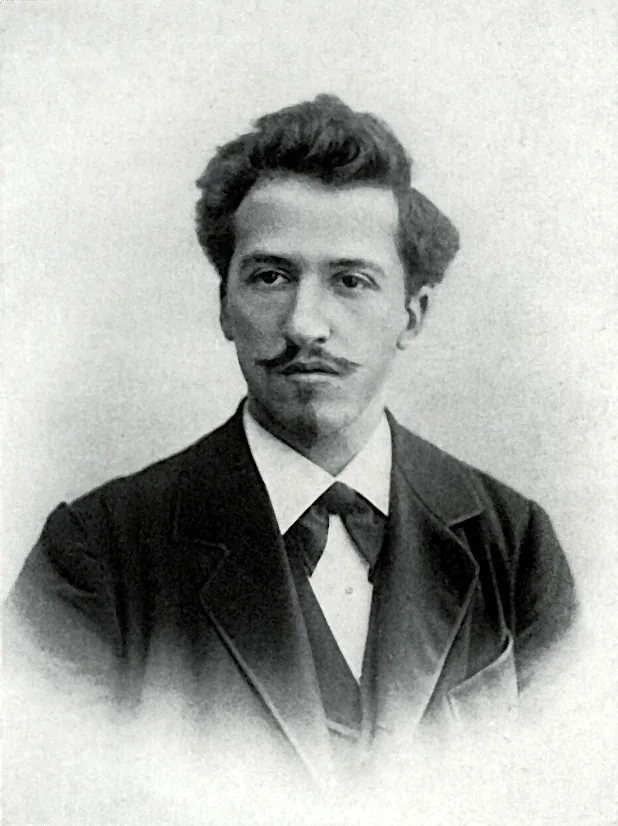
Mondrian turned abstraction into a discipline of balance rather than a decorative pattern. His late grids look simple only if you ignore the long training behind them: landscape structure, symbolic reduction, Cubist pressure, and the rigorous program of De Stijl. Read across that whole arc, Mondrian becomes much richer than the cliché of red, blue, and yellow rectangles.
Training and career arc
Born in Amersfoort in 1872, Mondrian began with Dutch academic training and sustained work from nature. Trees, dunes, mills, and church facades taught him axis, weight, and proportion long before he abandoned literal description. That origin matters because the late grids never truly sever themselves from observed structure; they compress it.
His career then moves through several decisive phases: Symbolism and Theosophy, the encounter with Cubism in Paris before the First World War, the disciplined clarity of De Stijl, and the faster syncopation of the New York years. Seen as a sequence of problems rather than a branded style, Mondrian becomes historically legible.
From landscape to neoplastic system
Mondrian did not leap from windmills to grids. He reduces, tests, and recalibrates over many years, stripping away curved forms, local color, and descriptive detail until verticals, horizontals, and primary colors can carry the full load of the composition. The breakthrough is methodological: he proves that reduction can intensify structure rather than empty it.
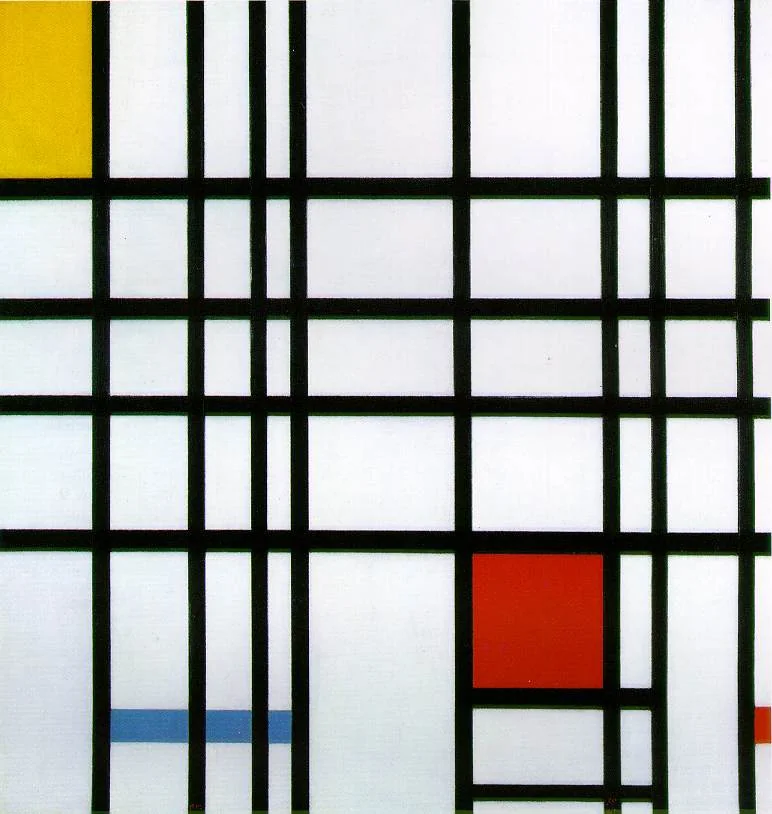
In Composition with Red, Blue and Yellow, that long reduction becomes visible. The canvas is compact, but nothing is casual: black lines regulate pressure, color blocks interrupt drift, and blank areas work like measured intervals rather than leftover space.
How to read Mondrian without flattening him
Start with balance before symbolism. Ask where the painting leans, which intervals feel tense, and how line thickness redistributes force across the surface. The point is not to decode a hidden story, but to see how a highly restricted vocabulary produces movement without losing equilibrium.
A good exercise is to compare an early tree painting with a late grid. The subject seems to disappear, yet the deeper concern remains continuous: how to hold tension in a stable structure. That continuity is what protects Mondrian from the usual oversimplification.
Mondrian beyond the design cliché
Mondrian is often treated as a design ancestor, and that part is true. His work shaped architecture, typography, editorial layout, and interface thinking. But if you stop there, you miss the harder point: these canvases are not templates, they are arguments about visual order.
Read him against Black Square, Yellow-Red-Blue, and the broader frame of Abstract Art. Malevich pushes toward absolute reduction, Kandinsky toward orchestration and inner force, while Mondrian stages equilibrium as a living tension. That difference is why he matters.
Legacy and continuing relevance
Mondrian's legacy remains central because he proved that extreme formal discipline could stay visually alive and culturally transferable. His grids helped define twentieth-century design pedagogy, but they also sharpen a more durable lesson for readers: simplicity in art is often compressed complexity.
That is the right way to end on Mondrian: not as a logo-like icon, but as an artist who spent decades building one of modern painting's clearest systems for thinking through proportion, relation, and visual balance.
His afterlife also depends on resistance to simplification. Museums, design schools, and digital systems borrowed Mondrian's surface grammar, but the paintings still matter because the intervals are too exact, the asymmetries too deliberate, and the whites too active to collapse into mere style. They keep teaching viewers that order can stay tense rather than static.
Key works in Explainary
Associated movement
Use the art quiz as a quick check: can you reconnect Piet Mondrian to the right visual system when grids, circles, and gestural abstraction are mixed together?