
Abstract Art
Black Square
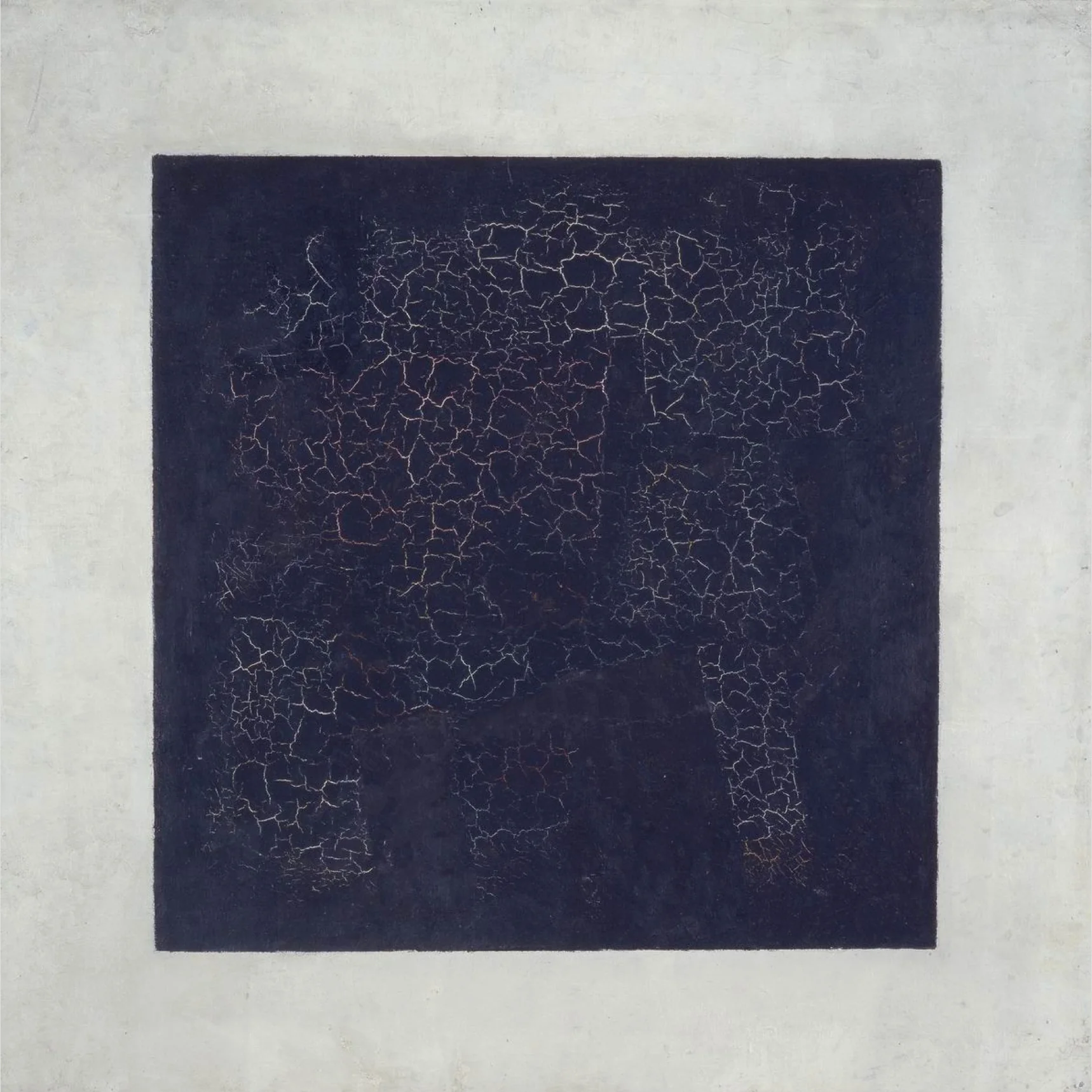
A radical reset of painting: no narrative scene, no figure, only form, edge, and surface as primary content. Malevich converts abstraction into a high-pressure test of visual meaning, where relation replaces representation and attention itself becomes the subject.
A hard break, not a minimalist joke
It is easy to dismiss Black Square as "just a square." That reaction misses the historical wager. Malevich positions painting at a point-zero: remove object depiction, remove anecdote, remove illusion, and test what remains when representation is suspended. Read with his broader trajectory, the gesture is method, not provocation.
What remains is not emptiness but tension: square against field, geometry against hand-made irregularity, concept against material support. The work asks whether pure relation can carry meaning without narrative cover.
Suprematist intention and 1915 context
Malevich's Suprematism emerges in a period of war, political volatility, and artistic exhaustion with inherited realism. His formula - "supremacy of pure feeling" - does not reject thought; it relocates thought. Meaning no longer sits in depicted objects. It sits in interval, pressure, weight, and rhythm.
At the 1915 "0.10" exhibition in Petrograd, Black Square was placed high in the room, near the position traditionally reserved for an icon. That hanging was not a joke. It staged abstraction as a new type of image authority, at once sacred parody and modern manifesto.
Material reality: edge, crackle, conservation
The painting we see now includes aging: crackle, tonal shifts, and subtle instability in the black zone. These are not disposable damages. They remind us that radical theory lives in pigment chemistry, canvas tension, restoration history, and museum conditions.
In an era dominated by frictionless digital images, that material vulnerability matters. Black Square is not pure concept floating above matter; it is concept under physical stress.
Edge tension as the core argument
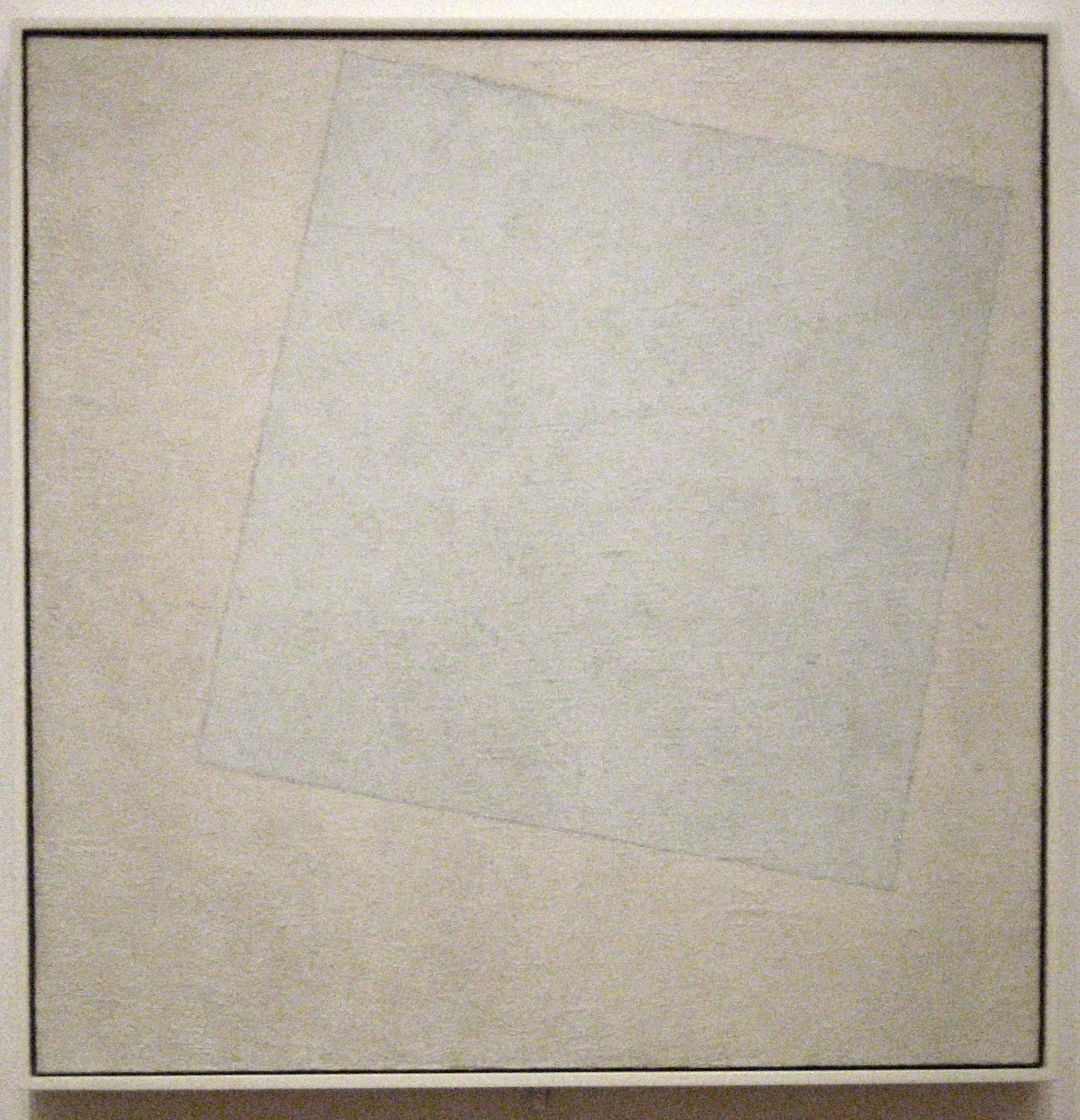
The decisive issue is not symbolism but edge behavior: where the square holds, where it frays, where black pressure meets the lighter ground. These micro-instabilities keep the work from becoming decorative geometry. Read with White on White, the painting makes its own thesis explicit: reduction does not eliminate meaning, it relocates meaning into relation, interval, and duration.
Reception, myth, and misunderstanding
The painting quickly generated two opposite myths: for some, it was proof that modern art had collapsed into absurdity; for others, it was a purified icon of total artistic freedom. Both myths simplify the work. Black Square is neither empty prank nor mystical shortcut. It is a disciplined argument about visual grammar, staged at maximum compression.
Its endurance comes from that tension. The picture is formally spare but historically dense. It condenses debates about revolution, spirituality, technology, and the limits of representation into one severe format. That density is why the canvas keeps attracting projection - and why close reading remains necessary.
Long afterlife in visual culture
Malevich gave modern visual culture a grammar of decisive reduction. You can trace afterlives in logos, interface systems, architectural graphics, and installation art. But the original remains harder than its descendants because it refuses utility. It asks, without compromise, what visual meaning can survive when the world-picture is turned off.
Seen beside Composition VII and Composition with Red, Blue and Yellow, Black Square marks one extreme pole of abstraction: not complexity, not harmony, but existential compression.
However, its endurance is not based on shock value alone. In practice, the canvas works as a disciplined field of edge behavior, tonal pressure, and asymmetry. By contrast with decorative geometric modernism, Malevich keeps the form unstable enough to resist comfort. As a result, looking becomes an active test, and therefore the image continues to generate serious argument.
Abstraction here is not the absence of meaning; it is meaning organized through relation, rhythm, and attention.
Explore more
Related works
If Black Square is clearer now, try the art quiz and see whether you can spot works by Kazimir Malevich in seconds.