
Abstract Art
Yellow-Red-Blue
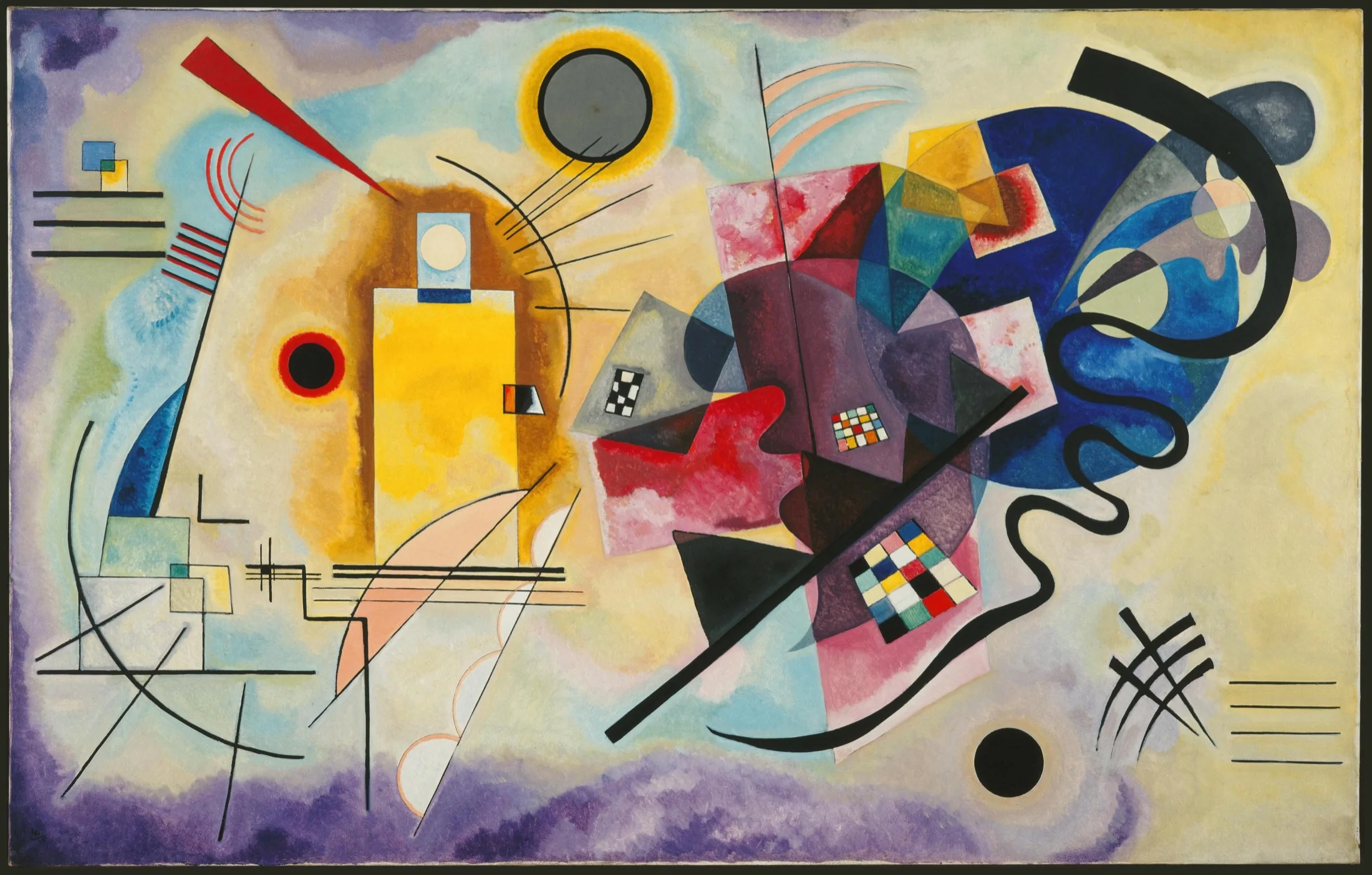
At first glance, this canvas looks stable: circles, lines, angles, a clear partition of space. Stay longer and it begins to move. Kandinsky designs the painting as a controlled conflict between geometric orders and chromatic pressure.
A Bauhaus canvas built as a field of forces
Painted in 1925, the work belongs to Wassily Kandinsky's Bauhaus years, when he was formalizing links between point, line, plane, and chromatic behavior. The title sounds elementary, but the structure is not. Kandinsky sets up a controlled confrontation between warm expansion and cool recession, then keeps the surface unstable through intersecting vectors, curved counters, and abrupt scale changes.
Chromatic zones, vectors, and shifting centers of gravity
The left half is pushed by yellow zones that feel centrifugal; the right side gathers blues and dark accents that deepen and slow the eye. Red concentrations in the center do not simply divide both sides, they redistribute weight. Circles, diagonals, and angled lines repeatedly interrupt one another, so the image never settles into a static diagram. You are reading a choreography of pressure, not a coded narrative.
Kandinsky's method: geometry that behaves like music
Kandinsky's key idea is practical: color and form can operate like active forces rather than decorative labels. Yellow advances, blue withdraws, red condenses intensity; arcs regulate tempo while diagonals inject speed. That is why the painting remains legible across multiple passes: one viewing gives impact, repeated viewing reveals architecture.
Where this sits in abstraction history
Compared with Improvisation 28 and Composition VII, this canvas is less storm-like and more engineered, but it keeps the same ambition: organizing sensation without relying on figurative storytelling. Set next to Malevich's Black Square, the contrast is even clearer. Malevich tests reduction; Kandinsky tests orchestration. Together they show two distinct routes inside Abstract Art.
Material decisions and museum-scale reading
The work is often discussed through theory, but its material construction is just as important. Kandinsky varies line thickness and contour sharpness so that some forms cut across the surface while others dissolve at their edges. He also balances flat color passages with more modulated transitions, which prevents the geometry from feeling mechanical. At full scale in the gallery, those decisions become clear: the painting is less like a diagram and more like a score performed with pressure changes.
Viewing distance changes meaning. Step back and the composition stabilizes into large directional zones; step closer and local frictions appear, especially where black accents interrupt warmer clusters or where curved forms counter diagonal thrust. This oscillation between macro-clarity and micro-instability is deliberate. Kandinsky is not illustrating abstraction as a style label; he is engineering a repeatable way of activating attention.
Reception, teaching value, and afterlife
The canvas also clarifies why Kandinsky mattered as both painter and teacher. In his Bauhaus years, he was not simply making striking images; he was building a vocabulary that could be taught, tested, and revised. Yellow-Red-Blue is one of the cleanest demonstrations of that program because it shows that precision does not kill intensity. It channels feeling through structure instead of opposing the two.
That lesson helps explain the painting's long influence across later abstraction and visual design cultures. Whether in postwar non-objective painting or in contemporary systems where hierarchy and contrast guide reading, the same issue returns: how to keep complexity legible. Read with Mondrian's grid logic, this work shows Kandinsky's alternative: not reduction to a minimum grammar, but polyphonic order held in tension.
Yellow-Red-Blue proves that rigor and emotion can share the same abstract surface.
Related links
If Yellow-Red-Blue is clearer now, try the art quiz and see whether you can spot works by Wassily Kandinsky in seconds.