
Designer, Printer, Socialist
William Morris
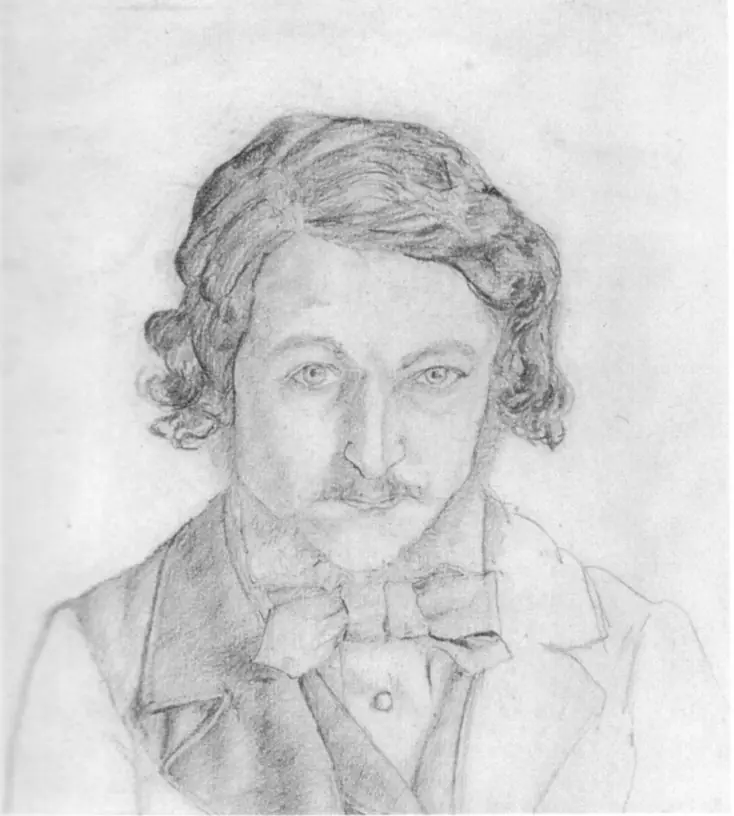
Morris treated decoration as a social fact. Wallpaper, textiles, furniture, and books were not secondary arts for him. They were evidence of how an industrial society valued labor, attention, and ordinary life.
That is why Morris cannot be reduced to floral pattern or Victorian nostalgia. He sits at the center of Arts and Crafts, but his real importance is broader: he turns workshop practice, domestic design, medieval study, printing, and socialist criticism into one coherent argument about what everyday objects should be.
Oxford, Red House, and the workshop idea
Morris did not emerge from a single academy studio. Oxford gave him the friendships that shaped everything that followed, above all with Edward Burne-Jones, and the orbit of Dante Gabriel Rossetti pushed him toward art made in conscious argument with industrial Britain. Architecture mattered early as well. Through Philip Webb and the building of Red House in the late 1850s, Morris helped turn the home itself into a designed environment rather than a pile of separate decorative decisions.
That setting explains the next step. Morris, Marshall, Faulkner & Co., and later Morris & Co., joined stained glass, furniture, wall decoration, textiles, and interiors under one workshop logic. The point was not simply to make attractive things in many media. It was to reconnect design with material knowledge and collective making.
Why the patterns hold up
Morris's patterns look lush because they are tightly controlled. Leaves, stems, birds, and flowers seem to grow freely, yet the repeat is carefully balanced so the surface can extend without collapsing into muddle. He studies nature closely, but he never copies it literally. The design has to remain readable on a wall, a hanging, or a book page over long use.
That is why pattern is serious work for him. A successful repeat has to stay alive while remaining structurally calm. It must avoid dead mechanical looping without falling into decorative noise. Morris builds density without confusion, which is harder than it looks.
What Strawberry Thief makes visible
Strawberry Thief makes Morris's intelligence visible at a glance. Birds, berries, and curling stems give the design immediate charm, but the real achievement is under the charm: pattern, rhythm, and repeat are doing disciplined work so that the textile can live across a room for years without becoming flat or monotonous.
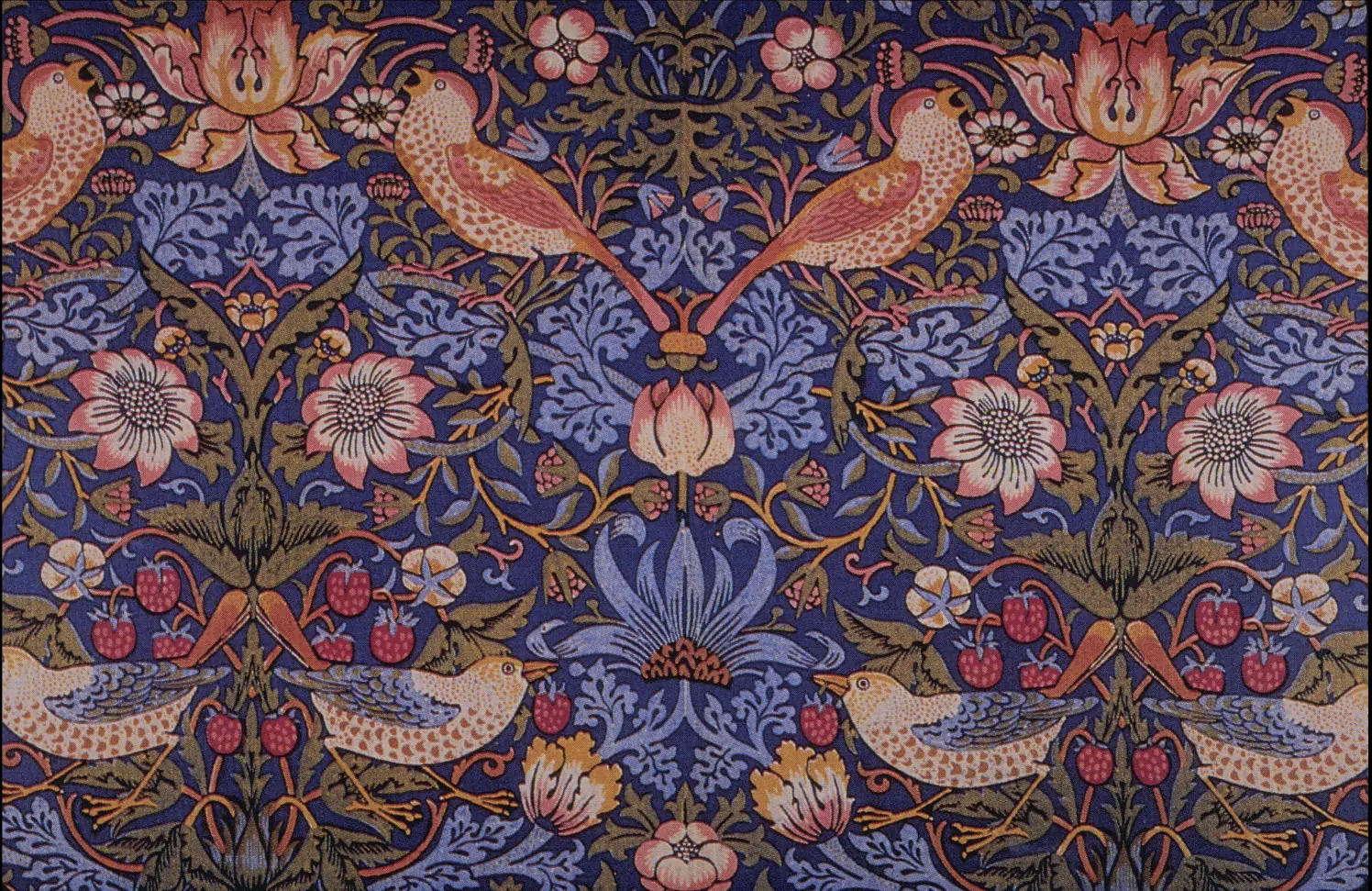
The work also keeps Morris from becoming abstract. He is not only a theorist of craft. He is a designer whose best surfaces show exactly how visual pleasure, technical discipline, and domestic use can reinforce one another.
Merton Abbey: craft, chemistry, and labor
Morris's reputation for beauty can hide how technical his production really was. At Merton Abbey, dyeing, weaving, and printing depended on repeated experiment with natural dyes, indigo discharge techniques, woodblocks, timing, and registration. Rich color was not just a matter of taste. It was a matter of process.
This is where his critique of industrial production becomes concrete. Morris is not interesting because he waves vaguely at craftsmanship. He is interesting because he knows what skilled production actually demands, and because he wants those demands to remain legible in the finished object rather than being buried under cheap uniformity.
From interiors to books
Kelmscott Press proves that Morris's project was never confined to wallpaper. In the 1890s he brings the same standards to book design: type, margins, paper, illustration, ornament, and page rhythm are treated as one environment. The book is not just a text container. It is a crafted object that teaches the reader how to look, pause, and move through a page.
His fascination with medieval art gives this project a longer history. Works such as the Book of Kells Chi Rho Page and the Lindisfarne Carpet Page show older ways of fusing ornament and reading into one visual field. Morris does not copy those models mechanically. He studies how they organize attention, then reworks that intelligence for modern printing.
Politics, socialism, and the luxury problem
Morris's politics belong inside the work, not beside it. His socialist writing makes clear that ugliness, shoddy production, and degraded labor are part of the same system. He wanted beauty to stop functioning as a luxury detached from ordinary life.
That ambition comes with an obvious contradiction. Many Morris objects were expensive and reached affluent interiors more easily than working-class homes. The contradiction should not be hidden, but it should be read precisely. It shows how hard it is to build humane production inside an economy trained to reward cheapness, speed, and disposability.
Legacy after Morris
Morris's legacy runs through pattern design, book design, conservation culture, workshop teaching, and later debates about ethical production. He helped make it difficult to treat furniture, wallpaper, textiles, and printed books as mere background. They became part of the history of serious looking.
He also remains current because present questions still sound like his questions. How should objects age? What should remain visible of labor? When does repetition become deadening, and when does it become order? Morris lasts because he makes those questions visible in things people actually live with.
Reading paths from Morris
Read Morris with Strawberry Thief and Arts and Crafts, then move backward to the Pre-Raphaelite Brotherhood and older manuscript ornament. The scale of his project becomes clearer that way: not simply a style, but a way of reconnecting decoration, labor, and daily use. Then try the art quiz.
Primary sources
- V&A: William Morris
- V&A: William Morris and wallpaper design
- V&A: William Morris, literature and book design
- The Met: William Morris, Textiles and Wallpaper
- National Gallery of Art: William Morris
- William Morris Gallery: About William Morris
- William Morris Gallery: Strawberry Thief
- William Morris Gallery: Morris & Co.
- National Trust: Red House
- National Trust: Who was William Morris?
Frequently asked questions
Morris linked design, labor, publishing, architecture, and socialism into one argument. He treated objects as evidence of how a society values work, attention, and daily life.
Morris & Co. was the decorative arts firm that grew out of Morris, Marshall, Faulkner & Co. It brought furniture, stained glass, textiles, wallpaper, and interiors into one workshop logic rather than treating them as separate trades.
Strawberry Thief shows Morris at full control: natural observation, repeat pattern, technical printing knowledge, and domestic use all work together in one surface.
Kelmscott Press extends the same principles into books. Morris treated type, margins, paper, ornament, and illustration as one designed environment, just as he had done in interiors and textiles.