
Movement Guide
Arts and Crafts
Arts and Crafts begins with a harsh suspicion: bad objects damage everyday life. Wallpaper, furniture, textiles, books, and buildings are not neutral background. They train attention, reflect labor conditions, and quietly decide whether domestic space feels dignified or degraded.
The movement reaches beyond the nostalgic medievalism to which it is often reduced. In late nineteenth-century Britain, Arts and Crafts turned decoration into a live argument about industry, worker skill, household reform, and the moral quality of modern design. Its real subject is not prettiness. It is the question of what kind of life production should make possible.
The industrial problem was also a design problem
By the second half of the nineteenth century, Britain could produce manufactured goods at enormous speed, but speed did not guarantee visual intelligence. Cheap historicist clutter, mechanically applied ornament, and the separation of designer from maker created a new kind of ugliness: objects that were plentiful, but thin in material logic and careless in form. Thinkers around John Ruskin and later William Morris treated that condition as cultural damage, not just bad taste.
Arts and Crafts therefore sits at an unusual junction. It inherits moral intensity and medievalizing imagination from the Pre-Raphaelite Brotherhood, yet it pushes that energy away from the isolated canvas and into furniture, textiles, books, metalwork, and architecture. The household becomes a site of reform. The question is no longer simply how to paint well, but how to make daily surroundings worthy of use.
Why William Morris made ornament argumentative
Morris sits at the center of the movement because he treated design as a total environment. Through Morris, Marshall, Faulkner & Co., and later Morris & Co., he helped connect wallpaper, furnishing textiles, stained glass, furniture, and book design under one ethical and visual logic. He did not want ornament added after structure; he wanted ornament to emerge from structure, material, and use.
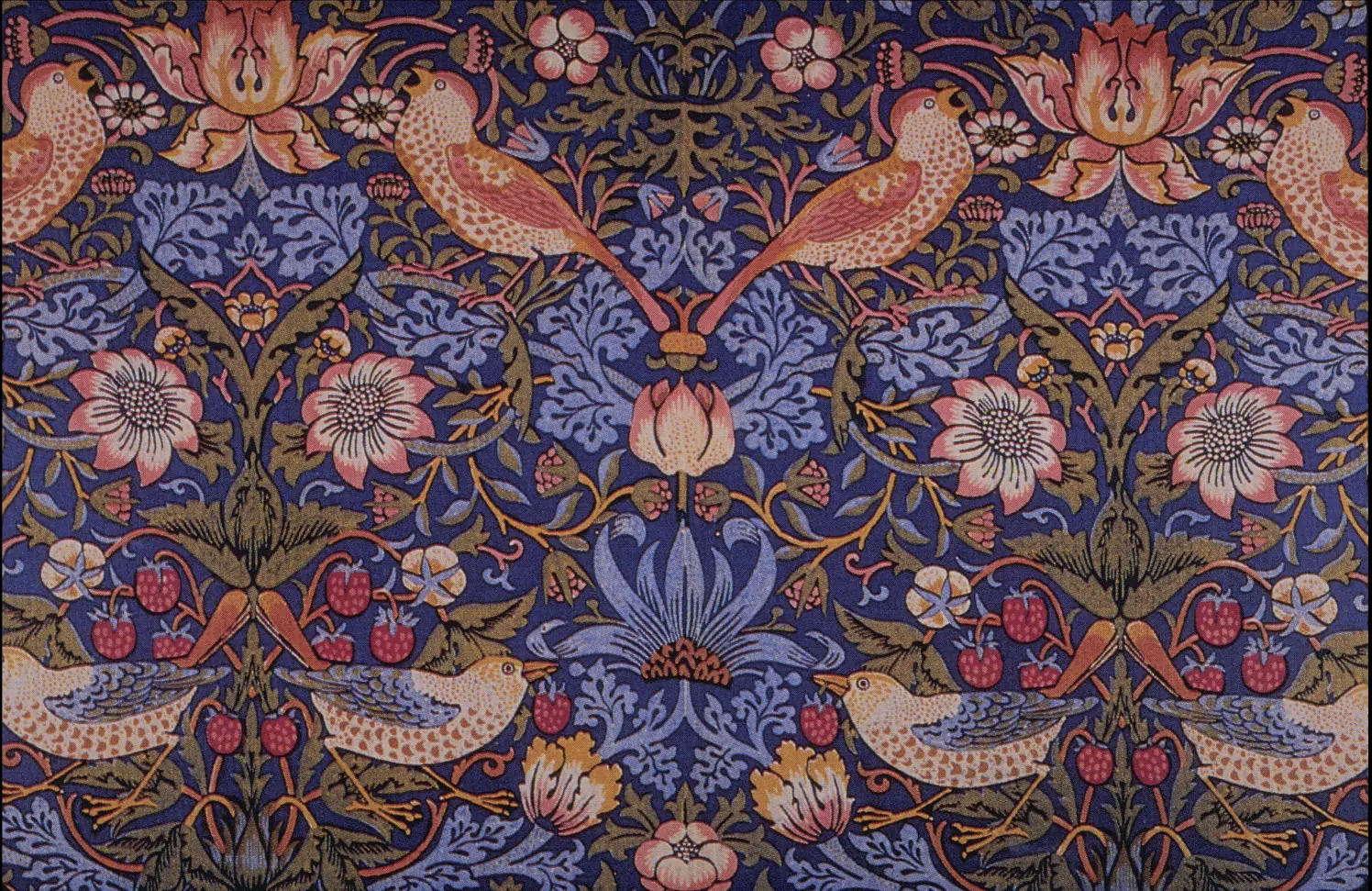
Ornament in Arts and Crafts is never just pretty pattern. In works like Strawberry Thief, vines, birds, and fruit are arranged densely enough to reward slow looking, but clearly enough to remain architecturally stable on the wall or across a room. Compare that pressure of observation with the natural exactness of Ophelia by John Everett Millais, and the lineage becomes visible: Pre-Raphaelite intensity is transferred from narrative painting into repeatable domestic design.
The same logic extends into book design. Morris's fascination with medieval page architecture makes more sense once you compare his printed surfaces with the Book of Kells Chi Rho Page, where ornament, rhythm, and reading are fused into one devotional field.
Strawberry Thief is not just a pretty pattern
Introduced in 1883, Strawberry Thief condenses the movement's program into one domestic surface. The repeat looks easy at first, but the design is tightly governed: birds pivot against looping stems, berries punctuate the surface, and color holds density without letting the whole thing collapse into decorative blur. Morris turns natural observation into an ordered field that can live with furniture, light, and human use over time.
Its importance is technical as well as visual. Morris wanted pattern to feel alive, which required demanding dye work, careful registration, and workshop knowledge rather than anonymous speed-first production. The point is not to romanticize hand labor in the abstract. The point is to keep the means of making legible in the finished object, so beauty does not arrive detached from labor.
Reform, luxury, and the movement's built-in contradiction
The hardest thing about Arts and Crafts is also the most revealing thing about it. A movement that spoke in the name of worker dignity often produced goods that only wealthy buyers could afford. That tension should not be hidden. It is the movement's central historical contradiction.
Yet the contradiction does not cancel the project; it explains its limits. High-quality, labor-intensive goods were expensive precisely because the industrial order Morris criticized had already normalized cheapness, speed, and visual indifference. Arts and Crafts could expose the human and aesthetic cost of that system more easily than it could build a mass-market alternative. In that sense, it is both reform movement and elite style.
In 2026, debates around sustainable interiors, durable materials, repair culture, and ethical supply chains are still asking the same question in new language: what social world is hidden inside the things we use every day?
How to read an Arts and Crafts object without reducing it to wallpaper
- Start with material truth: does wood still read as wood, textile as textile, print as print?
- Track the repeat. Where does the pattern loop cleanly, and where does the surface stay alive through controlled variation?
- Ask what tempo of use the object assumes: quick glance, daily touch, or long domestic companionship.
- Keep function and ornament together. In Arts and Crafts, decoration is meant to clarify structure, not distract from it.
Arts and Crafts is not the opposite of modern design; it is one of the arguments that helped produce it. If you later compare the movement with De Stijl or with Composition with Red, Blue and Yellow, you are not looking at old decoration versus new abstraction. You are looking at two different answers to the same design problem: how should order enter everyday life?
Set Arts and Crafts beside the Aesthetic Movement and another split appears. Whistler is willing to let beauty hold through tone, mood, and arrangement alone. Morris keeps pulling beauty back toward labor, material truth, and domestic use.
Legacy: what survived after the workshops
Arts and Crafts left clear marks on book design, typography, interior reform, preservation culture, workshop teaching, and the broader idea that design belongs to everyday ethics rather than luxury display alone. Its afterlife runs through garden suburbs, craft schools, publishing experiments, and later design education.
Its deeper legacy, however, is conceptual. The movement taught later modernity that style cannot be separated from production, and that decoration is never innocent when it organizes domestic experience. Even movements that rejected its vegetal richness, including De Stijl, inherited its seriousness about the total environment.
Key artists in Explainary
Key works in Explainary
A strong route through this page is to read William Morris first, then move backward to the Pre-Raphaelite Brotherhood, and forward to De Stijl. That sequence makes it easier to see Arts and Crafts as a hinge between moral decoration and later design systems.
Use the art quiz as a quick check: can you recognize Arts and Crafts through material honesty, dense repeat pattern, and the social ambition hidden inside decoration?
Primary sources
Frequently asked questions
Not in a simple sense. Arts and Crafts attacked degraded industrial production and the split between design and labor, but its strongest thinkers were trying to redefine quality, not erase technology from modern life.
Because Strawberry Thief shows how the movement turns ornament into structure. Morris uses repeat pattern, natural observation, and technically demanding printing to make a domestic surface carry arguments about attention, labor, and everyday dignity.