
Neo-Impressionism
The Evening Air
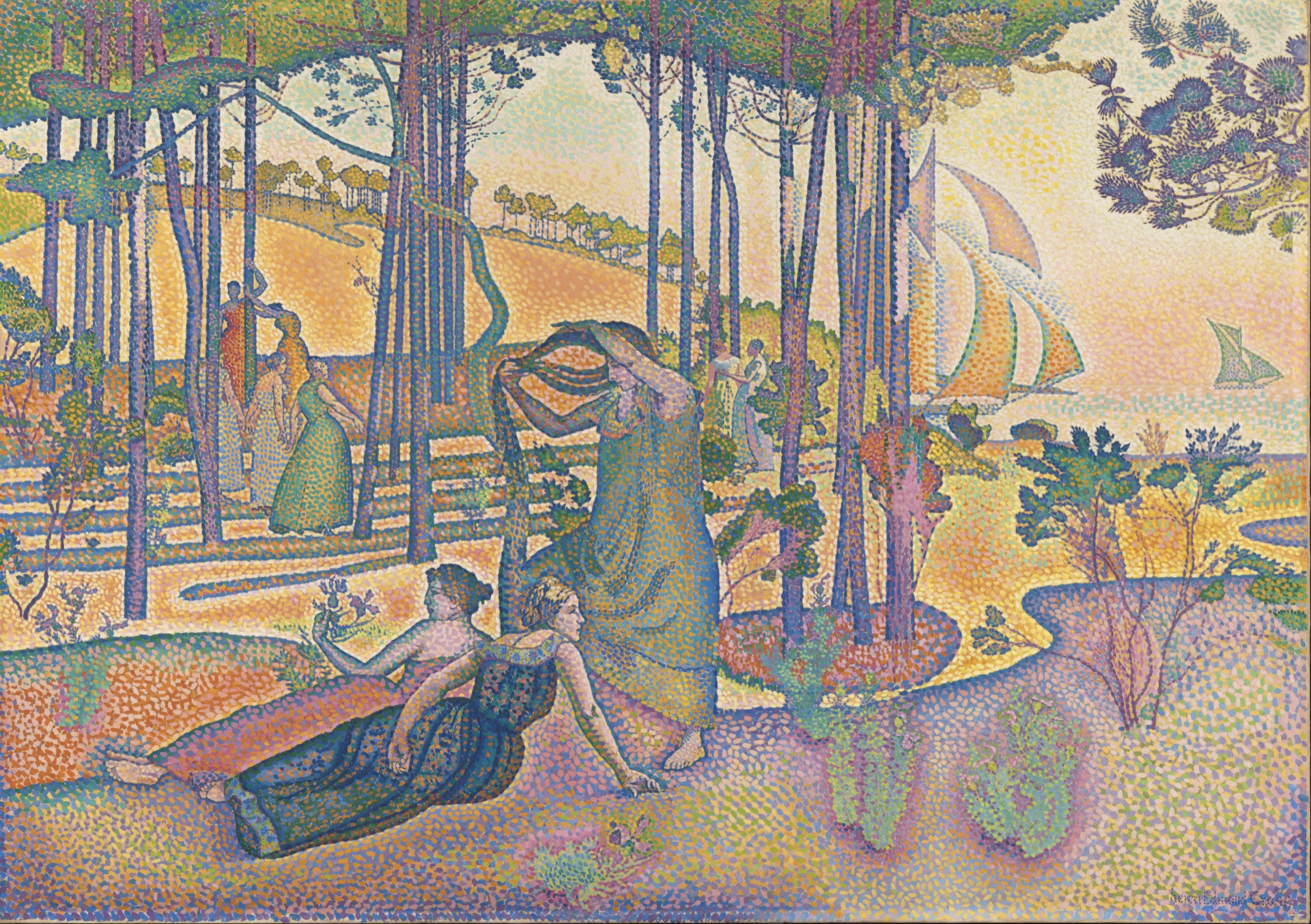
A woman leans into evening shade, another stands among pale trunks, and the whole Mediterranean landscape breaks into rectangular pieces of color. Henri-Edmond Cross's The Evening Air makes pointillism spacious, calm, and decorative: not a park crowd like Seurat, not a portrait-manifesto like Signac, but a large vision of southern light cooling into dusk.
The painting belongs to the mature phase of Neo-Impressionism, when the method was no longer only a theory of optical mixture. Cross shows how divided color could become architectural. Small strokes still build sensation, but they also make the canvas feel like a mosaic, a wall decoration, and an ideal landscape at once.
A southern monument after Seurat
Cross had moved to the South of France by the early 1890s, partly for health and partly for light. The Mediterranean coast changed the scale of his ambition. Instead of treating pointillism as a compact Parisian procedure, he turned it toward open air, warm stone, cypresses, and a slower rhythm of looking.
The Musée d'Orsay links the painting to an 1893 exchange with Paul Signac, who urged Cross to help raise a decorative monument to the sunny country they both loved. Signac pursued that idea in In the Time of Harmony; Cross answered with The Evening Air. Their shared project matters because it shifts Neo-Impressionism from analysis alone toward public scale, mural ambition, and a new decorative language.
What is shown
The scene is not a specific anecdote. Cross gives us figures in a landscape at the end of the day: bodies resting, standing, and pausing as heat drains from the air. The horizontals of the ground and sky steady the picture, while the vertical trees and figures hold it upright. Nothing rushes. The composition stretches time until evening feels almost physical.
The figures are classical without becoming academic. Their poses recall older pastoral and decorative traditions, especially the serene order associated with Pierre Puvis de Chavannes, yet the surface is wholly modern. Flesh, leaves, trunks, and air are not smoothed into illusion; they are assembled from marks that keep the painting visibly made.
From dots to mosaic
Cross remains faithful to divided color, but the scale of the canvas changes the touch. The marks are not tiny dots arranged with Seurat's severity. They widen into blocks, dashes, and rectangular pieces. This makes the painting easier to read from a distance and gives the surface a decorative strength close to mosaic.
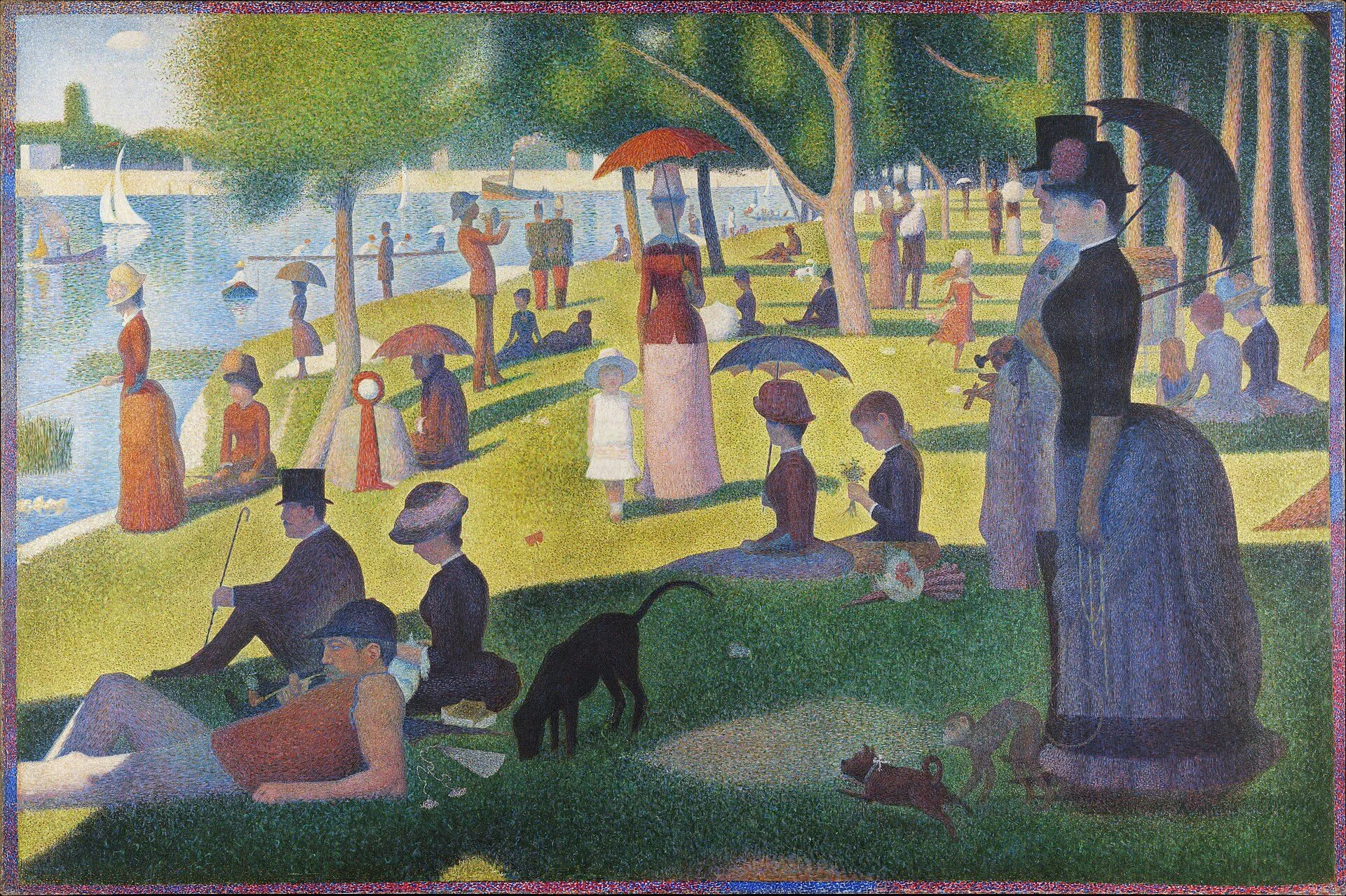
That change is central to the work. In La Grande Jatte, the repeated touch helps organize a public social scene with almost mechanical precision. In The Evening Air, it turns light into an atmosphere the viewer can inhabit. The method becomes less brittle, more expansive, and more sensual.
Cross, Signac, and the decorative turn
The friendship with Signac gives the painting another reading path. Signac could make pointillism sharp, urban, and polemical, as in Opus 217. Cross slows the same language down. His color is still calculated, but the result feels less like a manifesto than a climate.
That decorative turn does not weaken the method. It reveals one of its future uses. Once divided color becomes larger and more rhythmic, it can point toward Fauvism, modern decoration, and the liberation of color from local description. The painting is therefore not only a late pointillist achievement. It is one of the passages through which pointillism becomes twentieth-century color.
The Matisse connection
The Orsay record notes that Henri Matisse saw The Evening Air in Signac's dining room at La Hune and drew from it when making Luxe, calme et volupté. That connection is visible in the shared ambition: a sunny landscape, figures at rest, and color divided into independent strokes that carry pleasure as well as structure.
Matisse would push color much further, but Cross helps prepare the ground. The Evening Air shows how optical discipline can become decorative freedom. Its calm is not passive. It is carefully built from intervals, contrasts, and surface rhythm.
Why this work expands pointillism
The Evening Air belongs in the pointillist canon because it changes the movement's emotional temperature. Seurat gives Neo-Impressionism its analytic authority; Signac gives it public energy and theory; Théo van Rysselberghe brings it into Belgian portraiture. Cross adds a Mediterranean mode where divided color becomes breadth, leisure, and decorative monumentality.
The painting also prevents a narrow reading of pointillism as a single texture. The method could be strict or loose, urban or pastoral, public or intimate. Cross proves that it could also be ideal and sensuous without surrendering structure.
Cross turns pointillism from an optical grammar into evening air.
Explore more
Related works
Then use the art quiz to test whether you can distinguish Cross's Mediterranean mosaic from Seurat's social geometry and Signac's graphic spectacle.