
Romanticism
Cholera Plague, Quebec
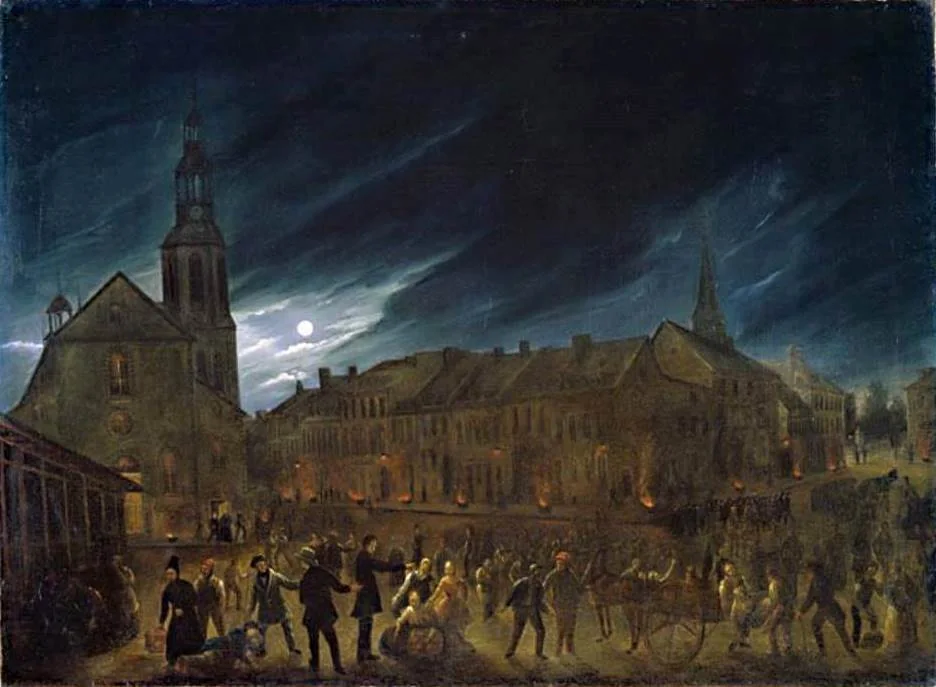
Joseph Légaré's Cholera Plague, Quebec is one of the rare early Canadian paintings that treats public health disaster as a civic event rather than a private tragedy. The canvas does not give us a single heroic protagonist. Instead, it gives a city under pressure: frightened crowds, unstable order, and a collective sense that normal time has broken. For art history and for Quebec history, that shift is decisive within nineteenth-century Romanticism.
Why this painting is structurally important
Before works like this, many local visual narratives in British North America leaned toward landscape, religious imagery, or commemorative scenes. Légaré introduces another possibility: urban trauma as historical subject. The city itself becomes an organism in crisis. Streets and built space are no longer neutral settings; they become vectors of fear, circulation, and policy failure.
Légaré's intention is explicit in the painting's method: he uses composition to make social fragility legible, not to deliver a single moral anecdote.
That move has long-term consequences. Later identity painting in Quebec often pivots around rural continuity or seasonal endurance. Légaré reminds us that collective memory also begins in rupture - moments when institutions are tested and social trust fragments.
Composition and crowd psychology
Légaré arranges bodies to produce tension between movement and blockage. The eye moves through clusters that appear simultaneously active and constrained, as if the city cannot decide whether to flee, gather, or submit. This ambiguity is central to epidemic experience: information is partial, danger is diffuse, and behavior becomes erratic.
Color and atmosphere reinforce the instability. Rather than crisp narrative segmentation, the painting uses tonal pressure to keep the whole scene unsettled. You do not receive a clean moral script. You receive uncertainty. In this sense, Légaré is less an illustrator of events than an analyst of collective perception under stress.
Religion, governance, and social order
In early nineteenth-century Quebec, epidemics were interpreted through overlapping frameworks: medical uncertainty, religious explanation, civic administration, and rumor. Légaré's painting reflects that overlap. It does not isolate one causal narrative. Instead, it shows the city as a field where belief, fear, and authority collide.
This layered representation makes the work unusually modern. Public crises rarely belong to one institution. They expose interactions between bureaucracy, communication, and shared symbols. Légaré captures that systemic character decades before "systems thinking" became common language.
An early civic memory image
Paintings can become memory infrastructure when they provide a durable visual shorthand for events too complex to summarize verbally. Cholera Plague, Quebec does exactly that. It condenses mortality, panic, and urban vulnerability into a scene that can be repeatedly revisited. In doing so, it participates in the formation of a civic archive: how a community remembers being fragile.
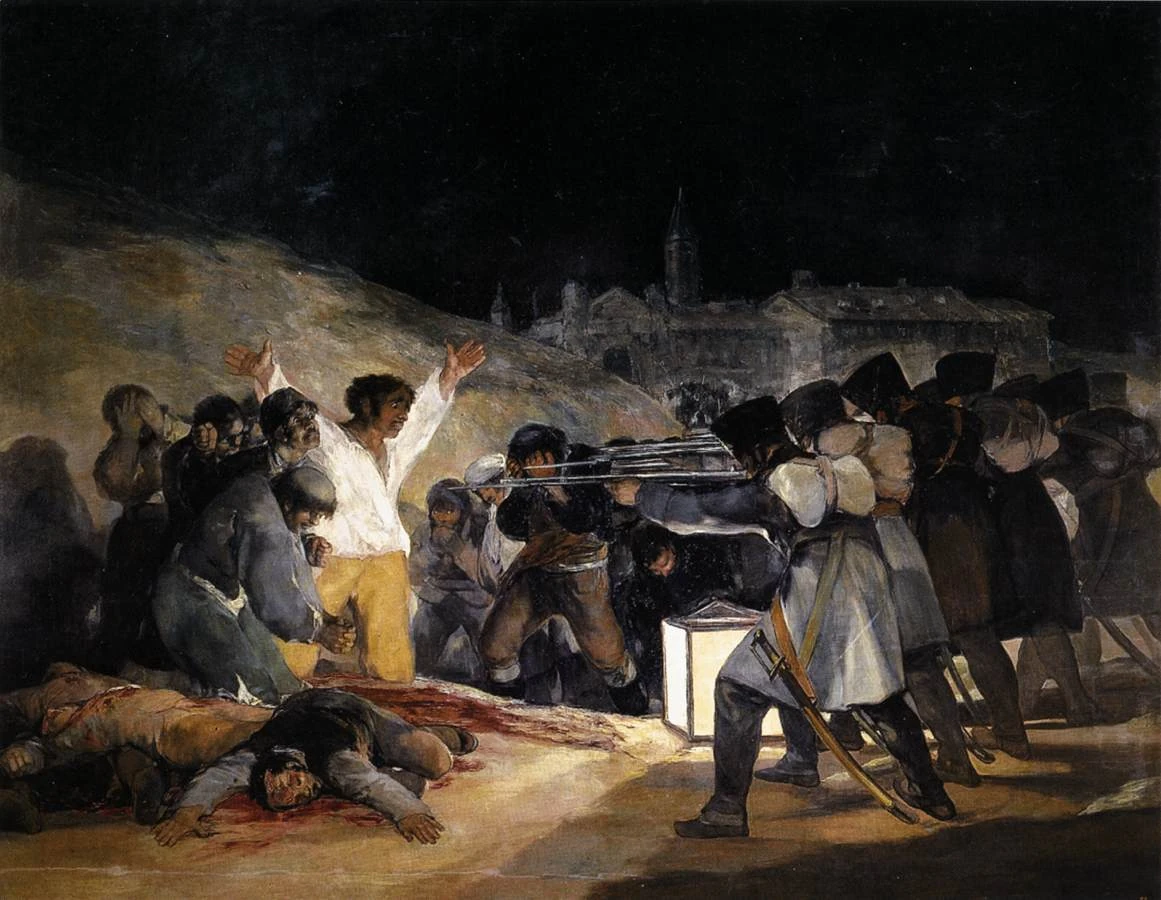
Compare this function with The Third of May 1808, where violence is concentrated in one climactic execution. Légaré's crisis is more distributed. There is no single villain, no single martyr, only a city struggling to remain legible to itself.
From crisis image to identity debate
Modern debates about Quebec identity often emphasize language, constitutional status, and cultural continuity. Légaré adds another axis: civic vulnerability and institutional response. Collective identity is not only formed by celebration and heritage; it is also shaped by remembered breakdowns and lessons drawn from them.
This reading helps explain why the painting still matters in 2026. Recent global health crises have sharpened public sensitivity to how communities process uncertainty. Légaré's canvas speaks across time because it shows that social fear has form, rhythm, and politics - and that art can register all three without reducing complexity.
For a broader framework, see our essay on how painting shaped Quebec identity, which reads crisis images beside rural continuity scenes to show how cultural memory systems are built.
Technique and limits
Technically, the work balances legibility and compression. Details are sufficient to anchor the scene in place, but not so exhaustive that the image collapses into reportage. Légaré's goal is not bureaucratic record-keeping. It is emotional and civic intelligibility. We see enough to understand the stakes, and enough ambiguity to feel unresolved tension.
As always, critical distance is necessary. Any historical painting filters events through available visual conventions and patronage contexts. Still, the work's value is substantial: it documents how a francophone artist in early nineteenth-century Quebec translated public catastrophe into collective image.
Légaré paints a city discovering, in real time, how fragile civic order can be.
Explore more
Related works
If Cholera Plague, Quebec is clearer now, try the art quiz and see whether you can spot works by Joseph Légaré in seconds.
Primary sources
- Wikimedia Commons file metadata
- National Gallery of Canada: Cholera Plague, Quebec
- The Canadian Encyclopedia: Joseph Légaré
- The Canadian Encyclopedia: Cholera in Canada
- Britannica: Cholera overview
- McCord Stewart Museum: Canadian urban and social history collections
- JSTOR: scholarship on Joseph Légaré and cholera-era Quebec