
Realism
The Toll Gate
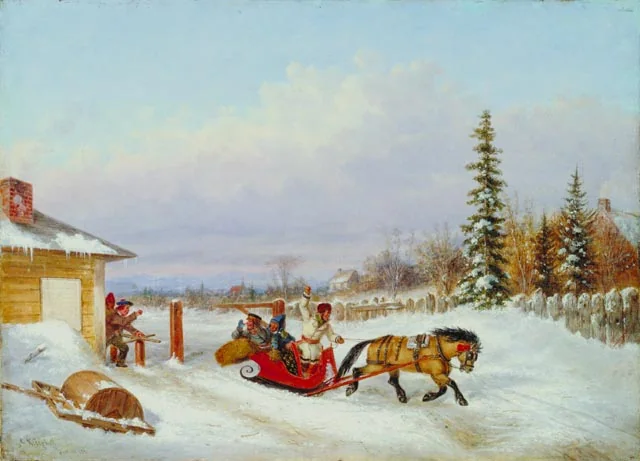
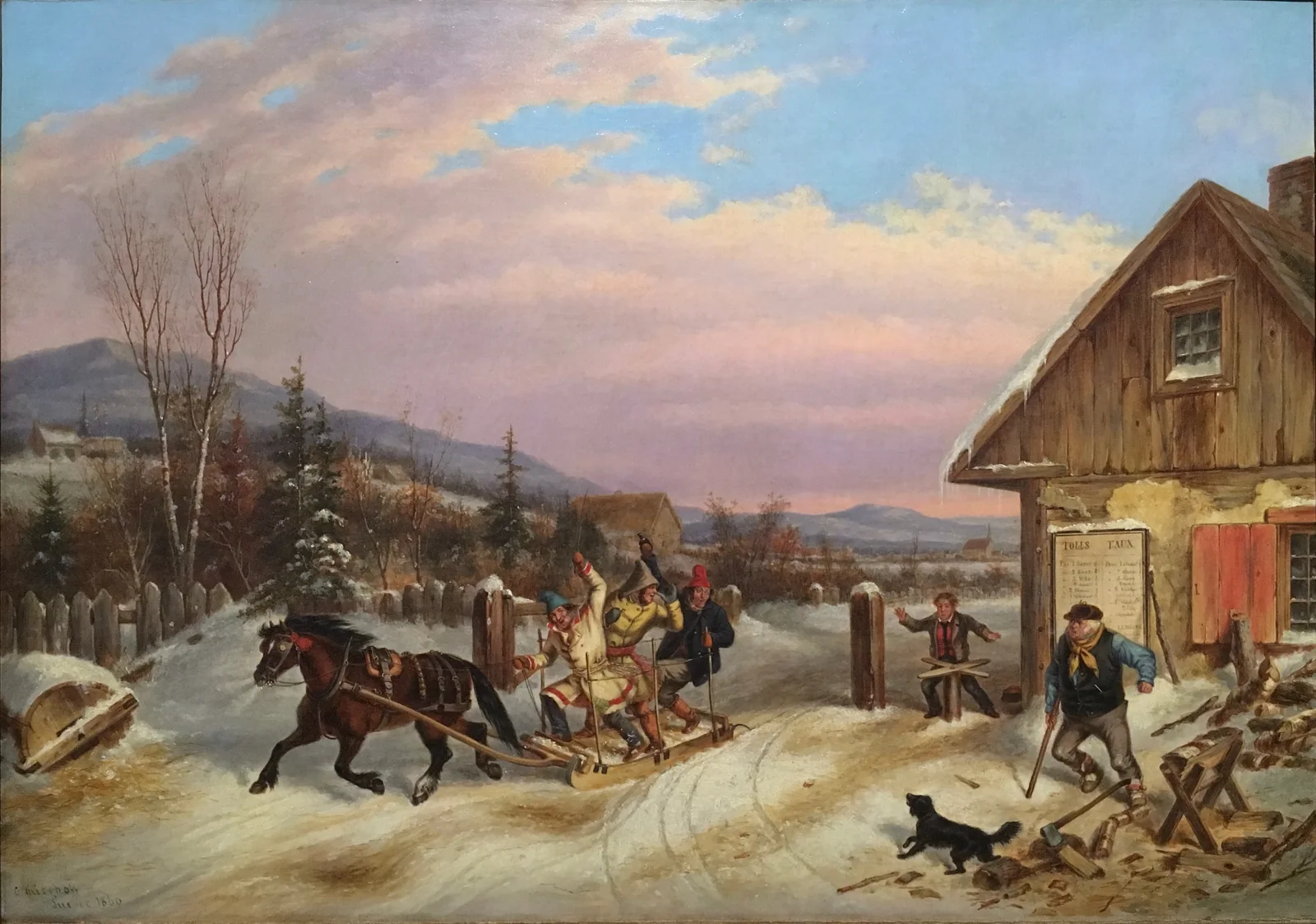
The Toll Gate is one of Krieghoff's clearest demonstrations that social power can be painted without allegorical grandstanding. A gate, a road, a sleigh, and a few figures are enough. The work turns infrastructure into narrative: the point where movement is interrupted, inspected, and priced. In nineteenth-century Quebec, that moment was both ordinary and politically charged inside a practical form of Realism.
An image of routine authority
Unlike battle scenes or ceremonial portraits, this painting works through routine. The toll is not an exception in social life; it is part of the daily choreography of travel. That everyday quality gives the image unusual force. Krieghoff shows authority not as abstract sovereignty, but as repeated encounter: where a person with goods, family, or labor meets a local agent of regulation.
Composition supports the idea. The route draws the eye toward the barrier and then distributes attention across figures who must coordinate around it. No single person dominates the scene. The true protagonist is the system itself: movement channelled through a point of control.
Realism as structural reading
Krieghoff is often described as a picturesque chronicler of winter life, and that is partly accurate. But The Toll Gate shows a harder realism. The artist is less interested in sentiment than in structure. Clothing, sleigh design, road conditions, and architecture are painted with enough specificity to make the scene socially legible. You can infer class position, economic activity, and the practical stakes of delay.
That legibility matters for historical interpretation. Paintings like this are not statistical documents, yet they can reveal how governance felt in lived time. Roads and tolls were fiscal instruments, but also cultural filters: they organized who moved easily, who waited, and who negotiated.
Order, friction, and negotiation
The emotional tone is controlled. Krieghoff avoids melodrama and allows low-level friction to carry the scene. This restraint is intentional. In everyday governance, conflict is rarely spectacular; it is procedural. The barrier demands recognition, but not panic. The traveler complies, bargains, or delays. The officer enforces, but with local knowledge. This reciprocal adjustment is what gives the painting its modern feel.
Placed beside Bilking the Toll, the contrast is illuminating. One canvas emphasizes the formal checkpoint; the other emphasizes tactical evasion. Together they build a small political theory of Quebec road culture: authority exists, but so does improvisation.
Landscape is not neutral background
Snow and winter atmosphere are integral to meaning, not decorative backdrop. Seasonal conditions increase dependence on roads and crossings, which in turn magnifies the importance of local gatekeeping points. Krieghoff paints this environmental pressure subtly: the cold intensifies urgency, and the gate appears less like a symbolic barrier than a practical bottleneck in a demanding climate.
This logic links the work to The Ice Bridge at Longue-Pointe, where winter infrastructure becomes even more explicit. Across these paintings, Krieghoff suggests that Quebec identity was shaped as much by logistical resilience as by abstract ideology.
Market image and identity archive
Krieghoff sold to audiences who valued recognizable "Canadian" scenes. That market context can tempt us to dismiss the work as stereotype. A better reading is layered. Yes, the painting packages a local world for circulation. But it also records meaningful social detail and stages a credible relation between community and authority. It is both commodity and archive.
That dual status explains why the work remains useful in current debates about heritage. Identity images are rarely pure. They emerge where self-description, external expectation, and material life intersect. The Toll Gate captures exactly that intersection.
Why read this work now
In 2026, discussions of belonging and governance are often framed at national or constitutional scale. Krieghoff reminds us that political identity is also produced by repeated local encounters: checkpoints, permits, fees, and social protocols. The painting gives us a concentrated view of that process.
For close reading, begin with three questions. Where is control physically located? Who appears to set the pace of movement? What forms of compliance or negotiation are visible? Answering these in sequence turns a "small" scene into a sophisticated analysis of social order.
The gate is the painting's main character: a device that converts road, weather, and people into governance.
Explore more
Related works
For a broader framework, pair this page with How to Understand a Painting and How Painting Shaped Quebec Identity.
If The Toll Gate is clearer now, try the art quiz and see whether you can spot works by Cornelius Krieghoff in seconds.
Primary sources
- Wikimedia Commons file metadata
- National Gallery of Canada: The Toll Gate
- The Canadian Encyclopedia: Cornelius Krieghoff
- Britannica: Cornelius Krieghoff
- McCord Stewart Museum: collections on nineteenth-century Quebec society
- JSTOR: scholarship on Krieghoff and Quebec road culture
- The Canadian Encyclopedia: Quebec history overview