
Realism
Bilking the Toll
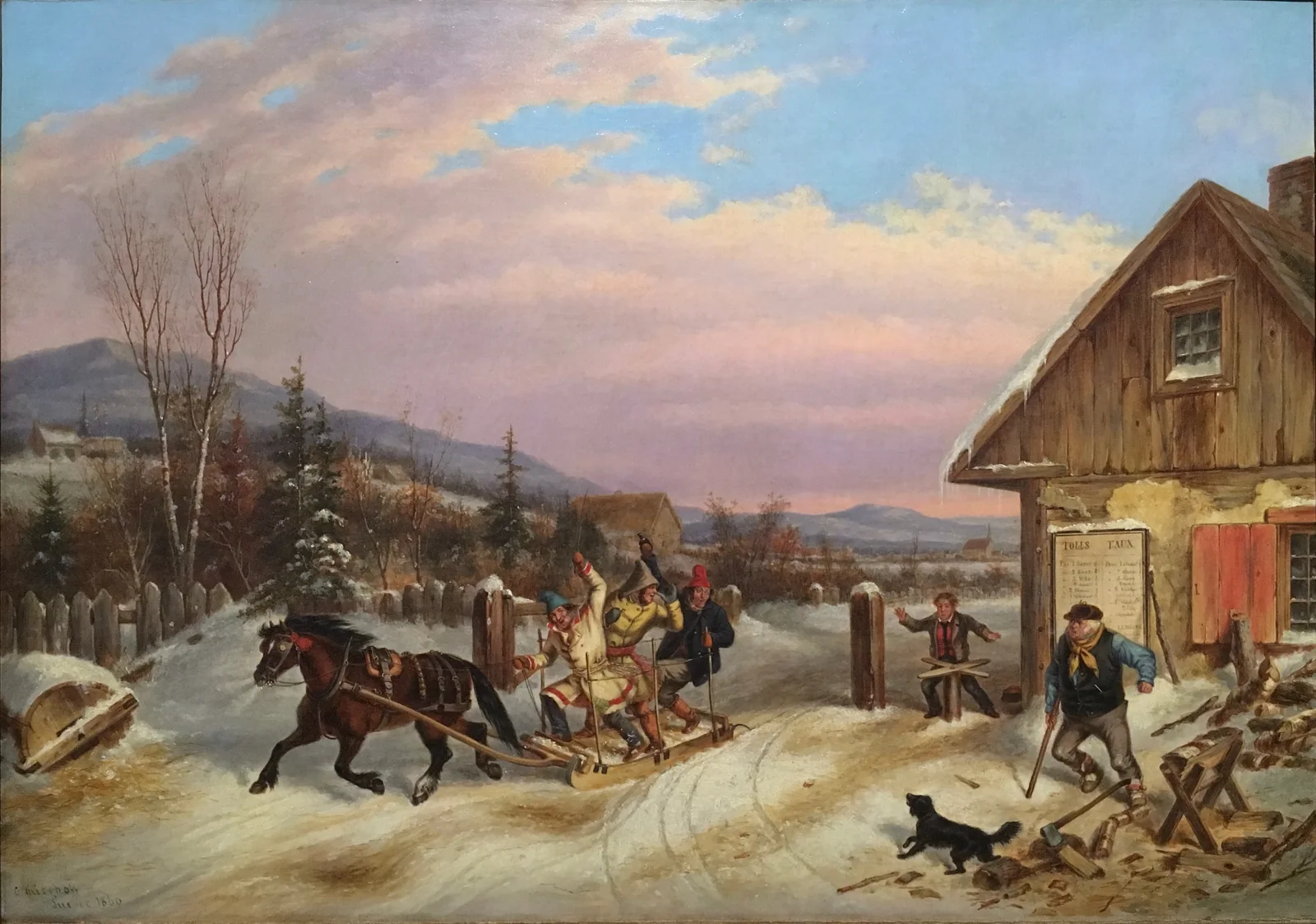
At first glance, Bilking the Toll looks like a witty anecdote on a winter road: a sleigh, a barrier, a moment of trickery. But Krieghoff is doing more than genre entertainment. He is staging a miniature political drama about authority, negotiation, and local intelligence in nineteenth-century Quebec, within a deliberately social strain of Realism. The painting still works because it captures a reflex many viewers recognize immediately: when power appears rigid, people improvise.
A scene built around one hinge
The whole composition turns on a single hinge: the toll barrier. Krieghoff structures space so your eye travels from the moving sleigh to the physical obstacle and then to the human figures managing the exchange. That sequence matters. The image is not about landscape first; it is about a transaction. Snow, trees, and sky provide context, but the narrative engine is the encounter at the checkpoint.
Notice how the painting avoids theatrical heroics. No one is depicted as grand or tragic. Instead, each figure is legible as part of a practical choreography: who pays, who watches, who advances, who delays. This sober clarity is one reason the painting remains persuasive. It feels observed rather than invented.
Humor as social analysis
Krieghoff's title gives the game away: to "bilk" the toll is to dodge payment. Yet the image does not condemn the act in moralistic terms. The tone is closer to amused recognition. In that choice, the artist reveals a lot about his social world. Rural and peri-urban communities in Canada East often experienced authority through small infrastructures - roads, fees, permits, local officers - rather than through distant constitutional abstractions. The painting translates that reality into a compact visual script.
Humor here is not trivial. It is analytical. By making the scene lightly comic, Krieghoff shows that political culture can be formed in ordinary, repetitive acts: bargaining, delaying, outsmarting, and saving face. The painting teaches viewers to see governance not only in institutions, but also in the friction of everyday life.
Class, language, and coded identity
Like many of Krieghoff's Quebec scenes, Bilking the Toll participates in the visual construction of the "habitant" world for mixed audiences, including anglophone collectors. That dual address creates tension. On one hand, the painting preserves clothing, transport habits, and winter practices with documentary value. On the other, it packages those practices into a readable type: the resourceful local subject navigating rules imposed by gatekeepers.
This tension is part of the work's long afterlife in discussions of Quebec identity. The canvas can be read as affectionate ethnography, as market-friendly stereotype, or as quietly critical social satire. The most convincing reading combines all three. Krieghoff knew how to satisfy demand for picturesque scenes, but he also embedded a sharper observation about power and agency.
Painting technique and narrative tempo
Technically, Krieghoff uses crisp edges and selective detail to keep the scene narratively legible at distance. Snow is not painted as empty white mass; it is varied enough to indicate movement paths and frozen texture. The sleigh and figures carry stronger contrast, which pulls attention toward decision points in the action.
Tempo is key. Many viewers feel the image as a paused instant, but it is actually dynamic: you can sense what just happened and what will happen next. The barrier may rise or remain closed; the sleigh may pass or stall. Krieghoff's control of this suspended tempo is what keeps the painting alive beyond antiquarian curiosity.
Why this scene still shapes how authority is read
In contemporary debates about identity and governance, it is easy to speak only at a macro level - constitutions, sovereignty, globalization, institutional reforms. Bilking the Toll reminds us that political culture is also built from micro-scenes: how people negotiate rules in concrete situations. The painting has endured because it gives form to that scale of experience.
Seen beside The Toll Gate, the logic becomes clearer. One painting shows the toll as formal authority; the other shows the toll as tactical game. Together, they map two sides of collective life: order and improvisation. Place them next to The Ice Bridge at Longue-Pointe, and you get a fuller Quebec trilogy of movement, risk, and regulation under winter conditions.
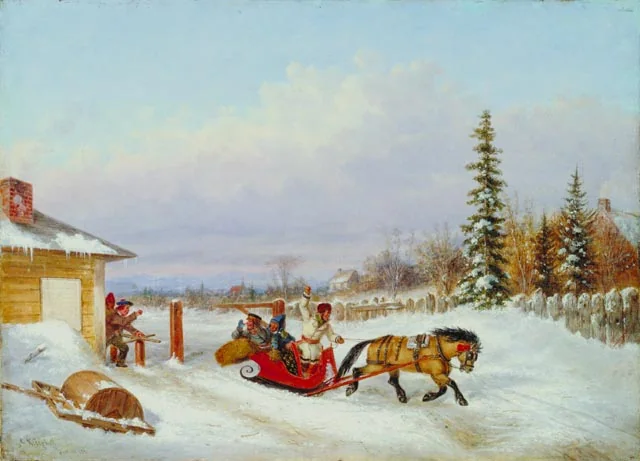
For broader context, read our analysis of how painting shaped Quebec identity, which links Krieghoff's winter scenes to later debates about memory, language, and civic self-image.
Krieghoff turns a roadside joke into a precise study of power at ground level.
Explore more
Related works
If Bilking the Toll is clearer now, try the art quiz and see whether you can spot works by Cornelius Krieghoff in seconds.
Primary sources
- Wikimedia Commons file metadata
- National Gallery of Canada: The Toll Gate
- The Canadian Encyclopedia: Cornelius Krieghoff
- Britannica: Cornelius Krieghoff
- McCord Stewart Museum: collections and Canadian social history context
- JSTOR: scholarship on Cornelius Krieghoff
- The Canadian Encyclopedia: Canadian Art overview