
Essay
How Painting Shaped Quebec Identity: 8 Defining Works
Quebec's arguments about belonging, sovereignty, and the shape of the collective did not begin in party programs. They first took visible form in paintings. That is the arc running from Joseph Légaré to Krieghoff, then from Clarence Gagnon to Borduas, Riopelle, and Lemieux.
That older visual archive matters again now. Quebec is once more debating sovereignty, language, autonomy, and the definition of a common civic identity. You can also see it in part of the current sovereigntist revival, especially among some younger voices trying to frame an independent Quebec in more inclusive terms. These paintings help explain why the debate keeps returning, and why it still carries so much emotional force.
The lazy summary says Quebec painting begins in parish snow and ends in modern abstraction. The stronger story is harder and better: civic vulnerability, then the rural myth of French Canada, then the winter road as everyday politics, then Charlevoix as place-memory, then the break opened by Refus global, and finally a postwar field in which Quebec no longer needs one single image of itself.
Read in that order, these eight works do more than illustrate society. They show a collective image being built, revised, and widened. They also explain why Quebec visual history cannot be reduced either to folklore or to modern rupture. Both are real; neither is the whole story.
1) Joseph Légaré, Cholera Plague, Quebec: crisis before myth
Start with crisis, not folklore. In Cholera Plague, Quebec, Légaré makes collective danger visible in the streets of Quebec City. The painting is full of bodies, movement, alarm, and institutional fragility. Before nation becomes a romantic slogan, belonging appears here as something harsher: exposure shared in one place.
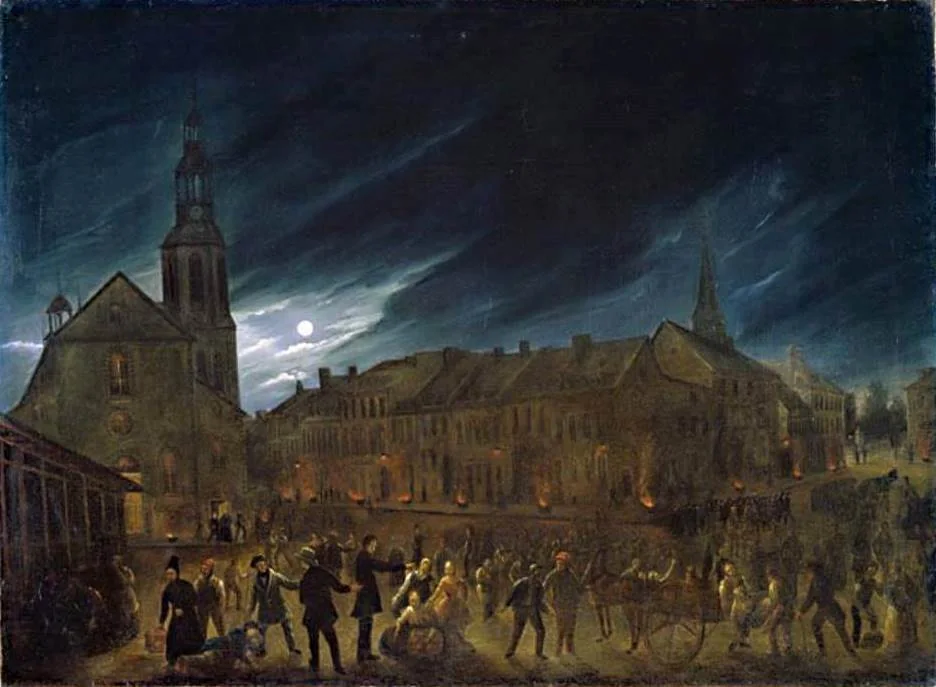
That matters because the painting makes city, crowd, and public order inseparable. Streets and buildings are not background here. They are part of the social drama. A great deal of later Quebec painting will move toward rural continuity or modern experimentation, but Légaré establishes an early premise that never disappears: collective identity becomes visible when ordinary order breaks down.
2) Cornelius Krieghoff, The Habitant Farm: making the habitant legible
With Krieghoff, the center of gravity shifts. The Habitant Farm gives viewers one of the clearest visual formulas of old French Canada: wooden house, snow, sleigh, practical labor, and the rhythm of rural settlement. It is one of the images through which Quebec becomes easy to picture.
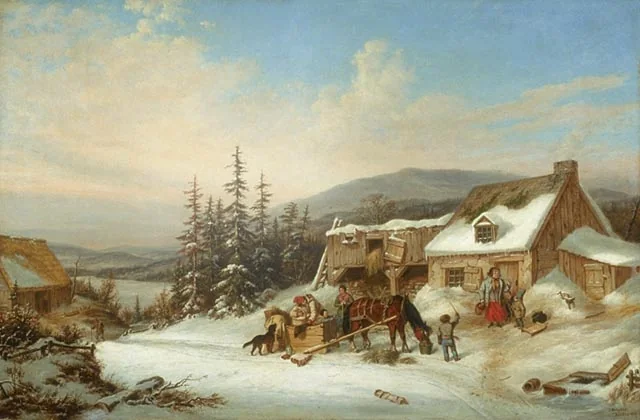
But the painting is double-edged. It preserves real details while packaging rural life into a legible image for a market that included anglophone and imperial buyers. One of Quebec's strongest identity images was therefore also shaped under an outside gaze. That tension never really disappears. Quebec identity is not only self-assertion. It is also self-staging.
3) The Toll Gate: the road as local politics
If The Habitant Farm stabilizes home, The Toll Gate shows everyday authority at work. The toll barrier is small, but that is exactly why it matters. Movement is ordinary until power asks to regulate it. On this winter road, politics appears not as parliament but as encounter, fee, delay, and negotiation.
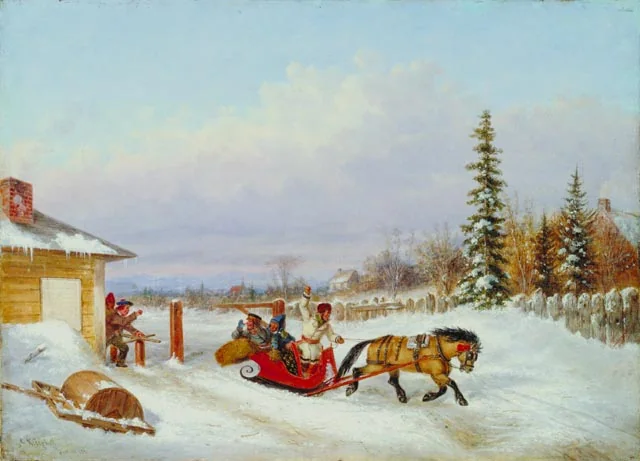
This is where Realism acquires a distinct Quebec inflection. The point is not heroic labor on an epic scale. It is the way routine institutions, roads, climate, and small frictions shape social life. Krieghoff makes local power readable at ground level.
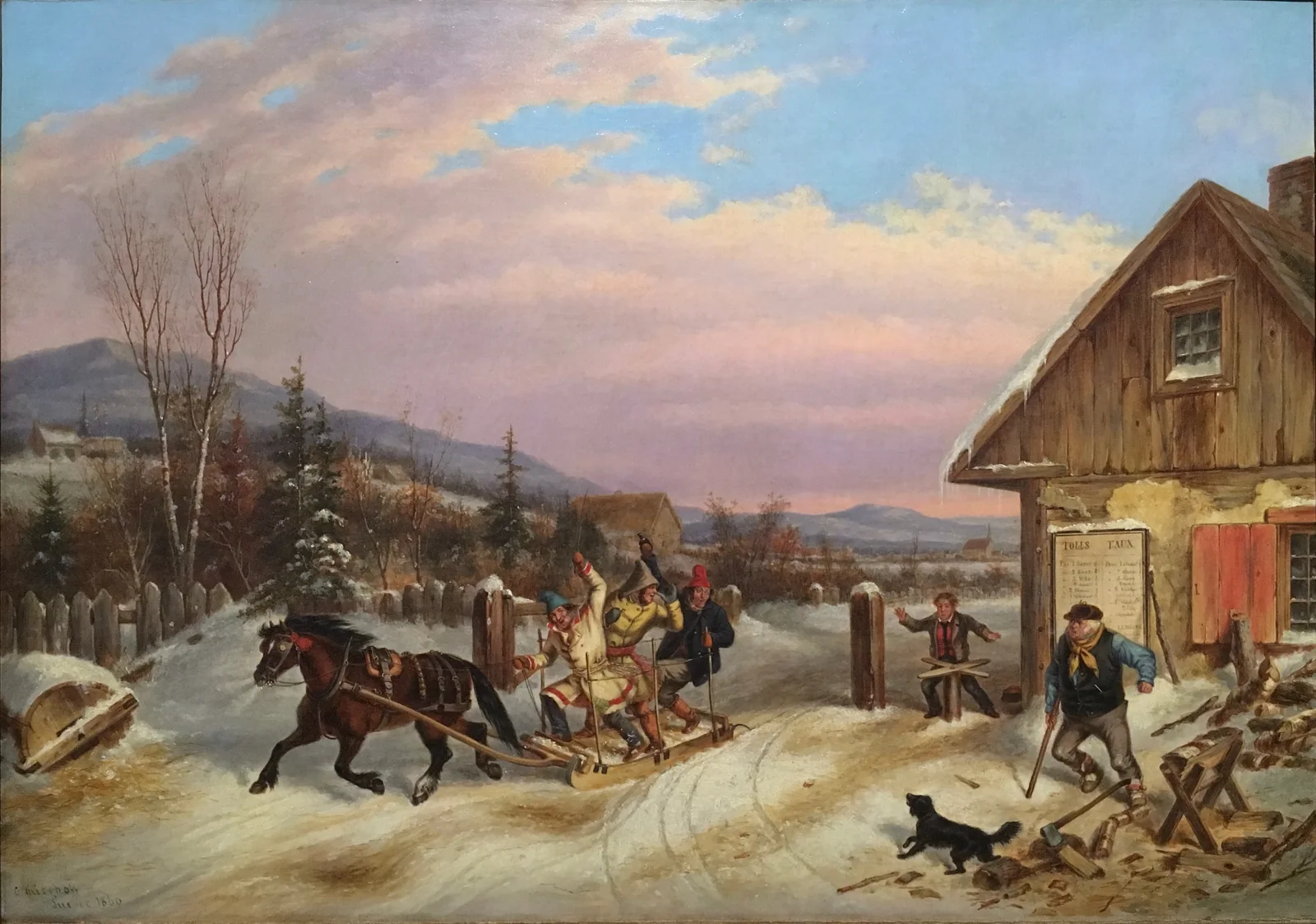
4) Bilking the Toll: wit against remote authority
One year earlier, Krieghoff had already painted the comic inversion. In Bilking the Toll, the prestige goes not to obedience but to tactical intelligence. This is not revolutionary iconography. It is something more ingrained: suspicion of remote power, admiration for practical wit, and pleasure in local improvisation.
That mixed register still matters. Quebec public life often combines doctrinal seriousness with irony and tactical play. Krieghoff captures that tone early: one can respect the existence of the rule and still admire the person who slips around it.
5) The Ice Bridge at Longue-Pointe: winter as social structure
Winter in Quebec painting is rarely just weather. In The Ice Bridge at Longue-Pointe, ice becomes route, danger, and routine at once. People cross because life has to keep moving. Risk is real, but it is absorbed into ordinary competence.
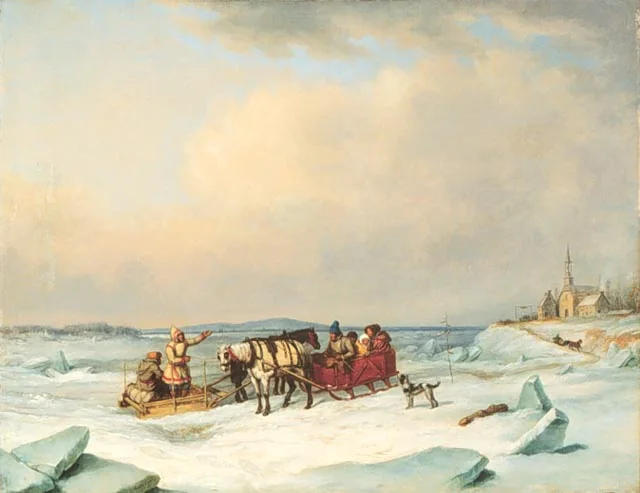
That distinction matters. Quebec identity is often built less around exceptional heroism than around the normalization of difficult conditions. Endurance here is not spectacle. It is a social competence shared across bodies, routes, and seasons.
6) Clarence Gagnon, Baie-Saint-Paul: turning Charlevoix into memory
By the early twentieth century, Quebec painting shifts from anecdote toward atmosphere and structure. In Baie-Saint-Paul, Gagnon simplifies roofs, roads, snow, and distance until the village becomes more than a location. It becomes a durable memory of place: a local world made portable.
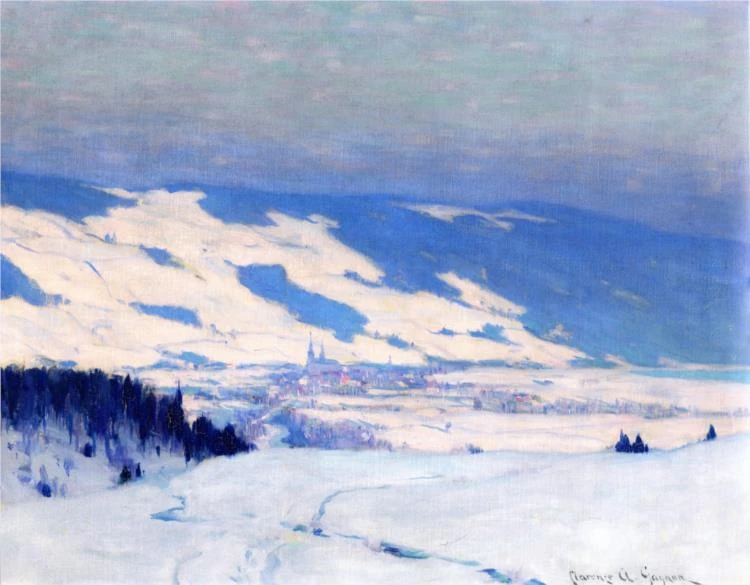
This is why Gagnon matters so much to Quebec visual history. He does not simply describe Charlevoix. He converts it into a repeatable image of settlement, climate, and collective scale. The village can now circulate as a memory-image, not just as a local report.
7) Paul-Émile Borduas, Abstraction verte: breaking the old script
With Borduas, Quebec painting stops needing a village scene to speak about itself. Abstract art and the Automatist milieu around Refus global break the old obligation to represent continuity through parish life, winter routine, or inherited landscape. The key shift is not only stylistic. It is cultural. A Quebec artwork can now claim legitimacy through experiment, dissonance, and refusal.
That moment matters because it widens the field without erasing what came before. Quebec identity is no longer tied to one inherited set of images. It can include rupture as well as memory, risk as well as belonging.
8) Riopelle's Pavane and Lemieux's Les Ursulines: plurality after rupture
Postwar Quebec does not settle into one new style. Jean-Paul Riopelle pushes scale, matter, and gestural energy toward an international modern language without becoming culturally anonymous. Jean Paul Lemieux does almost the opposite: he empties scenes out, slows them down, and lets silence carry historical weight. The important point is that both count.
Together, they show a mature visual culture no longer trapped inside one image of the collective. Quebec painting can now move between density and spareness, cosmopolitan ambition and austere inwardness, without losing its identity altogether.
What this sequence changes in the way we read Quebec
The weak narrative says Quebec moved from tradition to modernity in a straight line. Painting shows a layered structure instead: civic crisis, rural myth, everyday negotiation, regional memory, abstract rupture, then plural postwar modernity. None of these layers fully cancels the others. They accumulate.
That is why Quebec visual history still feels current. Recent arguments about sovereignty, language, immigration, and belonging keep reactivating older image archives, sometimes explicitly, often by instinct. Some contemporary sovereigntist voices try to describe Quebec in civic and inclusive terms rather than genealogical ones. These paintings make the stakes easier to see: they show which images of the collective Quebec inherited, and which ones it has had to widen.
Read the sequence through Realism, then through Abstract Art, and the transition stops looking like a clean break between old and new. It becomes a contested redefinition of what collective life should look like in paint.
A quick method for reading identity paintings
Use four checks. Ask who occupies the center, how territory functions, what kind of time the image stages, and what form of authority or freedom it normalizes. In Légaré, the answer is collective danger. In Krieghoff, it is negotiated everyday order. In Gagnon, it is durable belonging. In Borduas, Riopelle, and Lemieux, it is the widening of what Quebec can look like without ceasing to be itself.
Quebec painting did not illustrate a ready-made identity; it built one, revised it, and kept it open.
Continue with related analyses
Test your visual memory
Ready to keep exploring? Open the art quiz and test how quickly you recognize artists and titles after reading.
Sources
- National Gallery of Canada: Joseph Légaré, Cholera Plague, Quebec
- National Gallery of Canada: Cornelius Krieghoff, The Toll Gate
- National Gallery of Canada: Clarence Gagnon
- Britannica: Cornelius Krieghoff
- Tate: Realism
- MoMA: Abstraction
- The Met: Post-Impressionism
- The Canadian Encyclopedia: Refus global
- The Canadian Encyclopedia: Paul-Émile Borduas
- The Canadian Encyclopedia: Jean-Paul Riopelle
- The Canadian Encyclopedia: Clarence Gagnon
- The Canadian Encyclopedia: Jean Paul Lemieux
- CityNews Montreal: Around half of young people in Quebec support sovereignty: poll (June 26, 2025)
- The Canadian Press via CityNews: Young, proud, online: Quebec's newest sovereigntists hope to revive an aging movement (October 30, 2025)
- CityNews Montreal: Quebec's sovereignty question lingers, 30 years after 1995 referendum (October 30, 2025)
- Perspectives on Politics: Minority Affirmations and the Boundaries of the Nation: Evidence From Québec
Rights note on discussed works
Three works discussed in this essay are not currently published as standalone artwork pages on Explainary because we do not have public-domain image rights for our distribution context: Paul-Émile Borduas's Abstraction verte (1941), Jean-Paul Riopelle's Pavane (1954), and Jean Paul Lemieux's Les Ursulines (1951).
Frequently asked questions
A strong route starts with Cholera Plague, Quebec, then Krieghoff's The Habitant Farm, The Toll Gate, Bilking the Toll, and The Ice Bridge at Longue-Pointe, before opening toward Gagnon, Borduas, Riopelle, and Lemieux.
Because he stabilizes some of Quebec's most durable images: the habitant, the winter road, the toll gate, and the tactical negotiation with authority. He turns daily life into a repeatable image of itself.
Because winter is not only atmosphere in this tradition. It structures movement, work, risk, and authority. The Ice Bridge at Longue-Pointe is the clearest example.
The break is larger than style. Around Borduas and the Automatists, Quebec art no longer has to justify itself through inherited rural or devotional imagery. Experiment becomes culturally legitimate.
No. Rural myth is one layer, but Quebec painting also includes civic crisis, regional atmosphere, abstract rupture, and plural postwar modernity. Compare this essay with Realism and Abstract Art to see the full arc.
Ask four questions: who occupies the center, how territory functions, what kind of time the image stages, and what form of authority or freedom it normalizes. That keeps interpretation tied to visible evidence.