
Realism
The Habitant Farm
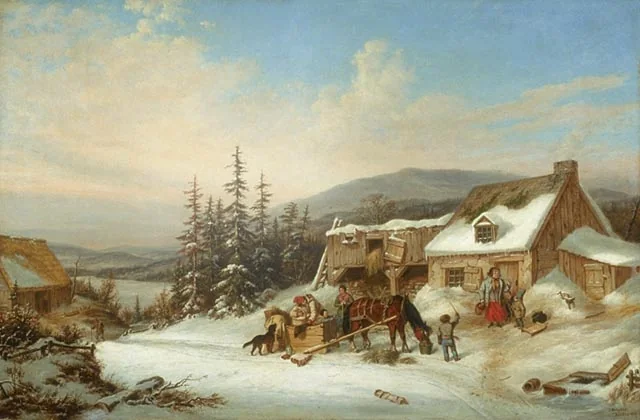
The Habitant Farm looks calm, domestic, and reassuring. A farmhouse, a snowy setting, and figures embedded in routine produce an image of continuity. Yet that apparent simplicity hides one of the most influential visual constructions in Canadian art: the idea of Quebec's rural world as the stable core of collective identity. Krieghoff did not invent this myth alone, but he gave it a durable form that still shapes how many people imagine nineteenth-century Quebec through Realism.
What the painting makes visible
Krieghoff organizes the composition around habitation and labor. Buildings are neither romantic ruins nor monumental architecture. They are working structures, integrated into land and season. Human presence is not theatrical; it is procedural. This is central to the painting's effect. The farm is represented not as exceptional prosperity or extreme hardship, but as a socially legible unit of daily life.
Because of that balance, the image feels trustworthy even when it simplifies reality. Viewers can read class, climate, and rhythm without decoding complex symbolism. Krieghoff's realism works here as a communication strategy: enough detail to persuade, enough order to stabilize meaning.
From observation to identity script
The "habitant" in nineteenth-century visual culture was never just a neutral ethnographic category. It was a social script through which language, religion, and rural continuity could be pictured. The Habitant Farm contributes to that script by emphasizing endurance and rootedness. Snow does not erase social life; it frames it. The farm appears as a durable cell of community.
At the same time, the painting circulated among audiences whose relationship to that world was often external. Collectors and institutions valued these scenes as signs of local color and colonial distinctiveness. That market context means the painting is both self-image and exported image. Understanding both dimensions is essential if we want to read it critically rather than nostalgically.
Technique and emotional register
Krieghoff's handling of paint supports the work's quiet authority. Edges are clear enough to preserve object identity, while atmospheric transitions keep the scene cohesive. Snow is articulated with tonal variation so that surfaces remain believable rather than decorative. Architectural lines and human figures are proportioned to suggest function before sentiment.
The emotional register is similarly controlled. There is no overt drama, and that is precisely the point. The painting normalizes continuity. It suggests a social world where order is maintained through repeated routines: work, shelter, movement, and adaptation to winter constraints.
What the painting leaves out
Any identity image gains force by excluding as much as it includes. The Habitant Farm minimizes conflict, inequality, and political struggle. It compresses rural life into a coherent visual unit and avoids the fractures that would complicate that coherence. This selective framing does not make the work false; it makes it ideological in the strongest sense - an image that organizes collective perception.
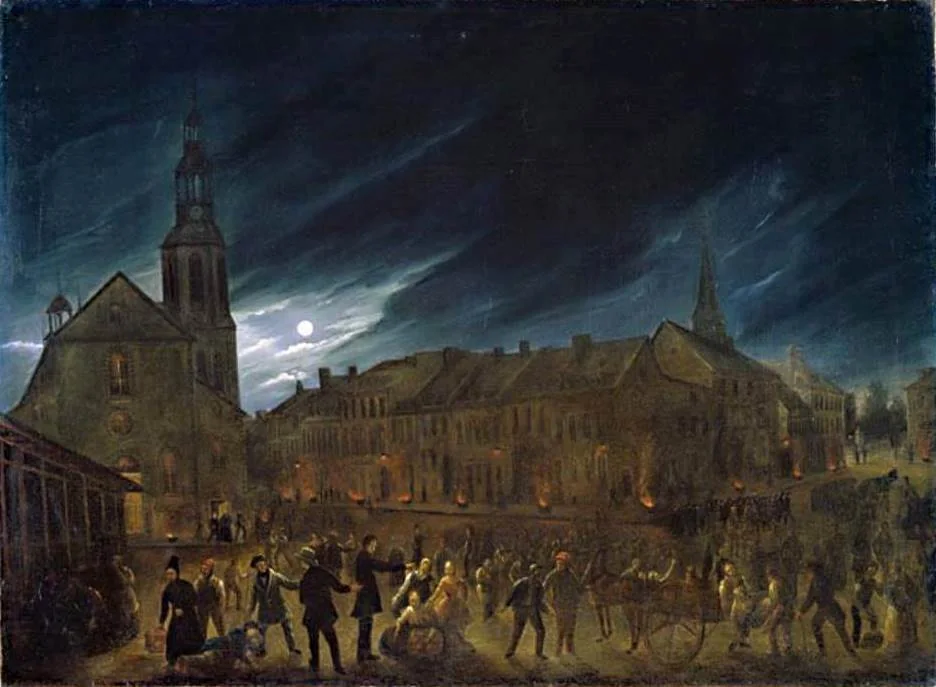
That is why comparing it with works like Cholera Plague, Quebec is useful. Légaré paints civic disruption and vulnerability. Krieghoff paints managed routine. Together they show that identity in art can oscillate between crisis and continuity.
Why this image remains central to Quebec memory debates
Current debates about Quebec often pivot between heritage defense and civic reinvention. The Habitant Farm helps explain why heritage remains emotionally powerful: it offers a compact visual model of coherence under pressure. But it also warns us about the risks of reducing identity to one rural template. Modern Quebec was never only farm and parish; it was also urban, industrial, intellectual, and later avant-garde.
Read in that broader sequence, Krieghoff becomes more interesting, not less. He is not just the painter of old scenes. He is a key participant in the long construction of an image archive that later artists, writers, and political actors would adopt, contest, or revise.
For a wider frame, compare this rural stability with Baie-Saint-Paul and read how painting shaped Quebec identity. The pairing clarifies how landscape, labor, and memory were edited into a durable cultural narrative.
Krieghoff paints rural life as a social system, then turns that system into memory.
Explore more
Related works
Use the art quiz as a quick check: can you connect The Habitant Farm to Cornelius Krieghoff when the options are mixed?
Primary sources
- Wikimedia Commons file metadata
- The Canadian Encyclopedia: Cornelius Krieghoff
- Britannica: Cornelius Krieghoff
- McCord Stewart Museum: Canadian rural and social history collections
- JSTOR: scholarship on Krieghoff and habitant imagery
- National Gallery of Canada: related Krieghoff context
- The Canadian Encyclopedia: Habitant (historical term)