
Venetian Mannerism / Musée des Beaux-Arts de Lyon
Danaë
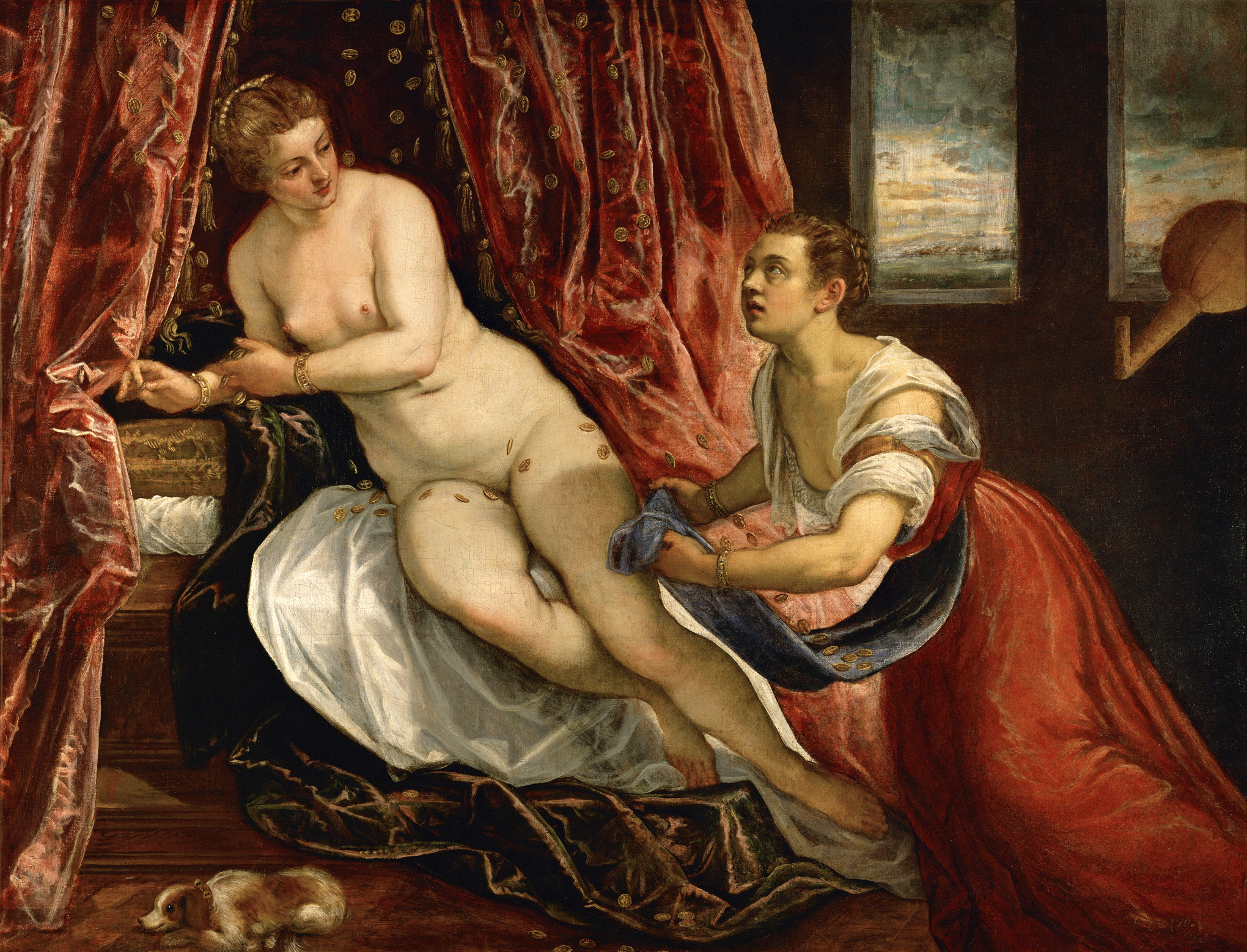
Gold coins fall through red curtains, Danaë reclines on a bed, and a servant gathers the shower as if Zeus's miracle were also a payment. Jacopo Tintoretto's Danaë, held by the Musée des Beaux-Arts de Lyon, turns a classical myth into a brilliant Venetian scene where desire, wealth, comedy, and painterly speed cannot be separated.
The myth is simple. Acrisius, king of Argos, locks his daughter Danaë away after hearing that her son will one day kill him. Zeus reaches her anyway, entering the closed chamber as a shower of gold. Danaë gives birth to Perseus. In older Christian readings, the miraculous conception could even be compared with chastity and the Annunciation. By the Renaissance, the subject often becomes more erotic, worldly, and ambiguous.
What Tintoretto changes in the myth
Tintoretto does not paint the myth as a remote divine episode. The gold has weight. It lands on fabric, touches skin, slides into folds, and falls toward the servant's apron. The scene is sensual, but the strongest visual joke is material: divine rain has become money. Danaë looks toward the falling coins; the servant looks upward and gathers them. The miracle is visible as a transaction.
That does not make the painting crude. It makes it sharper. Venice was a city of trade, luxury, fabric, banking, and spectacle. Tintoretto uses the myth to make a painting about the texture of that world. Red curtains, white sheets, flesh, gold, and dark interior space create a scene where mythology meets a recognizably Venetian appetite for surfaces and value.
A composition built from diagonals
The museum's focus sheet describes the painting as a moving composition, and that movement is visible immediately. Danaë's body runs diagonally through the picture. The servant's body answers with another diagonal. The curtains drop from above, the coins fall in a scattered vertical rhythm, and the folds of fabric make the eye slide across the bed rather than settle calmly.
Tintoretto's method is to make the myth readable through motion and material detail. He does not aim for a frozen emblem of divine visitation. He wants the viewer to follow the gold as it becomes light, money, touch, and visual rhythm inside one crowded Venetian room.
This is where the painting connects to Mannerism. Nothing feels classically stable. The body is luminous but elongated, the space is compressed, the fabric is theatrical, and the whole image turns elegance into instability. Tintoretto gives the scene beauty, but he refuses calm balance.
Why the dog matters
At the bottom of the painting, a small dog lies near the edge of the bed. It is easy to miss because the red fabric and the falling gold dominate the first look. Once noticed, the dog changes the register of the scene. It brings domestic familiarity into a mythological event and makes the room feel less like an ideal chamber than a lived interior.
The dog also strengthens Tintoretto's irony. Mythological painting often tries to raise the subject above ordinary life. Here, the ordinary keeps returning: a servant, a bed, coins, curtains, a pet. The divine story is still present, but it has entered a room full of social and material details.
Compare it with Venetian beauty at Lyon
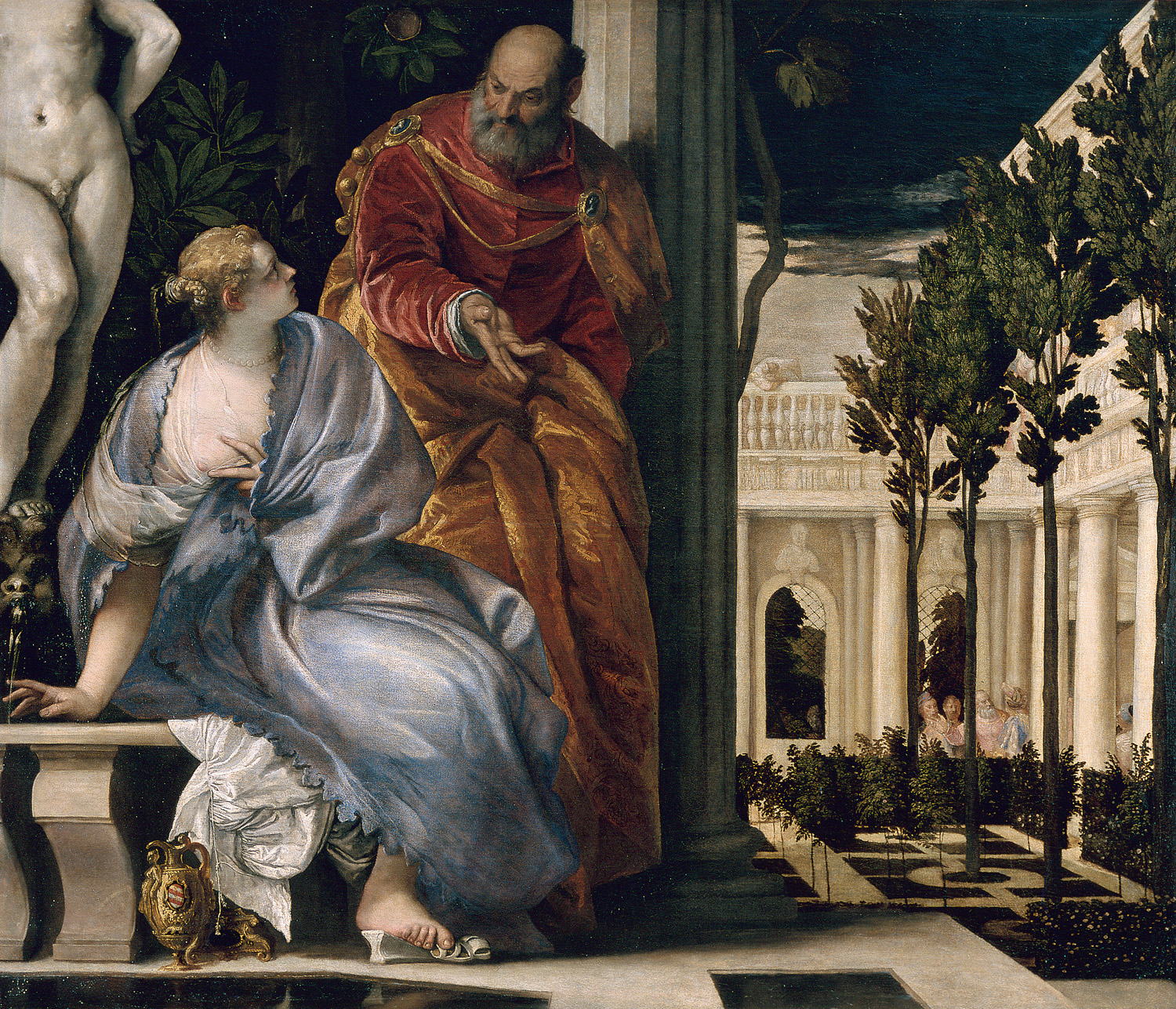
Inside the Lyon collection, Bathsheba Bathing by Veronese sharpens the reading. Both paintings use beauty, fabric, and biblical or mythological subjects to test the boundary between admiration and discomfort. Veronese slows the scene into ambiguity; Tintoretto makes it move, flash, and slide.
The other comparison is Titian. Tintoretto knew the prestige of Titian's Danaë paintings, but the Lyon picture does not simply repeat them. It is less dreamy and more pointed. The servant is not marginal; the coins are not just a symbol; the comedy of greed sits close to the erotic subject.
How to read it in the museum
Start with the falling gold, then follow where it lands. It moves from the upper space through the curtains, onto Danaë, toward the servant's apron, and into the dark folds near the bed. Then look at the red curtains as painting: they are not background decoration, but the field where light, money, and motion become visible.
Continue with Tintoretto, the guide to Mannerism, and Veronese's Bathsheba Bathing. Then test your eye with the art quiz.
Explore more
Primary sources
Frequently asked questions
Danaë is an oil on canvas by Jacopo Tintoretto, held by the Musée des Beaux-Arts de Lyon. It turns the myth of Zeus visiting Danaë as a shower of gold into a Venetian image of desire, money, and painterly movement.
The painting is in the Musée des Beaux-Arts de Lyon. The Louvre collection record identifies it as a French State transfer to the Lyon museum in 1811.
In the myth, Zeus enters Danaë's locked chamber as a shower of gold. In Tintoretto's painting, the gold also becomes literal money, making the scene less purely divine and more sharply Venetian, ironic, and material.
Yes. It belongs to the Venetian late Renaissance and Mannerist world through its diagonal body, unstable movement, theatrical fabric, and artificial brilliance.