
Movement Guide
Mannerism
Mannerism begins when Renaissance mastery starts to look too complete to trust. The great solutions of the High Renaissance do not disappear, but they stop feeling fully sufficient. Bodies lengthen, poses become more difficult, space grows less stable, and painting starts to display its own artifice more openly. What changes is not skill. It is the use of skill.
Mannerism should not be described as mere decline after Leonardo, Raphael, and Michelangelo. It is a sixteenth-century answer to a real artistic problem: what happens after balance, ideal form, and compositional authority have already reached a peak? One response is to make art stranger, more elegant, more pressured, and sometimes more spiritually unsettled.
What changes after the High Renaissance
The shift is historical as well as formal. The early sixteenth century is shaped by religious fracture, political violence, and a crisis in the confident image of Italy as the stable center of artistic order. The sack of Rome in 1527 is not the only cause of Mannerism, but it is part of the larger atmosphere. Painters inherit a language of mastery and start pushing it toward unease.
The movement often feels controlled and strained at the same time. It keeps technical confidence, but no longer presents the world as if harmony were easy. Grace becomes more artificial. Space becomes less trustworthy. Anatomy remains brilliant, but it no longer guarantees calm.
How to recognize it quickly
- Figures may look elongated, twisted, or arranged in unusually complex poses.
- Space can feel compressed, tilted, or less stable than in High Renaissance painting.
- Color often becomes sharper, cooler, or more self-consciously refined.
- The image may feel elegant and tense at once, rather than straightforwardly natural.
With Michelangelo, form begins to tighten
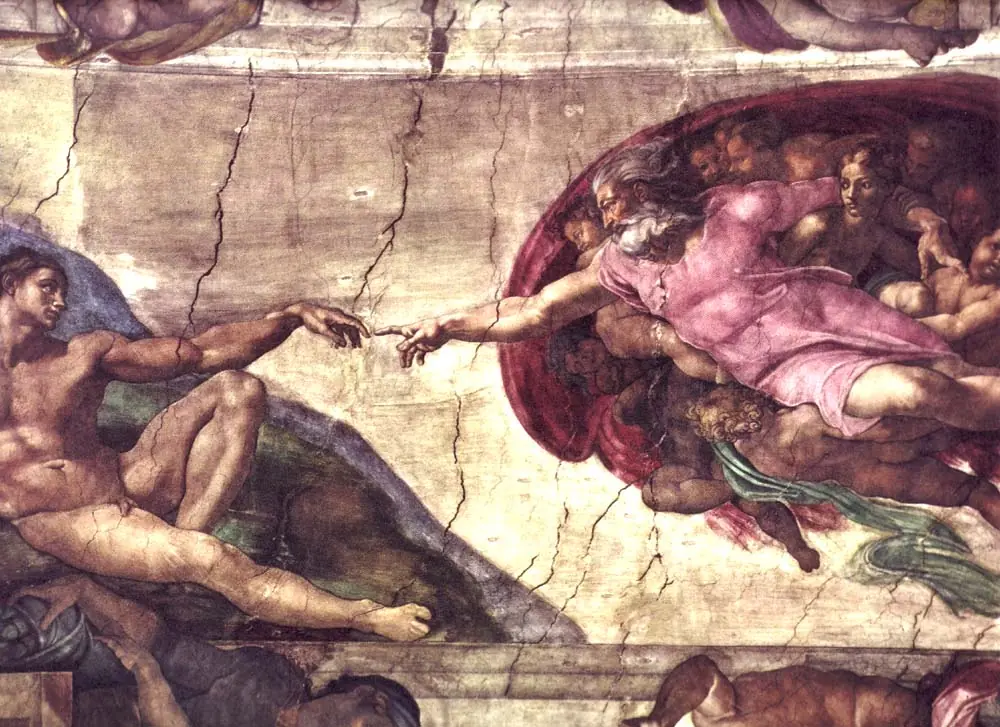
Michelangelo is not a Mannerist in the simple sense, but he helps explain the turn. In The Creation of Adam, the bodies are already charged beyond ordinary repose. The difference is that the pressure is still held inside an overall equilibrium. Mannerist artists take that kind of tension and let it spread more visibly into proportion, pose, and space.
This is one reason Mannerism is so easy to misread. It does not reject mastery. It makes mastery look more self-aware. In Italy, artists such as Pontormo, Parmigianino, and Bronzino show what that means: bodies can be beautiful and improbable at once, and refinement itself can become slightly disturbing.
Tintoretto gives Venetian color a nervous edge
Jacopo Tintoretto shows a Venetian route through Mannerist instability. In Danaë, held by the Musée des Beaux-Arts de Lyon, a mythological bedroom becomes a stage of falling coins, red curtains, diagonal bodies, and compressed space. The picture remains sensual and colorful, but calm Renaissance balance has disappeared.
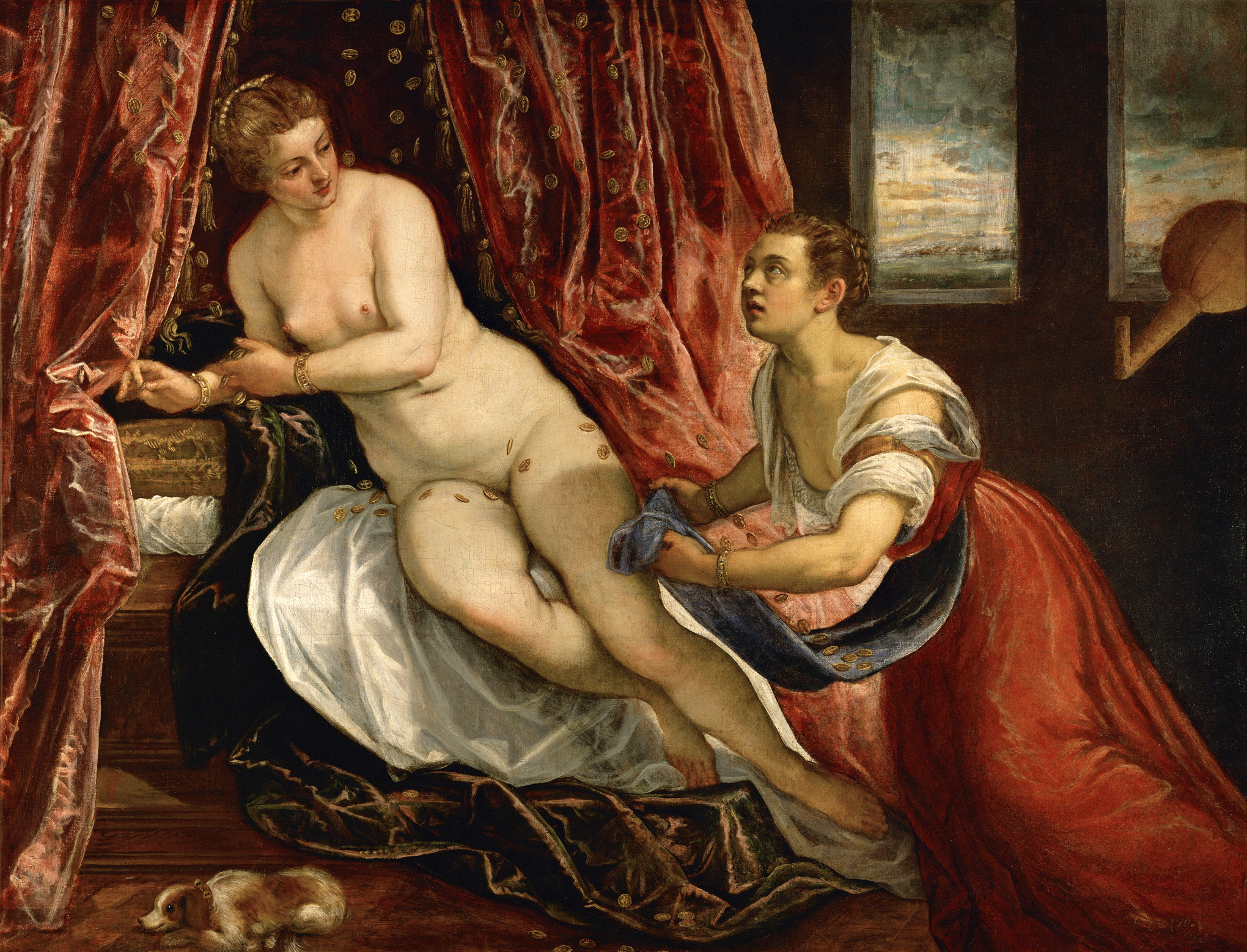
This Venetian strand is useful because it keeps Mannerism from looking like one single formula. Elongation and artifice do not always appear as cold elegance. They can also appear as movement, fabric, light, and a scene that refuses to settle.
El Greco carries the language to Toledo
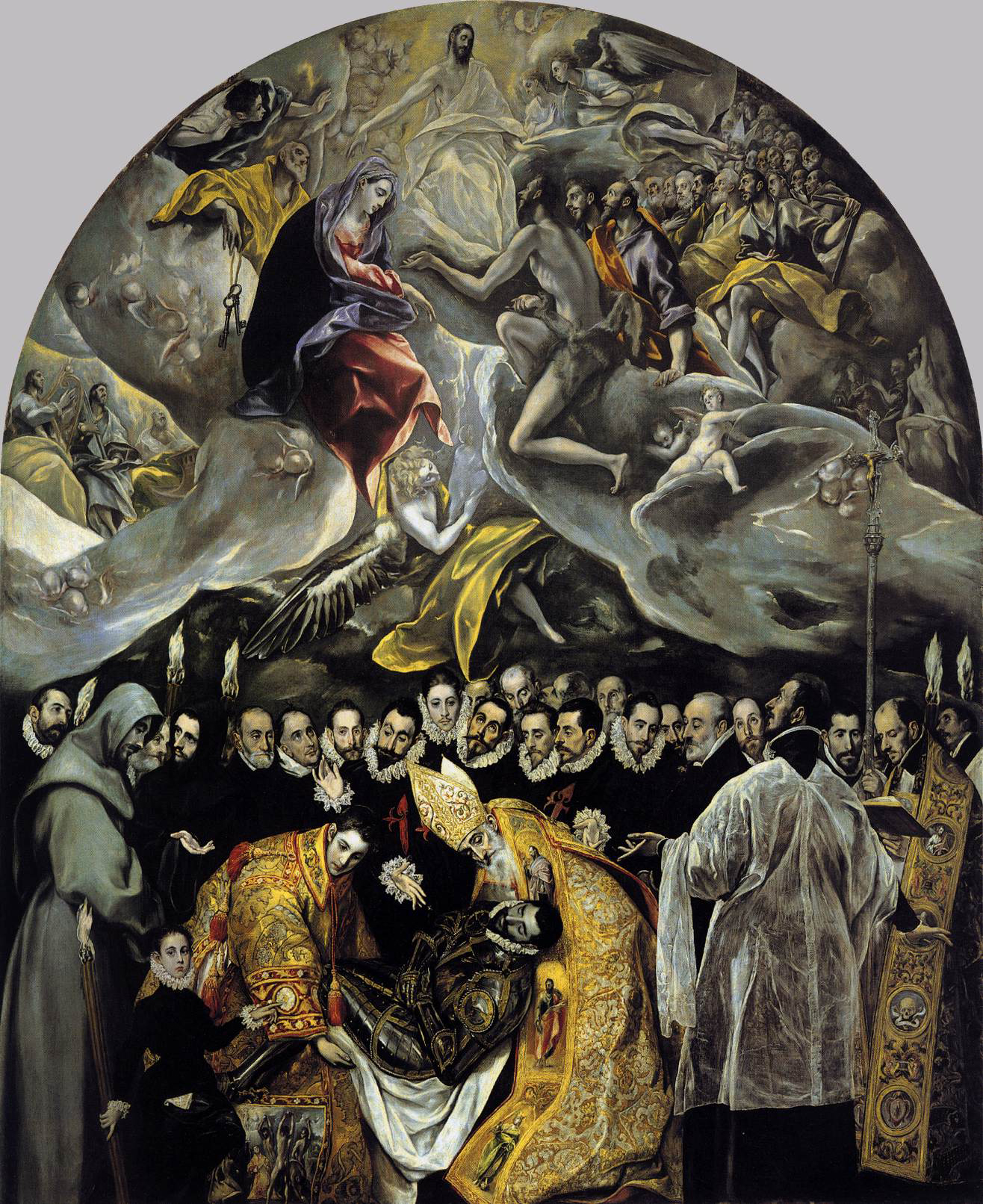
In The Burial of the Count of Orgaz, El Greco divides the canvas into a lower civic portrait and an upper visionary zone. Below, men in black stand with social precision and earthly weight. Above, saints, clouds, and the soul of Orgaz rise through an elongated heavenly field that no longer obeys ordinary physical space.
El Greco does not simply prolong Italian Mannerism. He transforms it. Byzantine inheritance, Venetian color, and Counter-Reformation spirituality all enter the picture. The result is not just elegant distortion. It is a new religious language in which elongation becomes a way of making transcendence visible.
Not yet Baroque
The comparison with Baroque clarifies the next shift. In The Calling of Saint Matthew, Caravaggio does not keep heaven at a visible distance. He brings revelation down into one dark room and one shared physical moment. Baroque intensity becomes immediate, theatrical, and fully staged for the spectator's body.
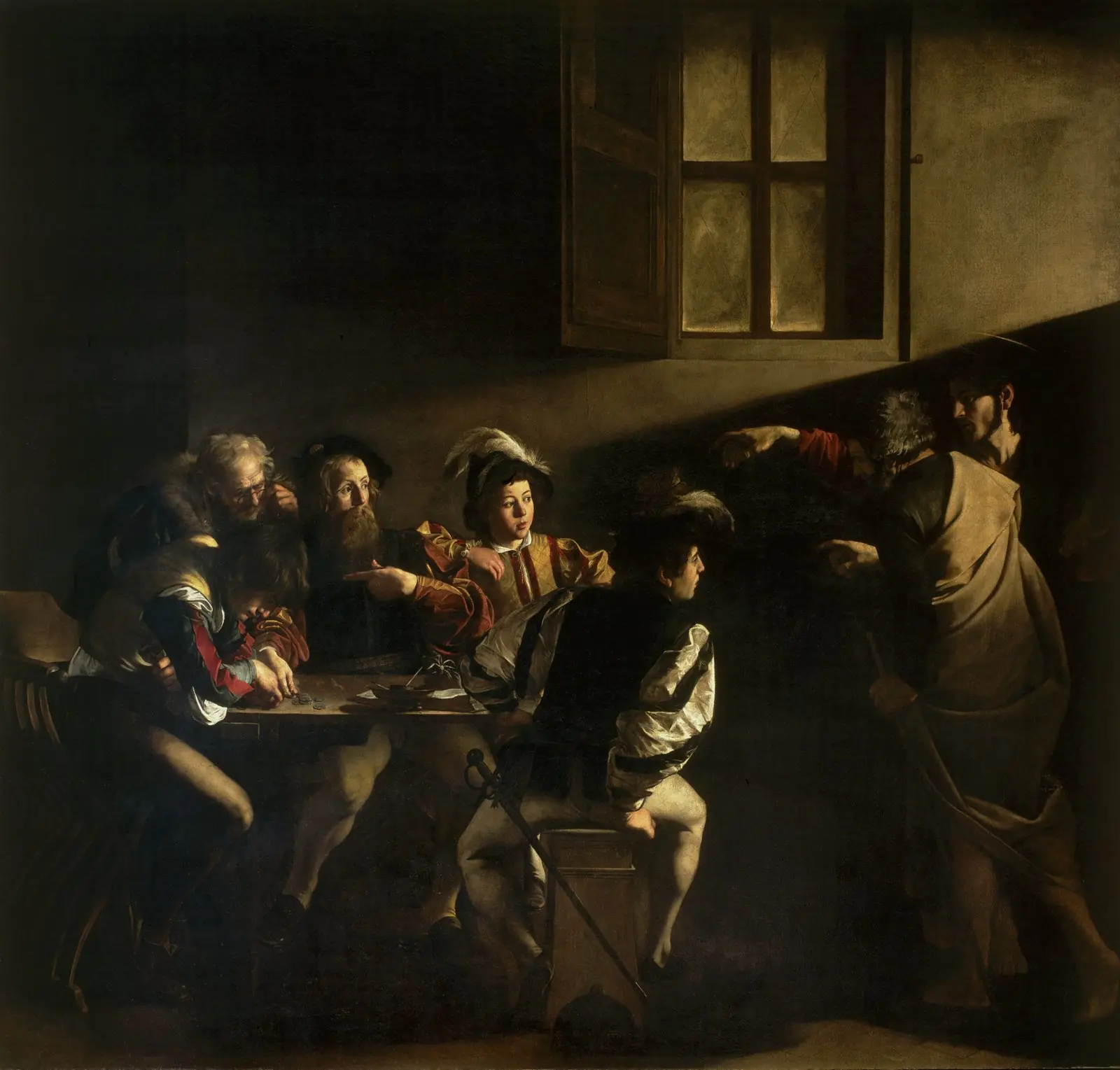
Set beside that, Mannerism looks less like weak preparation than like a distinct choice. It allows elegance, instability, and spiritual distance to remain visible. It does not yet make the event fully shared with the viewer. It makes the image stranger first.
For the larger before-and-after frame, read Renaissance vs Baroque: What's the Difference in Art?. The essay helps place Mannerism between High Renaissance equilibrium and Baroque immediacy.
How to identify its logic
Start from a single painting. Ask whether the image feels balanced in a calm way or balanced under strain. Then look at proportion. Are bodies convincing because they seem natural, or because they seem deliberately heightened? Finally, look at space. If the picture feels refined but slightly hard to inhabit, you may be in Mannerist territory.
- Keep the High Renaissance in mind as the order being stretched.
- Keep Baroque in mind as the next step that turns distance into immediate event.
- On Explainary, move from The Creation of Adam to The Burial of the Count of Orgaz, then to The Calling of Saint Matthew.
Key pages on Explainary
Then try the art quiz.
Primary sources
Frequently asked questions
Mannerism is defined by stylization under pressure: elongated bodies, unstable space, heightened poses, and a sense that Renaissance balance has been stretched into something more artificial and tense.
No. Mannerism is not simple decline. It is a deliberate artistic response to a moment when High Renaissance solutions looked too complete, prompting artists to turn mastery toward difficulty, elegance, and strain.