
French Classicism / Biblical Painting
The Flight into Egypt
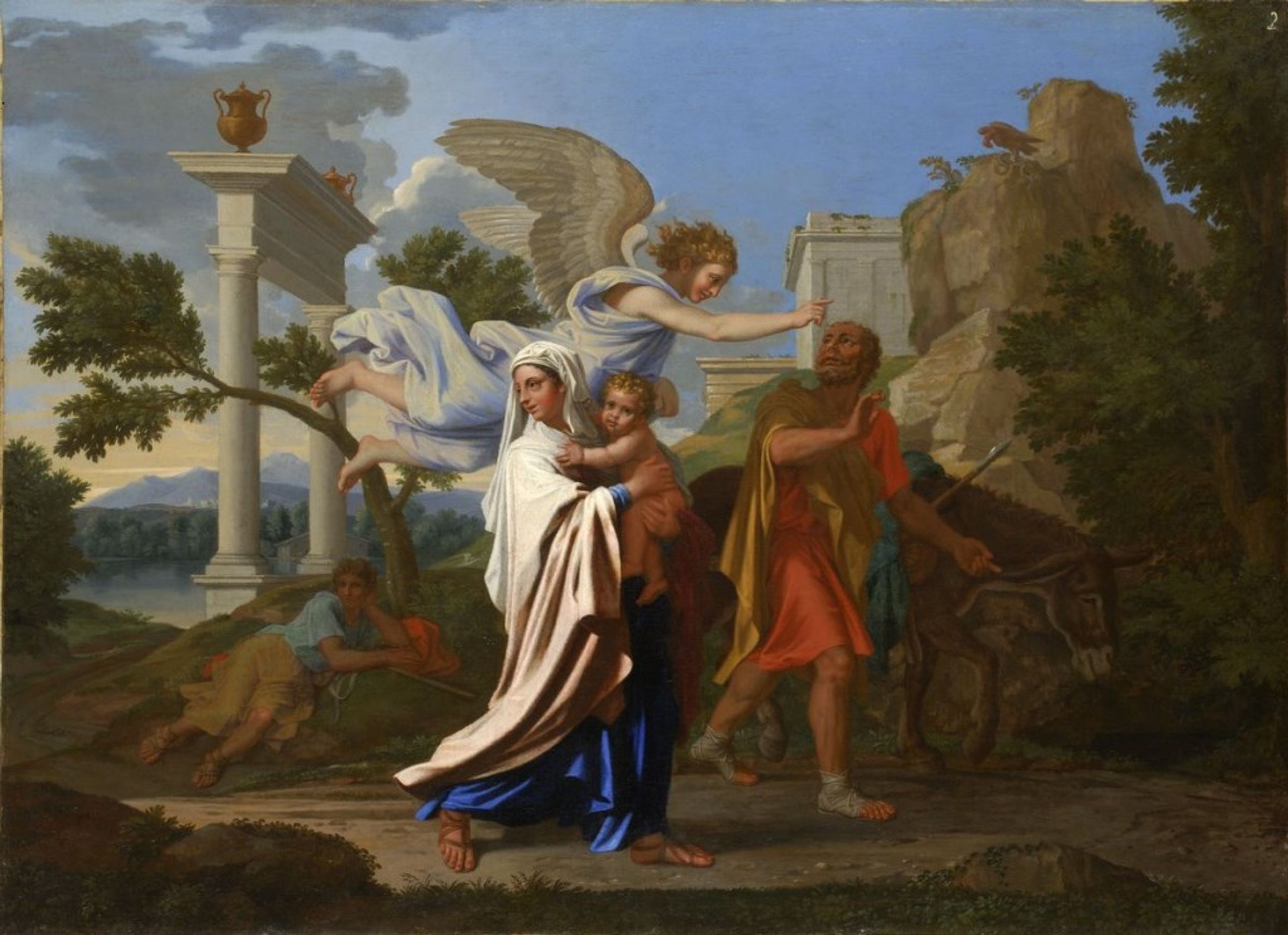
A refugee family crosses a quiet Roman landscape, and Poussin makes escape look calm without making it safe. Nicolas Poussin painted The Flight into Egypt in 1657, near the end of a career spent mostly in Rome. The oil on canvas is now in the Musée des Beaux-Arts de Lyon. It shows Joseph, Mary, and the Christ Child leaving danger behind them after Joseph has been warned in a dream to flee King Herod's massacre.
The subject could easily become melodrama. Poussin chooses something harder: danger under discipline. The Holy Family moves through open country, guided by an angel, while architecture, trees, gestures, and sightlines turn the journey into a measured system. The work holds movement and order in the same frame. Poussin does not remove fear from the biblical story; he makes it pass through classical form.
The biblical danger behind the calm
The story comes from the Gospel of Matthew. Herod learns from the Magi that a child called the “king of the Jews” has been born in Bethlehem and orders the killing of the city's young children. Joseph is warned in a dream to take Mary and Jesus to Egypt. Poussin does not show the massacre or the dream. He shows the passage after the warning: the family has already left, and the road is now the subject.
The painting is not about the instant of terror. It is about the long condition of flight. Joseph turns toward the angel as if still asking for direction. Mary looks back while carrying the child at the center of the composition. The donkey advances toward shadow; Jesus faces outward, drawing the viewer into the scene. The quietness is not comfort. It is concentration: exile becomes orientation, endurance, and movement under protection.
Poussin's method: organize the road
The Musée des Beaux-Arts de Lyon notes that Poussin builds the composition around a diagonal that separates a sacred, celestial area from a profane, earthly one. The Holy Family occupies the middle zone. They are not outside the world, but they are not abandoned inside it either. The angel's direction, Mary's protective gesture, the donkey's path, and the background architecture all help organize the painting as a route.
Follow the eyes and hands. Joseph questions the angel; Mary turns back, as if the past remains present; the Christ Child faces the viewer; the donkey carries the group forward. Nothing is accidental, yet nothing feels stiff. The diagonals converge toward Mary's protective gesture, which the museum connects to the Seven Sorrows of the Virgin and to the future Passion of Christ. The escape from Herod already contains later suffering, and Poussin's classical order gives that pain a structure.
Rome, antiquity, and the invention of a Christian landscape
By 1657, Poussin had lived in Rome for decades. He drew on antique ruins, Renaissance models, and contemporary classicism with extraordinary control. The Lyon museum points to several sources: the Virgin's turning pose probably echoes a Roman relief; the angel and the reclining traveler recall Raphael's frescoes and prints; the portico and bending tree draw from antique visual memory.
These borrowings do not make the painting academic in a weak sense. They give the Christian episode historical depth. The Holy Family crosses a landscape where antiquity, Rome, Scripture, and painting itself meet. Road, trees, architecture, and sky slow the scene down, moving the viewer from the biblical event to a wider condition: departure, protection, exile, and the unknown future.
A late work for a Lyon patron
The painting was commissioned in 1657 by Jacques Sérisier, a Lyon silk merchant living in Paris. Poussin was then about sixty-three and already one of the central figures of European painting. Its modern history reinforces the Lyon connection: rediscovered on the art market, recognized as a major Poussin, classified as a national treasure, and acquired for the Musée des Beaux-Arts de Lyon through an effort involving the French state, the Louvre, the region, the city, and private patrons. The local weight is unusually strong: patronage, rescue, and present visibility all connect Lyon to one of the defining painters of French classicism.
Classical order before David and Delacroix
Later French history painting turns Poussin's order in two directions. In The Death of Socrates, Jacques-Louis David hardens antique death into a public lesson. In Last Words of the Emperor Marcus Aurelius, Eugène Delacroix keeps the classical subject but lets color, doubt, and succession disturb it. Poussin stands earlier in the chain: historical and sacred narrative become legible through order before later artists either harden or fracture that order.
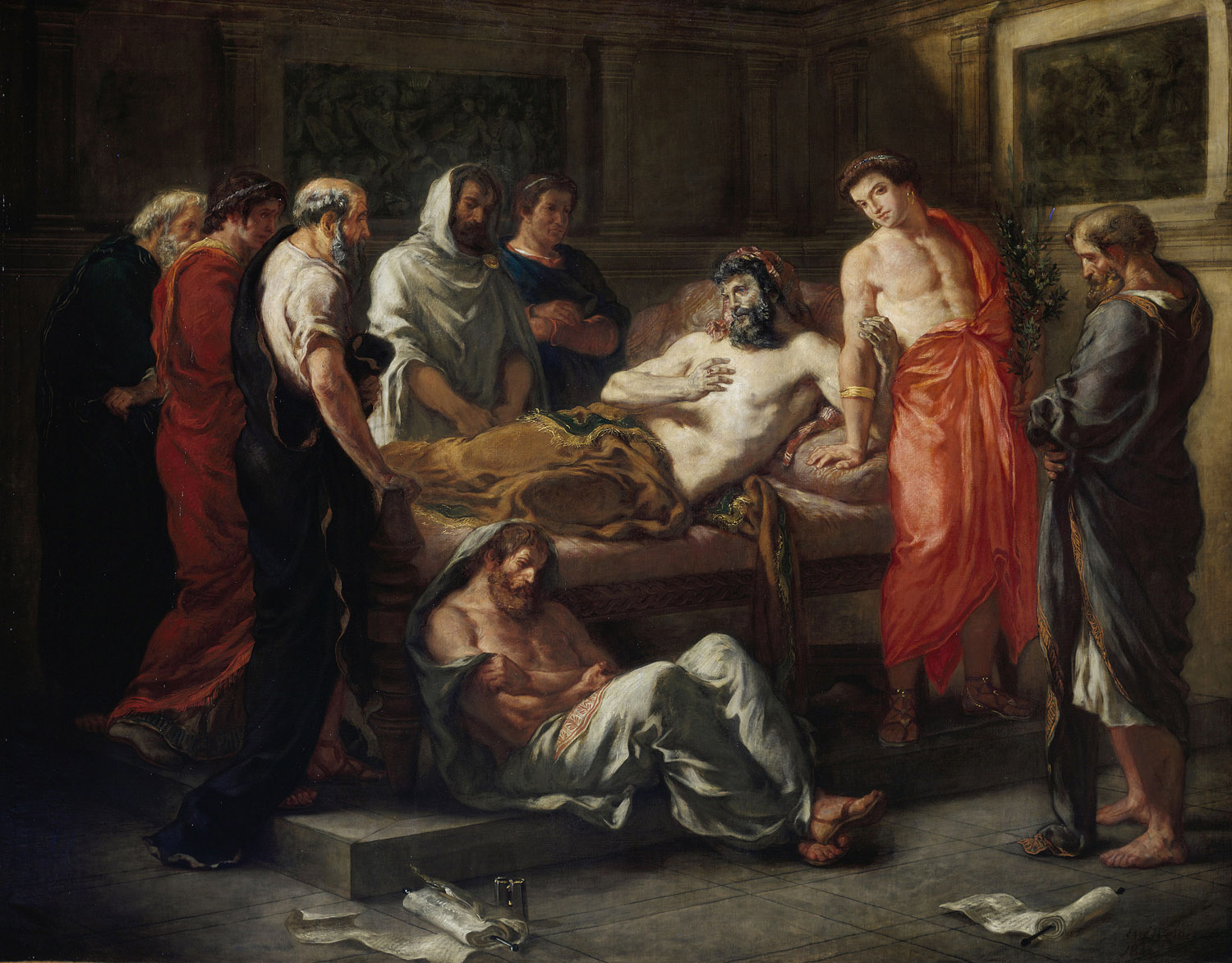
Poussin is not simply “calmer” than Delacroix or David. His intelligence lies in the distribution of pressure: danger stays outside the frame, the route fills the image, and the whole landscape becomes a moral situation.
How to read it in the museum
Begin with the angel and Joseph: their exchange establishes direction. Move to Mary and the Child, where protection and vulnerability are concentrated, then follow the donkey toward the darker passage ahead. The figures work best as a sequence rather than as isolated characters.
Then widen the view. The portico, trees, and sky are not background decoration; they insert the biblical flight into a long history of forms. Poussin asks viewers to hold urgency and order at the same time: the family is fleeing, but the painting thinks slowly. Continue with the profile of Nicolas Poussin, the guide to Baroque, and the analysis of Last Words of the Emperor Marcus Aurelius, then test your eye with the art quiz.
Explore more
Primary sources
Frequently asked questions
The Flight into Egypt is a 1657 oil painting by Nicolas Poussin, now in the Musée des Beaux-Arts de Lyon. It shows Joseph, Mary, and the Christ Child escaping Herod's massacre, guided by an angel through a classical landscape.
The painting is in the Musée des Beaux-Arts de Lyon. It was acquired with major public and private support, deposited in Lyon in 2008, and transferred to the museum's ownership in 2014.
It is a late work by one of the founders of French classicism. Poussin makes a biblical escape feel ordered, meditative, and emotionally complex through diagonals, gestures, landscape, and antique references.
The painting shows the episode from the Gospel of Matthew in which Joseph is warned in a dream to take Mary and Jesus to Egypt to escape King Herod's order to kill the children of Bethlehem.