
Artist Guide
Nicolas Poussin
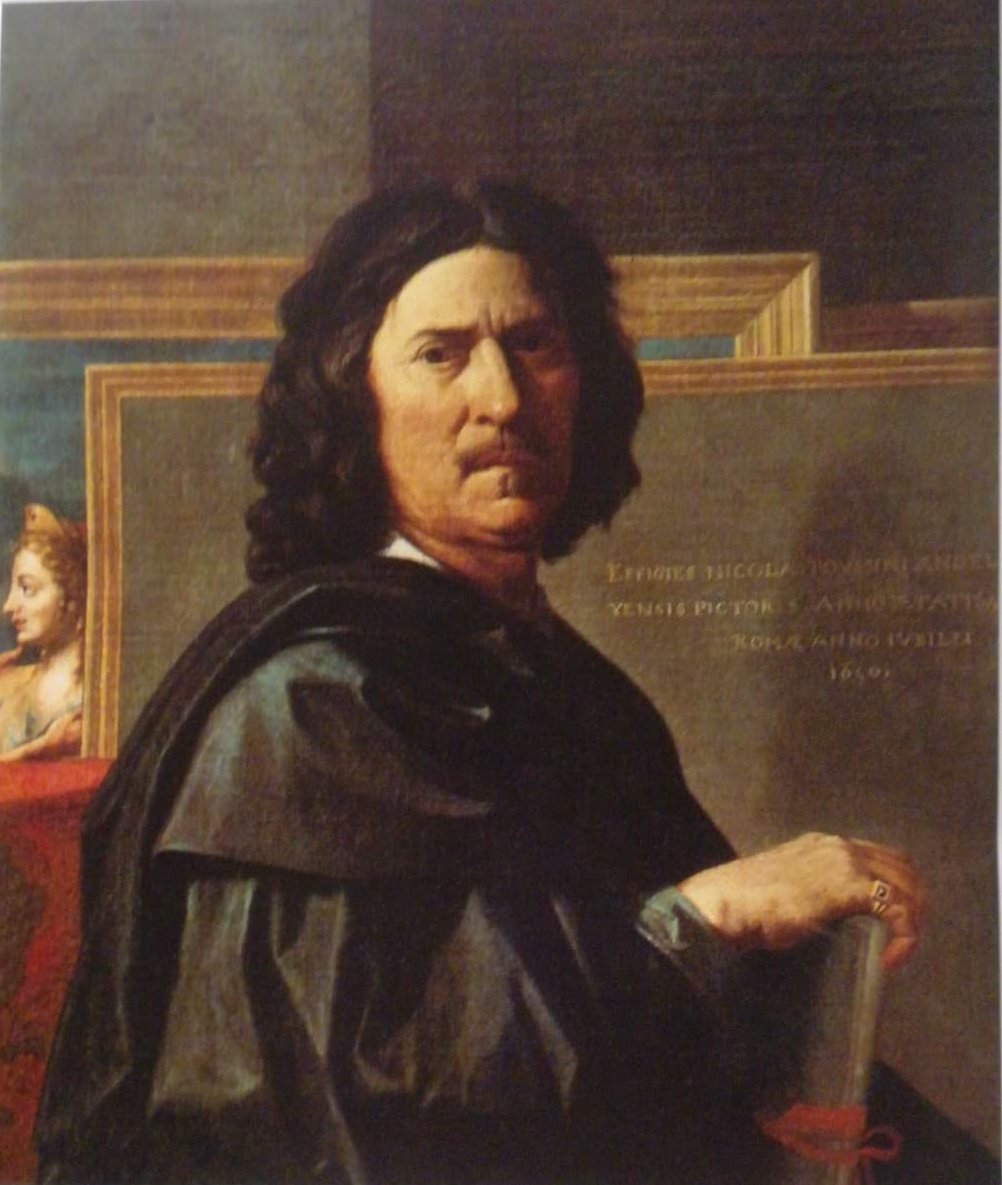
Nicolas Poussin made painting think without making it cold. His art is built from order, but not from stiffness: bodies, gestures, architecture, light, and landscape are arranged so a story can be understood as a moral problem. He became the defining painter of French classicism, even though the decisive part of his career unfolded in Rome.
Born in Les Andelys in Normandy in 1594, Poussin trained in France, worked in Paris, and reached Rome in 1624 after earlier failed attempts. Except for a short and difficult return to France in 1641-1642, Rome remained his artistic center. There he studied antiquity, Raphael, Renaissance composition, and the living culture of patrons, scholars, and collectors. His mature paintings treat biblical, ancient, and mythological subjects with a discipline that made him central to later French art.
A French painter formed by Rome
Poussin's importance comes from a productive displacement. He is a French painter whose authority is Roman. Ancient reliefs, sarcophagi, Raphael's architecture of figures, and the learned circles of seventeenth-century Rome gave him a visual language that could carry complex thought without theatrical excess. He did not imitate antiquity as decoration. He used antique order to clarify action.
His history paintings are deliberate constructions. A Poussin scene is rarely a spontaneous snapshot. Every figure has a relation to the whole, and the viewer reads the story through posture, spacing, direction, and rhythm. The painting asks for attention, then rewards it with structure.
History painting as a system of thought
Poussin specialized in history painting: scenes from the Bible, classical mythology, and ancient history. For him, the highest subject was not simply the most dramatic subject. It was the one capable of being ordered into a visual argument. The Met notes his interest in matching style, handling, and formal means to the mood of each subject, a practice later linked to his “theory of the modes.”
That idea explains why Poussin can look severe but not monotonous. A martyrdom, a pastoral scene, a bacchanal, and a sacred journey should not be painted in the same emotional key. He calibrates the language of the painting to the kind of action being shown. Classical restraint becomes flexible rather than dry.
The Lyon masterpiece: exile under control
The Flight into Egypt, painted in 1657 and now in the Musée des Beaux-Arts de Lyon, shows Poussin's late intelligence at full strength. Joseph, Mary, and the Christ Child flee Herod's violence, but the image avoids obvious panic. The family moves through a classical landscape guided by an angel, while diagonals, gestures, and architecture turn the road into a moral structure.
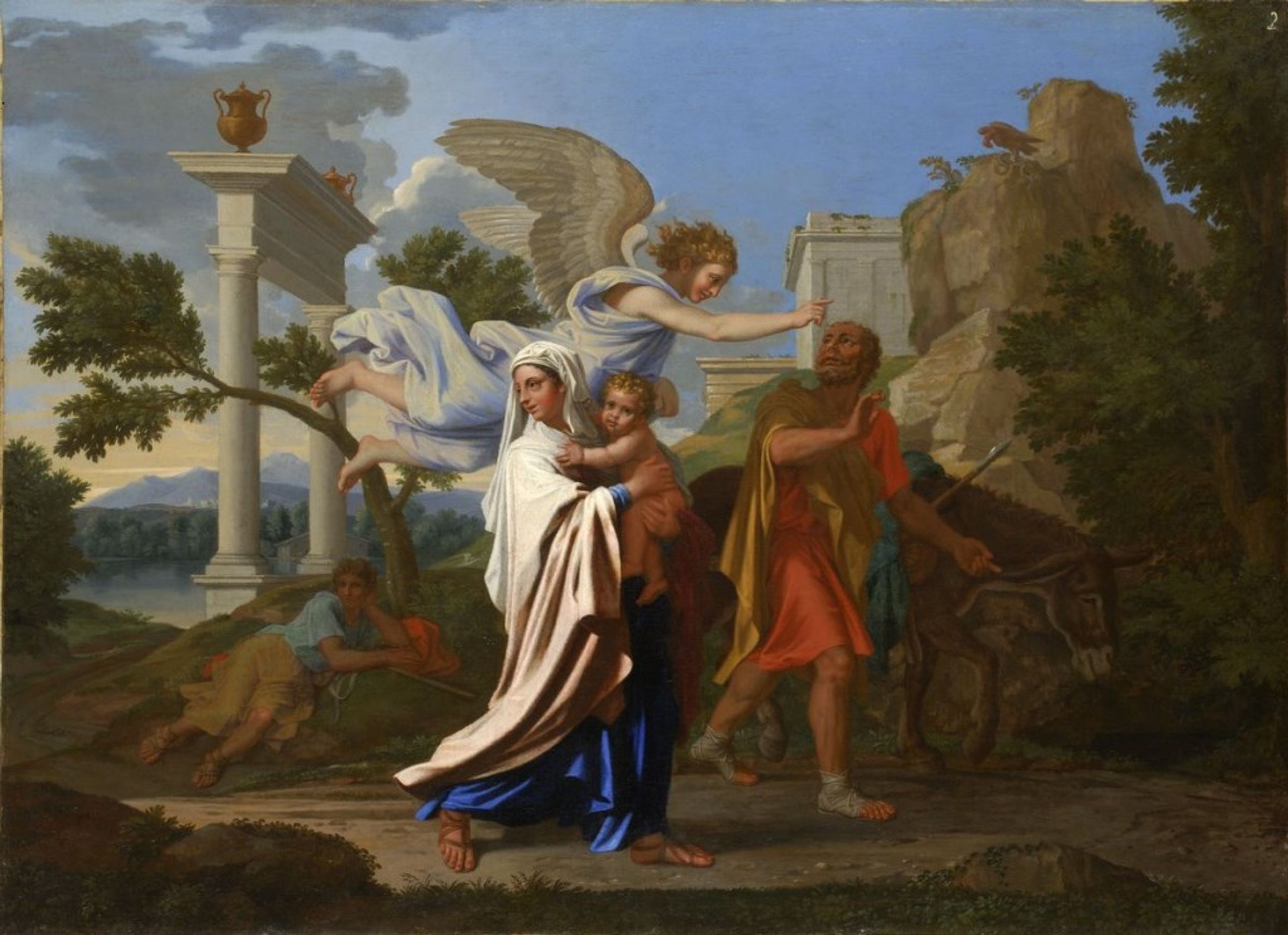
The painting also shows why Poussin matters beyond style labels. The subject is urgent, but the execution is calm. That gap is not weakness. It is the means by which the painting asks the viewer to think about danger, time, and protection rather than merely react to them.
Between Baroque and neoclassicism
Poussin belongs historically to the seventeenth century and is often placed within the broad field of the Baroque, but his branch of the period is not Caravaggio's darkness or Rubens's expansion. It is a classical Baroque of measure, direction, and learned construction. He shows that the century's art was not only spectacle. It could also be pressure held in disciplined form.
His afterlife is enormous. Jacques-Louis David and later neoclassical painters inherit his seriousness about antiquity, moral clarity, and public structure. Ingres inherits another part of the lesson: line as intellectual control. Much later, Cézanne would admire Poussin as a painter who could make nature answer to durable structure.
A legacy of disciplined looking
Poussin is valuable for readers because he slows interpretation down. His paintings rarely surrender everything at first glance. A viewer must track direction, weight, spacing, and echoes between figures. Once that habit forms, other paintings become easier to read: David's rhetoric, Delacroix's instability, and even modern composition look sharper after Poussin.
Start with The Flight into Egypt, then compare it with The Death of Socrates and Last Words of the Emperor Marcus Aurelius. The path shows how French painting repeatedly returns to classical subjects, then changes what order is allowed to do.
Key works in Explainary
Associated movements
Baroque - the seventeenth-century field in which Poussin's classical discipline develops.