
Artist Analysis
Diego Velázquez
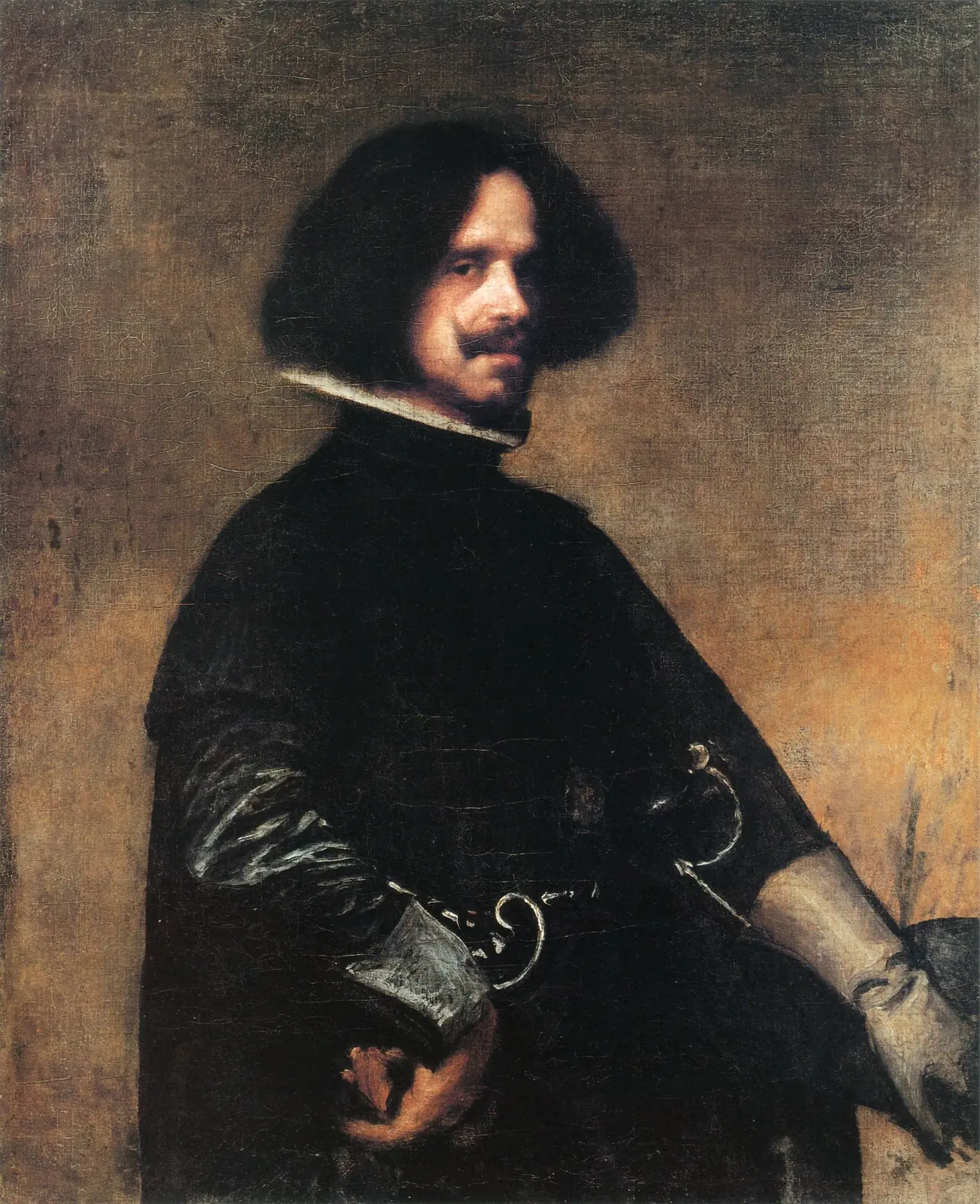
Diego Velázquez makes court painting think about itself. In works such as Las Meninas, power, spectatorship, and paint handling are fused into one system. Rather than decorative ceremony, his portraits stage unstable relations between ruler, artist, and viewer. The result is less dynastic display than an analysis of visibility.
Seville training, Madrid ascent
Born in Seville in 1599, Velázquez trained in a workshop culture where technical discipline and direct observation were inseparable. His move to Madrid and his appointment at the court of Philip IV placed him at the center of imperial image politics. Portraits had to satisfy protocol, but they also had to look alive. This tension became the engine of his art.
What makes his trajectory unusual is that he applied the same seriousness to different ranks inside court society: kings, heirs, attendants, dwarfs, and workers. Court painting in his hands became less a flat ceremony than an inquiry into how status appears through vision.
Painting hierarchy without freezing people
Velázquez builds authority through optical control: muted palettes, reflected light, and brushwork that seems loose nearby but coherent at distance. These choices are not decorative style. They regulate how power is seen. Fabrics, faces, and architecture stay credible, while figures avoid becoming rigid icons.
His portraits of court dwarfs and jesters are decisive in this respect. Inside a highly stratified system, he often gives them presence and psychological weight rather than caricature. The painting acknowledges hierarchy while preserving human density.
Las Meninas and the unstable point of view
Las Meninas (1656) synthesizes his method. The room is arranged as a network of sightlines: the Infanta and attendants in the foreground, the painter at work, the mirror image of the monarchs, and the viewer implicated in the same visual circuit. Instead of one fixed center, Velázquez distributes attention across competing positions.
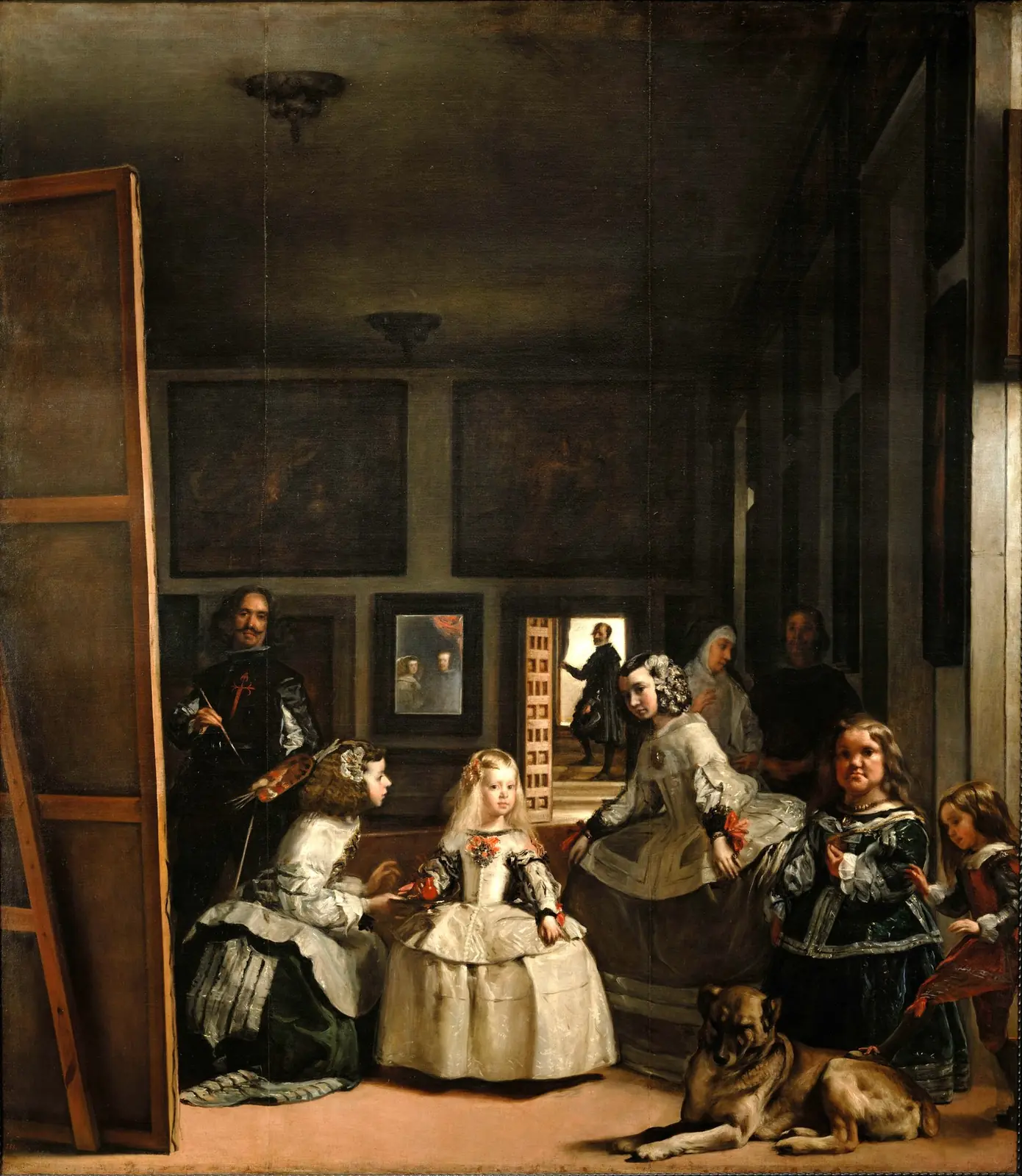
A concrete anecdote clarifies the painting's layered history: the red cross of the Order of Santiago on Velázquez's chest was likely added after he received the honor. Whether by his hand or later intervention, the detail shows how biography, court ritual, and image revision can coexist in one canvas.
Court office, Italian journeys, and controlled execution
Velázquez was also a court officer handling protocol and collection logistics. Two trips to Italy deepened his knowledge of Venetian color and Roman precedent, but his mature achievement in Madrid was managerial as well as painterly: he integrated administrative duties, diplomatic travel, and studio production without losing visual precision.
Seen this way, the apparent ease of his late brushwork is highly controlled. Each mark carries decisions shaped by institutional time, access, and the politics of visibility.
A practical way to read Velázquez
Start with structure: map doors, mirrors, and diagonals before assigning symbolic meaning. Then test viewing distance by moving close and stepping back; the optical shift from broken marks to stable form is part of the argument. Finally, compare him with Caravaggio: Caravaggio heightens rupture, while Velázquez often heightens calibration.
This sequence keeps interpretation anchored in material evidence, not just in labels.
From Goya and Manet to modern painting
The line from Velázquez to Goya, Manet, Sargent, Picasso, and Bacon is not ceremonial homage. Later painters returned to him to rethink how paint can remain visibly paint while carrying social and psychological complexity. That inheritance becomes especially clear in The Third of May 1808 by Goya, where representation stays legible while turning into ethical indictment rather than court display.
For Explainary readers, the strongest path is to link this profile with Las Meninas and the broader Baroque context: the key legacy is his transformation of visibility itself into a historical subject.
Key works in Explainary
Associated movements
Continue with the art quiz to validate recognition, context, and comparison.