
Dutch Golden Age
The Milkmaid
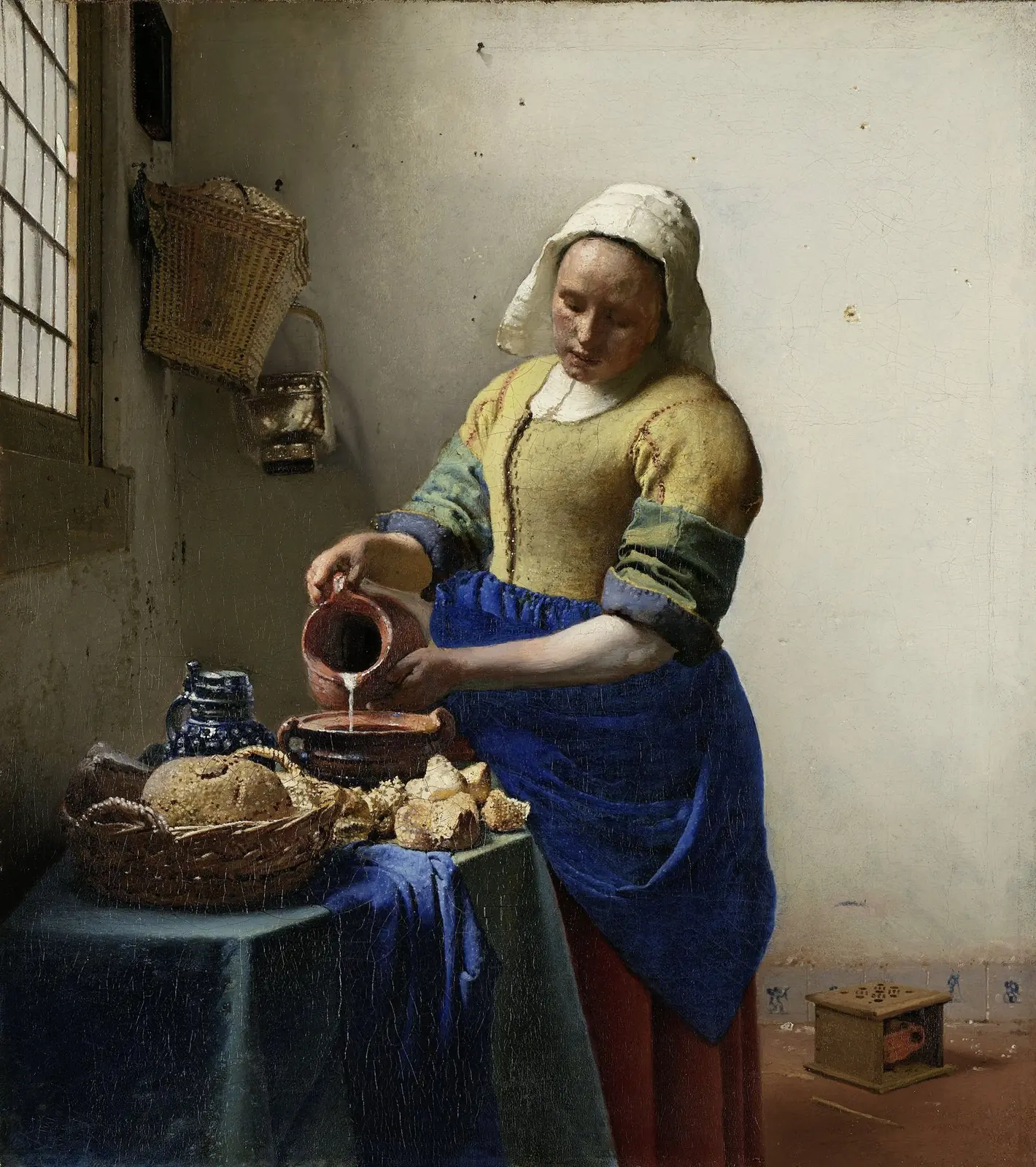
A woman pours milk, and Vermeer turns a domestic task into a study of time, labor, and attention. The panel is small, but nothing in it is casual: bread, pottery, wall texture, and light gradients are arranged so everyday work acquires unusual dignity.
Dutch context: household economy and painted interiors
Made around 1657-1658, the work belongs to a Dutch Republic culture where domestic interiors were central to painting and to social identity. In such scenes, objects are not neutral props. They signal class, discipline, consumption, and material order.
That context helps explain why the servant is neither idealized nor trivialized. Vermeer presents labor as concentrated competence, not anecdotal genre charm.
What the painting shows in concrete terms
A maid stands near a left-hand window, pouring milk into a bowl on a table with bread and a basket. The room is sparse: plaster wall, tiled base, simple furniture. Movement is minimal, but the pouring stream creates a measured temporal axis.
Because the action is so restrained, viewers notice subtle hierarchies: hand position, vessel angle, cloth weight, and the precise placement of highlights on crust and ceramic.
Vermeer's method: measured light instead of theatrical drama
Light enters from the left and gradually softens across wall and objects. This is not Baroque spotlight rhetoric. It is calibrated diffusion that makes space believable and surfaces distinct: rough bread, glazed jug, matte plaster, woven basket.
The painting's force comes from this optical discipline. In this canvas, Vermeer shows how visual order can elevate ordinary work without exaggeration.
One relevant comparison inside Vermeer's own practice
If you compare with Girl with a Pearl Earring, the difference is instructive. There, attention collapses into one face and one earring. Here, attention is distributed across a work environment. Same painter, opposite attention architecture.

Why the painting remains compelling
The Milkmaid endures because it is legible instantly yet rewarding under slow looking. From across the room, you read stillness and concentration. Up close, you discover a technical argument about how paint can model labor, matter, and duration.
Two material details are especially useful for close reading. First, the bread: its granular highlights are not decorative sparkle but a way of measuring surface density and dryness against the smooth ceramic and the reflective metal accents. Second, the wall punctures and stains: they prevent the space from becoming idealized and keep the scene anchored in lived domestic wear. Together, these details explain why the painting feels truthful without relying on theatrical realism.
The figure's posture also carries social meaning. Her concentration is not romanticized inwardness; it is task discipline. Vermeer grants dignity by precision: stable stance, controlled pouring, and a clear relation between body and tools. That is why the scene can be intimate without becoming sentimental.
Vermeer proves that restraint can carry as much force as spectacle.
If this structure is clearer now, try the art quiz and check whether you can identify Vermeer quickly among related works.
Explore more
Related works
Primary sources
Frequently asked questions
Vermeer locks attention through measured light geometry: wall, bread, hands, and jug are calibrated so quiet labor becomes monumental without drama.
The work belongs to Dutch seventeenth-century domestic painting, where everyday interiors could encode class, virtue, and material discipline.
A useful first step is Girl with a Pearl Earring, to see how Vermeer shifts from distributed domestic attention to concentrated face-based attention.