
Ukiyo-e
The Great Wave off Kanagawa
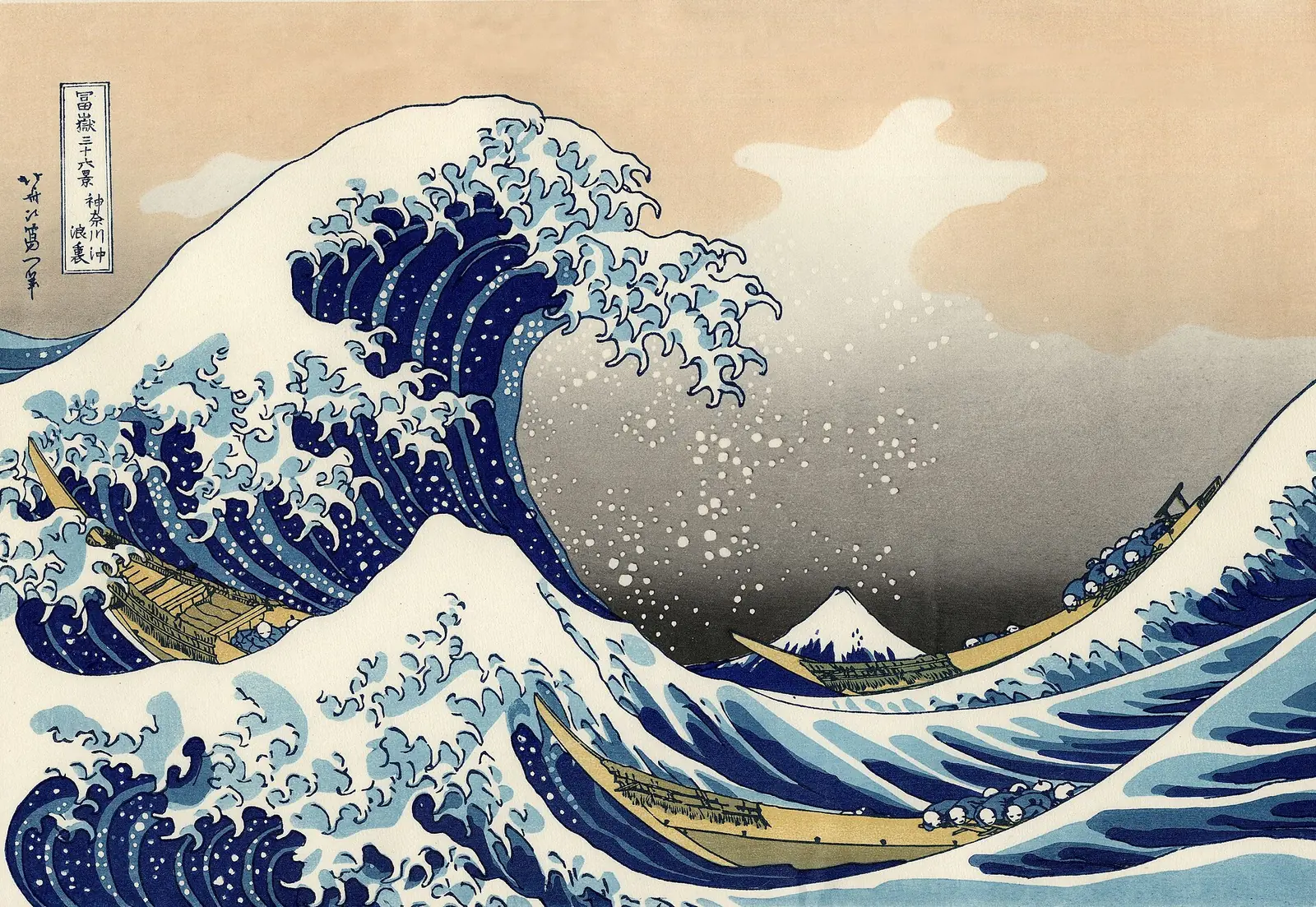
Hokusai did not paint an abstract idea of danger: he designed a highly concrete scene of labor under pressure. Boats carry fish to market, rowers brace in rhythm, and Mount Fuji sits far behind as a geometric constant. The image became global because it is both immediately legible and technically rigorous.
Before the wave became an icon
The Great Wave off Kanagawa was published around 1830-1832 as part of Thirty-six Views of Mount Fuji in Edo (now Tokyo). It belongs to commercial ukiyo-e print culture, where publishers, designers, carvers, and printers collaborated to produce multiple impressions for an urban market.
This context matters. The sheet was not a unique aristocratic object made for courtly display. It was conceived for circulation, comparison, and repeat viewing. Its famous afterlife in Europe and North America extends that original logic of wide distribution.
What this sheet actually depicts
The print shows three long oshiokuri-bune cargo boats, likely in the fish trade, caught under a towering offshore breaker. The rowers are bent forward in synchronized posture. Fuji appears small but clear on the horizon, framed by the wave's arc.
This is why the scene feels urgent without becoming chaotic. Hokusai gives you precise visual anchors: boat diagonals, foam clusters, horizon line, and mountain triangle.
Hokusai's wager: tension without chaos
The intention is not meteorological reporting and not pure spectacle. Hokusai stages an unstable instant while preserving structural legibility. Human effort, natural force, and long-duration time (Fuji) are held in a single controlled argument.
Methodologically, this depends on workshop precision: separate carved blocks, layered printing, and advanced use of imported Prussian blue. Gradations (bokashi) create depth without abandoning graphic clarity.
A geometry of threat
The composition is organized around nested curves. The crest of the main wave echoes the boats and the secondary wave, so movement feels coherent rather than random. The most famous "claw" foam forms are visually sharp, but they are distributed with strict spacing discipline.
Scale does the intellectual work. Fuji is the nominal subject of the series but appears visually minimized here. That inversion creates tension: the wave dominates the eye, yet Fuji stabilizes the whole design. Color supports this hierarchy with strong blue contrasts and restrained neutrals.
The print's power comes from a paradox: a violent subject rendered with almost mathematical calm.
How this print conquered visual memory
Nineteenth-century collectors and artists in Europe helped canonize the sheet during the rise of Japonisme. Cropped framing, contour-driven structure, and flat-yet-deep spatial logic influenced painters, designers, and later mass visual culture.
Today, the image circulates as a meme, logo, poster, and teaching staple. Its endurance is not accidental branding. It survives because the composition is robust enough to support endless reuse while preserving recognizability.
Read it against its sister images
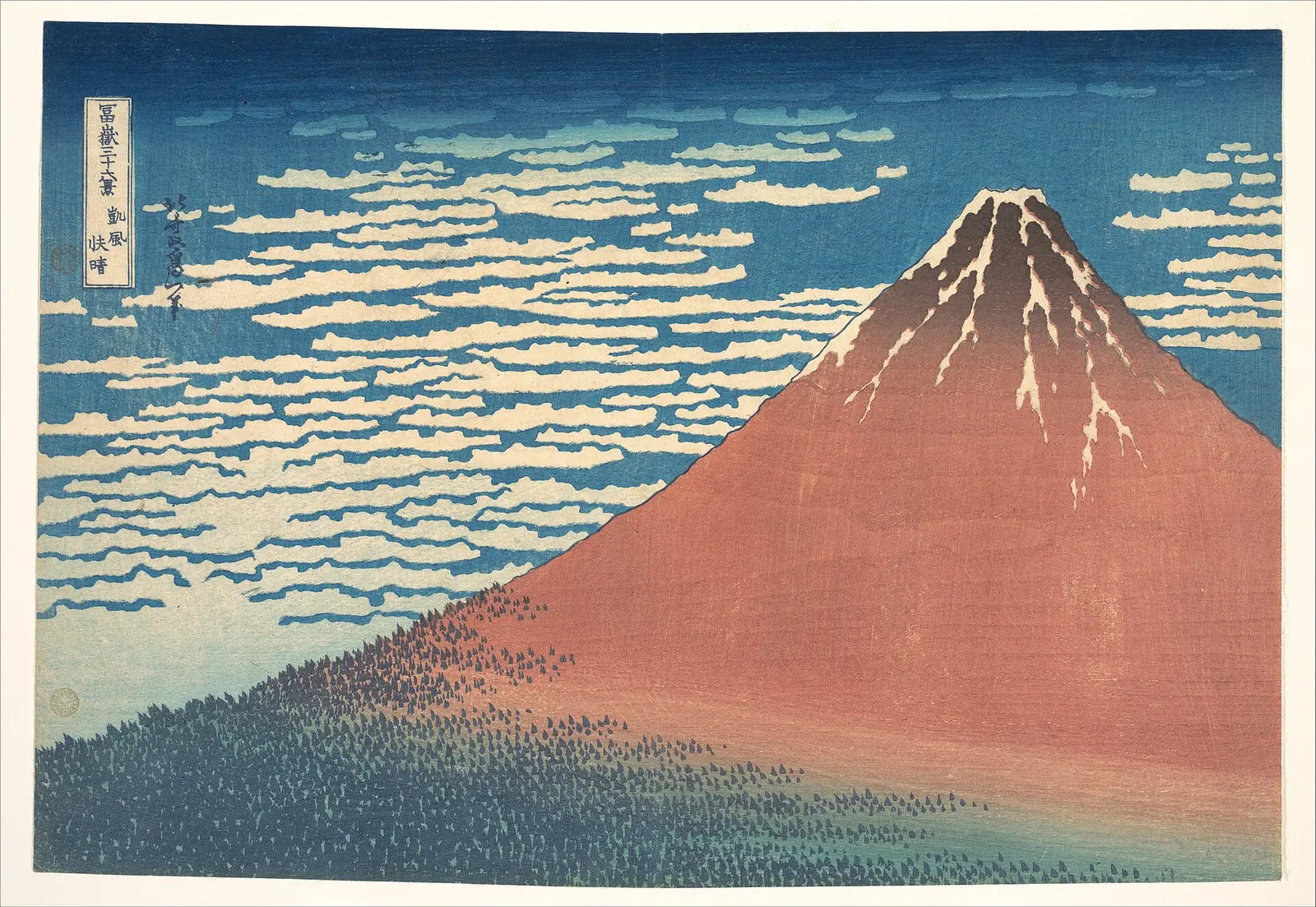
Start with Red Fuji: same series, opposite mood. There, Fuji is dominant and atmospheric change is slow. In The Great Wave, pressure is immediate and directional.
Then compare with Evening Shower at Atake by Hiroshige: rain diagonals and atmospheric sequencing produce another kind of speed. Finally, test how Van Gogh absorbed ukiyo-e lessons in The Starry Night.
Explore more
Related works
Primary sources
For a more exact reading
If you want to study this print rigorously, compare at least two different impressions from museum collections. Note differences in paper tone, blue saturation, and line sharpness, then separate what belongs to Hokusai's design from what belongs to printing state and preservation history.
This method avoids two common shortcuts: treating one reproduction as the definitive object, and reducing the image to a timeless icon detached from workshop production and circulation history.
Use the art quiz to test whether you can identify Hokusai's compositional logic in seconds.
Frequently asked questions
Probably not in a strict scientific sense. Most scholars read it as a dramatic offshore breaker designed for visual impact.
It stages the tension between human labor, natural force, and long-duration stability represented by Mount Fuji.
There is no single original painting. The work is a woodblock print with multiple impressions now held in museums and collections worldwide.
Hokusai reduced Fuji's scale to intensify immediate drama while keeping a stable geometric anchor in the composition.
Through collaborative ukiyo-e production: design by Hokusai, carving by specialists, and multi-block color printing by workshop printers.